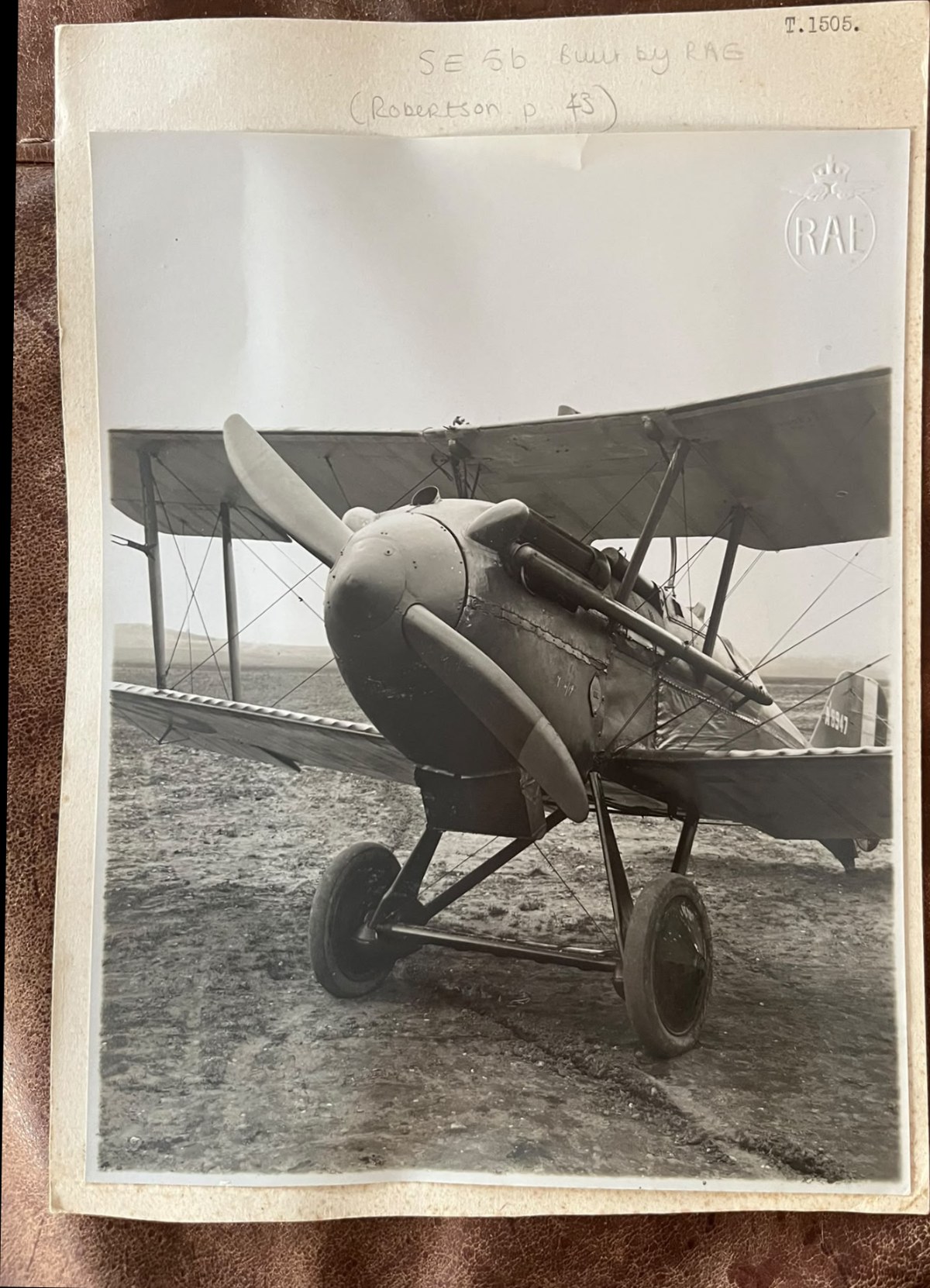
The official Royal Aircraft Establishment photograph of the S.E.5b, serial A8947 — the sole example ever built. After a good deal of research, it is my understanding that this is the only official photograph of the aircraft known to survive.
The area around Farnborough has been central to British military aviation since 1904, when the British Army’s Balloon Factory moved there from Aldershot. It was also the site of what is generally acknowledged as the first powered flight in Great Britain: on 16th October 1908 the American showman Samuel F. Cody, having moved from kite-flying to powered flight, flew his own British Army Aeroplane No.1 some 1,390 feet.
Cody continued working for the Balloon Factory, which in 1912 was renamed the Royal Aircraft Factory. Initially it was a repair facility for the frequently crashed or damaged aircraft obtained from foreign manufacturers, but skill and ingenuity were soon used to create new types and variants — in the early days, most aviation development came down to trial and error.
By the beginning of the Great War the Factory was firmly established, producing its own designs of aircraft and balloons for the army under various contracts, for the now-separate air arm known as the Royal Flying Corps. The naval equivalent, the Royal Naval Air Service, went down a private-manufacturer route, in part so as not to compete for orders.
The standardisation of types owed much to the appointment of Mervyn O’Gorman as Superintendent of the Factory. A consulting engineer in civilian life, he brought a new scientific approach to design and manufacture. On 8th March 1911 he presented “Problems Relating to Aircraft” to the Institution of Automobile Engineers — prophetically, given how many automobile factories would be turned over to aeroplane production during the war — defining three classes of aircraft:
Class B — main wings preceded by the propeller and followed by a smaller, more lightly loaded plane (e.g. the Antoinette, Avro, Bleriot and Breguet machines of the period); alternatively known as tractor types.
Class F — main wings followed by a smaller, more lightly loaded plane, but with the propeller between the main wings and the tailplane (e.g. the Bristol Boxkite, Farman designs and de Havilland types); alternatively known as pusher types.
Class S — main wings preceded by a small, more intensely loaded plane and succeeded by the propeller (e.g. the Santos-Dumont or Valkyrie designs).
The first S type was a reconstructed Bleriot XII; the first F type was one of Geoffrey de Havilland’s pusher designs, which he brought to the Factory and sold to them for the princely sum of £400; and the first B type was a reconstructed, damaged Voisin pusher donated by the Duke of Westminster.
By 1918 the Factory had produced a range of military models with varying degrees of success — the B.E.1, the B.E.2 series, the B.E.12, the F.E.1 and F.E.2, the F.E.8, and the S.E.5 and S.E.5a. Of these, the S.E.5 and S.E.5a had developed into among the finest fighting aeroplanes — “scouts” or “fighters” as they were variously known — on the Western Front.
Designer Henry Folland was given a brief in 1916 to meet Trenchard’s specification for a fighting aircraft that could reach 10,000 feet in 15 minutes, fly at a minimum of 100 mph at that height, and stay airborne for at least three hours (four preferably). After much design and alteration, A4845 — the first Royal Aircraft Factory production S.E.5 — was finished before March 1917. Its 150hp Hispano-Suiza engine gave a top speed of 114 mph at 10,000 feet, a climb to that height in a little over 14 minutes, and an endurance of just over two and a half hours. Top speed at sea level was 128 mph and the service ceiling around 17,000 feet.
Further improvements — replacing the “greenhouse” screen with the smaller Triplex type found on the Avro 504, a revised undercarriage, and the 200hp Wolseley Viper engine — produced the S.E.5a. Together with the Sopwith Camel, it became the mainstay of the British fighter offensive on the Western Front from 1917 until the Armistice in November 1918.
Despite this, back at the Royal Aircraft Factory they tinkered with an S.E.5a in an attempt to match the newest German front-line fighters, the Albatros D.V and the formidable Fokker D.VII. Taking an existing S.E.5a, serial A8947 — and retaining the 200hp Hispano-Suiza — they redesigned the nose into an Albatros-style streamlined front end with a large spinner. It was given an entirely new top wing, based on the Fokker D.VII and larger in both span and chord. To replace the radiator grille and prevent overheating, a “chin” radiator was fitted, which could be retracted when gliding — via a cable-and-pulley system — to reduce drag. The fuselage and tail were unchanged, though a larger, curvier headrest was added.
Anticipation was high: the redesignated S.E.5b looked sleek and aerodynamic. In the event, the cleaner nose was offset by the extra drag of the enlarged wing, so performance was on a par with a standard S.E.5a. The war ended in November 1918, but testing continued. By 9th January 1919 a standard pair of S.E.5a wings had been refitted, and on or before 9th April 1919 a set of official photographs was taken.
When the RFC and RNAS merged on 1st April 1918 to form the RAF, the Royal Aircraft Factory was renamed the Royal Aircraft Establishment to avoid adding to an already frantic transition — which brings us to the artifact: the official RAE photograph of S.E.5b A8947.
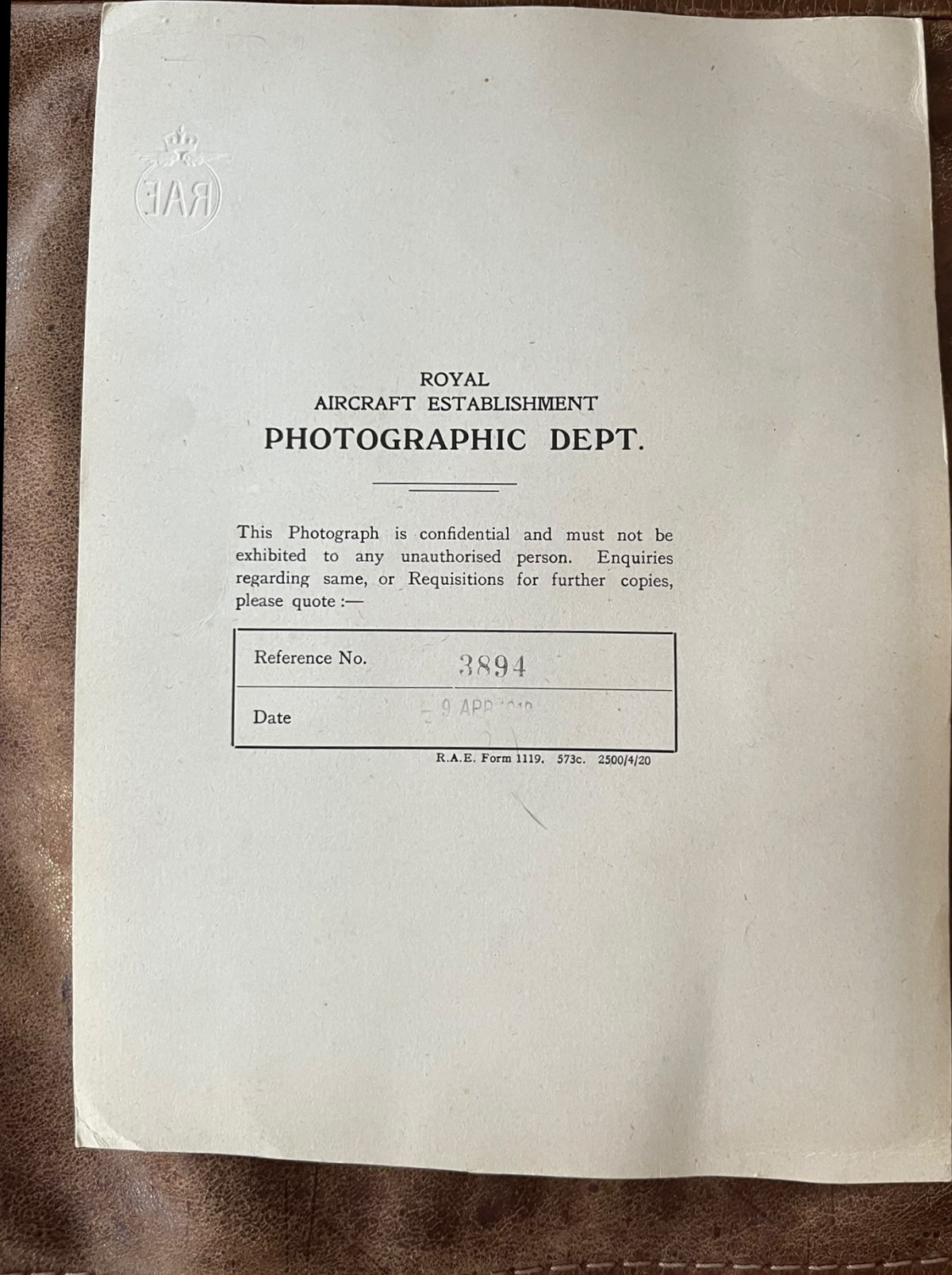
Though originally one of a series, it is — after much research — my understanding that this is the only official photograph known to survive. It measures seven and a half by nine and a half inches, is embossed in the top right corner, and is mounted on an original A4-sized card carrying a typed “T.1505.” The embossing passes through both card and photograph, so it was deliberate. On the reverse is a standard Royal Aircraft Establishment Photographic Dept. form, with reference no. 3894 and the date 9th April 1919.
The photograph itself is of excellent quality and condition. Unusually for the time it is in portrait, and it shows not only the serial number on the tail fin but also the streamlining of the nose.
Sadly, A8947 — the sole S.E.5b — crashed at Hendon in the early 1920s.
Leave a Reply