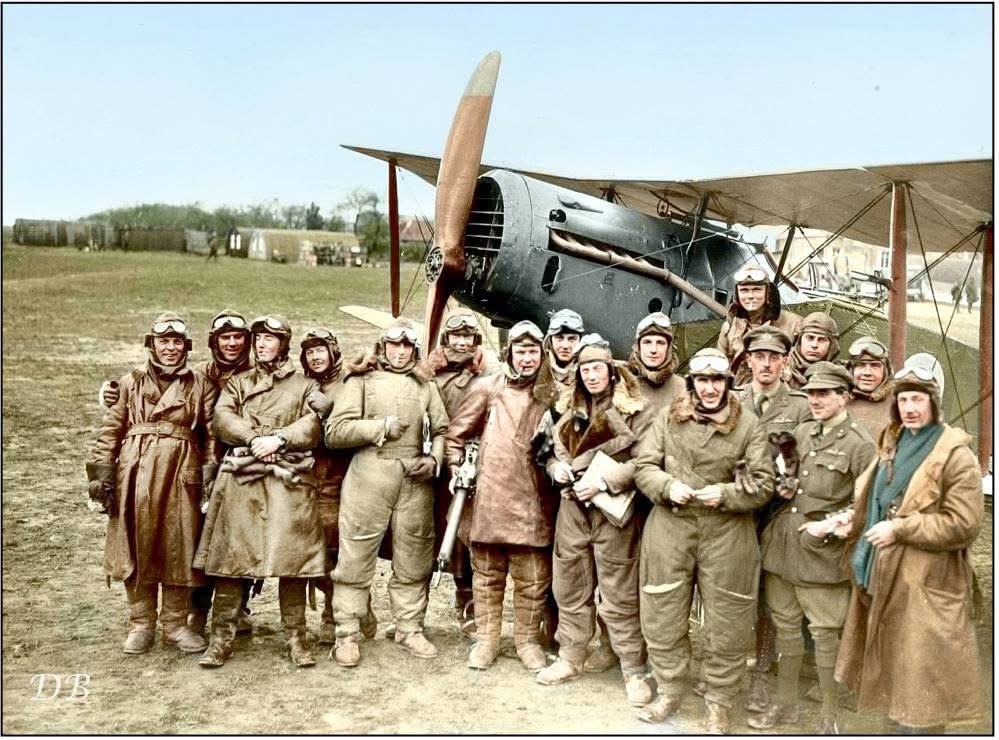
William Frederick James Harvey (8th January 1897 to 21st July 1972) was a British pilot, unusually credited with twenty-six victories. This is because he did not fly in a single-seater fighter squadron, but for 22 Squadron flying Bristol F.2b two seaters, albeit a formidable weapon in the right hands.
He was the first recipient of the Distinguished Flying Cross & Bar and was also awarded the Military Cross. Harvey served with the Signal Company of the Royal Engineers until he transferred to the Royal flying Corps in December 1916. After flight training and qualifying as a pilot, In December 1917 he was posted as a pilot to No. 22 Squadron.
His first air victory, a downed Pfalz D.III, was recorded 16th March 1918, followed by an Albatros D.V on the 18th. With three more kills in March Harvey established himself as an ace. In May 1918 he was promoted to Captain, and commanded 'B' Flight.
In the last week of May, Harvey, flying with Lt. George Thomson as his observer/gunner, shot down or drove down two observation balloons and four German airplanes; on 20th June he downed three aeroplanes in a single day. Shortly after this success Thomson was replaced with Captain Dennis Waight, who remained Harvey's observer until the end of campaign.
The crew between them scored 9 confirmed kills during the Battle of Amiens in August 1918. Of his twenty-six victories (comprising 3 balloons, 12 and 2 shared destroyed, and 9 'out of control') credited to Harvey, eighteen were achieved utilising his front gun, a synchronised Vickers firing through the propeller. After the war, Harvey served as an instructor with 33 TD Squadron, part of the Army of the Rhine (army of occupation).
When the war ended, he retired to Kent, writing many aviation-related articles and the history of his old RAF Squadron, No. 22, entitled 'Pi in the Sky'. Harvey married Mary Gurdon, sister of his squadron colleague in 1920, and during the Second World War he was awarded the MBE for his service. Below is an article in full recounted by Harvey and published in Air Pictorial in April 1968, for whom he was a regular contributor.
‘In narrating some incidents of the two retreats I have called on memory permanently impressed by the alarming events of those four weeks, controlled by letters, diary and logbook of the time. During these days of chaos, and before ground control, R/T or even inter-com, each flying officer conducted his individual war unseen except by the enemy for most of the time, and so it follows that my account must be personal. My squadron, No. 22, stationed in the north, had the dubious honour of being in the forefront of the retreat of a million front-line men of the B.E.F. when, for some obscure Teutonic reason, shells from a railway gun at Meurchin 25 miles away began falling on us at Treizannes, and at St.
Pol nearby, in the early hours of 21st March 1918, ninety minutes before zero hour in the south. The gunnery was good, the spread of bursts being less, perhaps, than 300 yards. The big shells penetrated the soft Flanders soil deeply before exploding, sending up tall, narrow columns of earth.
Major Harvey’s complete memoir continues in the PDF below.
Leave a Reply