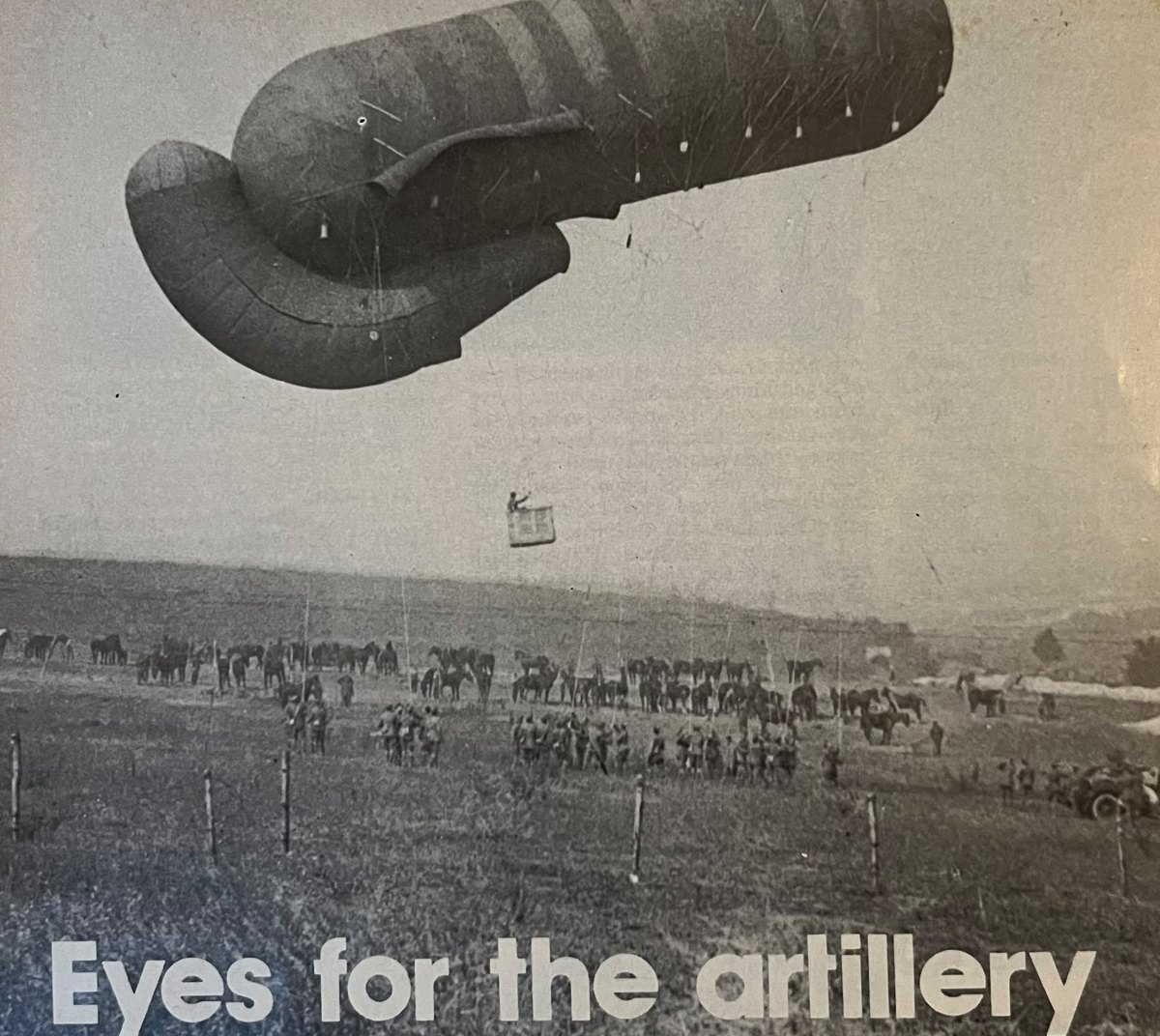
Or ‘Up, up and away!’
F. Russell Sadd with No.8 Kite Balloon Section in France, 1915.
Aeroplane Monthly of June 1976 carried the following article, under the headline ‘Eyes for the artillery’. I have reproduced it here in full, for anyone who has not seen the original, as it is a fascinating insight into a little-described arm of the aviation services.
‘The days of manned balloons for observation work have now passed, but very little has been recorded about the Balloon service of the 1914—18 War. F. Russell Sadd served on observation balloons with the Royal Naval Air Service, spending a year with No. 8 Section in France and following this with a further 2½ years with the Grand Fleet at Scapa Flow and Rosyth, in command of No. 3 Section aboard HMS Canning. The author here describes his early Balloon Service training and his operational experience in France.’
‘It was not until I reported for training at RNAS Roehampton in March 1915 that I realised I had been attached to the lighter-than-air side of the service. This training was condensed into weeks, to cover each phase of balloon work as much as possible. It was essential that all officers under training should not only be observers but should also be able to handle a kite balloon in case it should break adrift. We were given balloon training trips in thermal balloons under supervision of pre-war experts, and after six flights each officer had to make a solo flight in a small spherical balloon. The course consisted of map reading, elementary navigation, weather instruction, and rope work. The technical side of the use and manufacture of hydrogen, including safety precautions, was stressed. We had to familiarise ourselves with the component parts of the kite balloon including the rigging, towing lines, towing bridles and rigging suspension. It was also important to learn how to handle the balloon on the ground, and we were instructed in the drill required by the crew for such handling.’
‘Our training at Roehampton was carried out on the Drachen type kite balloon. These were made with one air-filled balloonet below the main bag, two stabilising sails, and a tail with several small parachute kites at the rear end. All these devices caused a great deal of vibration in high winds, and the type could not be successfully used in winds exceeding 30 m.p.h., the vibration making the use of binoculars for observation work impossible.’
‘The next stage in our training took us on to free balloons. These operated from Hurlingham, where there were facilities for filling the balloons with coal gas, and at Wormwood Scrubs Air Station where crews were trained for airship work. My first flight in a large balloon proved eventful and I shall never forget my introduction to this form of travel.’
F. Russell Sadd’s account continues in the PDF below — the storm over London, the uncontrolled descent at Romford, and his year with No.8 Section in France.
Leave a Reply