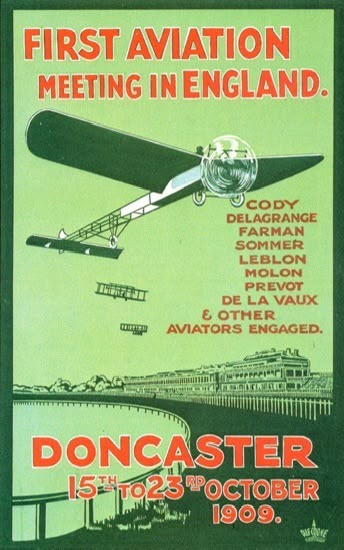
Or ‘the Aeroplane St. Leger’
Victorian Britain built an Empire built on trade and colonisation. This was in part due to having a large navy, the largest and best equipped in the world. Furthermore, since Nelson’s triumph at Trafalgar in 1805, it had never been challenged. The fact that the Empire HQ, i.e. the British Isles, was exactly that, meant that resources and interest was focused on naval technology and advancement, with the Edwardian Dreadnaught being thought the unsurpassed weapon of modern warfare. Partly for these reasons early aviation innovation was less prevalent than in either the United States or Northern Europe, so it wasn’t until the end of the new century’s first decade that aeronauts and aviation caught the public’s imagination. So, the honour holding the world’s first aviation gathering belonged to France.
The Grand Semaine d’Aviation, held between the 22nd August and the 29th August 1909, and was so named as it was sponsored by many of the leading makers of champagne, including Moët et Chandon. It was recognised as the first international public aviation meeting, and was the event that firmly put the aeroplane on to the world’s stage. Almost all of the well-known early aviators of the day entered, and the close to half a million visitors included Armand Fallières, the president of the French Republic and the British Chancellor of the Exchequer, David Lloyd George. British attendees included the influential Aeroplane advocate, Lord Northcliffe (the publisher of The Daily Mail) and General French, of the British Army. It took place at Bétheny, circa 5 km north of Reims, which later became the Reims – Champagne Airfield. A large grandstand was constructed for the event, together with a row of sheds to accommodate the aircraft. Next to the grandstand was the “Popular enclosure”, complete with an enormous scoreboard. Amenities for the spectators included a restaurant that could seat 600 people, an area of specially laid lawn with bandstands and flowerbeds, and a post office, from which 50,000 postcards were sent each day and nearly a million words dispatched by press correspondents that attended. A rectangular competition course of 10 km was marked out by four tall pylons, and set up for the various competitions, with the strip intended for taking off and landing in front of the grandstands, opposite which was the timekeepers hut, provided with a signalling system to indicate to the spectators which event was being competed for. Flying conditions were primitive: the area over which much of the flying was to take place was farmland: some of the crops under cultivation had not been harvested and where this had been done there were piles of hay and large haystacks, potential hazards for aviators partaking int the event.
There was a full programme of events for the delectation of the thousands of spectators, with some events run over a number of days. The events programme was as follows:-
- Sunday, 22nd August — Contest to decide the French team for the Gordon-Bennett Trophy; Prix de la Vitesse (day 1); Prix du Tour de Piste (day 1); Prix des Aeronauts (day 1).
- Monday, 23rd August — Grand Prix de la Champagne (day 1); Prix du Tour de Piste (day 2); Prix des Aeronauts (day 2).
- Tuesday, 24th August — Grand Prix de la Vitesse (day 2); Prix du Tour de Piste (day 3); Prix des Aeronauts (day 3). This was the day of the presidential visit.
- Wednesday, 25th August — Grand Prix de la Champagne (day 2); Prix du Tour de Piste (day 4); Prix des Aeronauts (day 4).
- Thursday, 26th August — Grand Prix de la Champagne (day 3); Prix du Tour de Piste (day 5); Prix des Aeronauts (day 5); Landing competition for spherical balloons.
- Friday, 27th August — Grand Prix de la Champagne (day 4); Prix du Tour de Piste (day 6); Prix des Aeronauts (day 6).
- Saturday, 28th August — Coupe Internationale d’Aviation Gordon-Bennett; Prix des Passagers (day 1); Prix du Tour de Piste (day 7); Prix des Aeronauts (day 7).
- Sunday, 29th August — Prix de la Vitesse (day 3); Prix des Passagers (day 2); Prix de l’Altitude; Prix du Tour de Piste (day 8); Prix des Aeronauts (day 8).
There will be multiple articles to be written by myself on this site going forward going into details about the meeting at Rheims. The organisation, size, scope and money-making opportunities, alongside the publicity, as daily stories were sent around the globe, sent like-minded people around the world into a frenzy, with countries, regions, and towns scrambling to be the next to hold a glamorous aviation event.
In Great Britain, the scramble rapidly turned into a two-horse race to have the honour of hosting Britain’s first aviation meeting, the Northern towns of Blackpool and Doncaster. In August 1909, inspired by the accomplishments of the French, but prior to the Rheims meeting, Lord Northcliffe, the owner of the Daily Mail, wrote to the Blackpool Corporation suggesting they hold their own air show. The Mayor of Blackpool led a delegation to the Grande Semaine d’Aviation de la
Champagne in Rheims, was impressed by the size and scale of the event in France; and in early September the Corporation started planning for their own event in the North West of England. Over £6000 in prize funds was raised, primarily by the Corporation, Lord Northcliffe and Sir Thomas Lipton, the Scottish tea magnate.
In order to run the event, the Lancashire Aero Club was formed in August 1909. The club then leased land at Squires Gate from a local golf course about 2 miles (3.2 km) south of Blackpool. The golf course was converted over the course of six weeks; the Ministry of Labour paid for 200 unemployed men to build the course, complete with grandstands, a clubhouse and hangars.
Imagine the scenes and discussions behind closed doors at the Royal Aero Club, who had authorised the event in Blackpool, when out of the blue it became apparent that a major aviation was planned to be held at the Racecourse at Doncaster for the 15th October 1909, 2 days before the event in Blackpool was scheduled to start. They therefore made concerted efforts to put a stop to the now ‘unofficial’ Doncaster show. They threatened six months disqualification from the Club for any pilot that attended the Doncaster meeting in any flying capacity, which at the time was an un-precedented move. Despite this, renowned aviators such as Roger Sommer, Samuel Cody, Léon Delagrange and Hubert le Blon were prepared to risk the wraith of the Royal Aero Club, and there was a total of 12 entrants from all over Europe. Perhaps the risk of expulsion from the Aero Club was lessened by the offer of appearance money. By the standards of the day, the ‘prize’ or ‘appearance’ money offered was phenomenal. The New York times reported, on the 17th of October, that U.S. born Samuel Cody had been offered $10,000 dollars just to turn up. A further eight solid silver trophies, financial inducements and offers of free accommodation by Doncaster Council and local businesses eager to earn publicity and revenue by having star aviators associated with their brand, for the event now termed ‘The Aeroplane St. Leger,’ with its association to the sleek horse race event, another meeting of racers with thoroughbred credentials.
Samuel Cody arrived to huge press interest, and in a blatant publicity stunt and also in an attempt to win a prize offered by The Daily Mail for the first British pilot in a British aeroplane to fly a circular mile, he signed British naturalisation papers in front of the crowd with the band playing both the Star-Spangled Banner and the National Anthem.
Unfortunately, he crashed his airplane on the first day of the meeting and made no significant flights. The racecourse at Doncaster was eminently suited to host an aviation event. The famous St. Leger course, a one and a half mile (12 furlong) which ran in an anti-clockwise rotation, acted as the race boundary, and 6 tall wooden pylons marked the course within. An arrangement of almost 60 flags acted as a public address system to communicate all the action.
The event began on 15th October 1909. The twelve aviators and their machines were as follows:- Hubert le Blon (in a Bleriot IX, with the propellor fitted behind the engine), Maurice Molon (Bleriot), Prevot (Bleriot), Captain Windham (in a British made ‘No.3’ with J.A.P. engine), Saunier (in a Chauviere, a twin-propellered parasol monoplane), Captain Maitland (Voisin biplane), Léon Delagrange (Bleriot IX), Count John van der Burch (Bleriot), Edward Mines (British built aeroplane with tricycle undercarriage), Shreck (a Wright Biplane, but the first to be fitted with wheels not skids) Samuel Cody (Cathedral biplane) and Roger Sommer (Farman biplane).
Sadly, on the first day, no flying took place due to strong winds blowing across the racecourse. The public, however, came in their doves to marvel at the varied, ungainly contraptions with their myriad of wings, struts and bracing wires. Some looked, in some cased proved rightly, as if they would not get off the ground. Captain Windham’s British built monoplane looked similar to the standard Bleriots, but had a unique ‘S’ shaped spiral propeller driving the J.A.P. engine that was made by the Watford Engineering Company. Although it looked sturdy, it collapsed whilst being pushed out of the hangar for its first flight. Cody’s Cathedral, so named after the katahedral shape of the wings, looked for all the world like a birdcage, with its mass of bracing wires and struts. Saunier’s brown canvas clad Chauviere, which by today’s standards looked like a powered hang-glider, with twin propellers in a pusher configuration, and Mine’s British built contraption, nicknamed the ‘coffee stall’, had literally a tricycle undercarriage, a box kite configuration, and, sadly, an engine which only produced 8 hp – not enough to get it airborne.
The second day however, the 16th, brought the wow factor to the gathered spectators. Ever the showman, Cody taxied straight out of the hanger at full throttle and swept straight into the air, seemingly in one movement; before passing low over the crowd. This pass, never seen before over Britains land, in itself caused a sensation. The Times printed “It was a spectacle never to be forgotten.” However, a short time afterwards, to the horror of the people below, although a section of the populace had paid to enter to see such an incident, he banked sharply to fly back over the crowd, overdid it, and one of the wheels brushed the soft racecourse turf. The ‘Cathedral’ tipped on a wing and crashed. Cody was thrown clear, but was not badly hurt, unlike his machine, which was severely damaged and took no further part in the event.
Later that day, Sommer thrilled the crowd in his Farman biplane by flying over nine miles. Roger Sommer, born on the 4th August 1877, in Pierrepont, France, was the son of Alfred Sommer, a Belgian industrialist. He became interested in aviation from an early age. A consummate pilot, he made the best flight of the meeting on the 26th October, when he managed 20 laps of the course in a little over 45 minutes.
Another competitor was Delagrange, who made a new record for speed at just over 53 mph, and due to this won one of the top prizes, The Inauguration Cup. Ferdinand Marie Léon Delagrange (born 13th March 1872, died 4th January 1910) was a French sculptor as well as early years aviator. Delagrange was born in Orléans, France. He was the son of a textile factory owner. As a teenager he studied sculpture at the École des Beaux-Arts under Louis Barrias and Charles Vital-Cornu and was represented at several exhibitions in Paris. He was a member of the Society of French Artists and received a commendation in 1901. Delagrange became a well-known automobile enthusiast. Delagrange was one of the first aviators in Europe. In 1907, he became interested in flying and was one of the first people to order an aircraft from Gabriel Voisin of the Voisin brothers, enabling them to get established as manufacturers of airplanes. (The brothers will be the subject in depth of aa future article). This aeroplane was the first of what was to become one of the most successful early French aircraft, the Voisin 1907 biplane.
He made his first public flight on 16th March 1907 at Bagatelle, France, where he flew the biplane. His feats soon attracted worldwide attention – it is rumoured that he turned down an offer of fame and a huge fortune, to the sum of $10,000, to visit the United States to perform demonstrations. In March 1908 a period of intense competition, but also camaraderie, between the pilot and designer Henri Farman and Delagrange began, Delagrange now flying the
new Delagrange II incorporating the modifications that had been made to Farman’s Voisin aircraft, now renamed the Farman Ibis and with a new covering of “Continental” brand rubberised balloon fabric replacing the original varnished silk. On 21st March Farman set a new Aéro-Club de France record with a flight of just over 2 kilometres. In the evening of the same day, Delagrange took Farman back to the hangar, making Farman the first fixed-wing aircraft “passenger”. At the end of May Farman had also made the first flights in Europe with a passenger, carrying Ernest Archdeacon for over 1200 metres at Ghent, in Belgium.
Later in 1908, Delagrange toured Italy, where he made flight demonstrations. It was during one of these demonstrations on 8th July 1908 that he made the world’s first flight with a female passenger, his partner and fellow sculptor Thérèse Peltier. On the 6th September 1908, he set distance and endurance records with a flight of 24.727 kilometres lasting 29 minutes 53.8 seconds at Issy-les- Moulineaux.
Early the next year, on 7th January 1909, Delagrange was awarded one of the first eight aviator certificates awarded by the Aéro-Club de France. He also received the Lagatiner prize for a fight at Port-Aviation at Viry-Châtillon, France, of 5.8 kilometres in 10 minutes 18 seconds. Delagrange participated in the world’s first air race at Port-Aviation on 23 May 1909 and in two other races that year. In addition to his original Voisin airplane, he also bought three Blériot XIs, and he formed a team by recruiting pilots Hubert Le Blon, Léon Molon, (who both flew at Doncaster), and Georges Prévoteau. He also flew in several non-competitive meetings. He was the first to equip a Blériot XI with a 50hp Gnome rotary engine – replacing the 25hp engine Anzani, thereby substantially increasing its performance.
When the first French “Brevets de Pilote” (pilot’s licences) were granted in 1910, Delagrange received No. 3, purely because the first 14 licence holders were awarded their certificates alphabetically. As we know, he attended and flew at the Doncaster Aviation Meeting, between the 16th and 26th October 1909. On the second day of the races (16th), he flew his Gnome-engined Blériot XI on one 6- mile lap in 7 minutes 36 seconds and at average speed of approximately 50 to 53 miles per hour (80 to 85 km/h), breaking the world speed record in spite of stormy weather. Delagrange was fourth in the Doncaster Aviation competition programme overall. A cartoon sketch by Dudley Hardy of Delagrange during his stay in Doncaster was reproduced in the Doncaster Aviation Meeting Souvenir Programme.
After Doncaster, in an attempt to win the 1909 International Michelin Cup, presented for the longest non-stop fight distance of 1909, Delagrange established a new distance record for monoplanes, and a new world speed record on 30 December 1909 in a flight at Port-Aviation, covering 200 kilometres in 2 hours 32 minutes at an average speed of approximately 79 kilometres per hour (49 mph); however, he did not succeed in beating his friend Henry Farman’s record for distance.
Sadly, on the 4th January 1910, in front of a large crowd of spectators, Delagrange was piloting his Blériot XI as part of the Croix d’Hins event over Bordeaux, France, in stormy weather in an area whose winds frequently blew at over 20 miles per hour. This flight was a preliminary flight before his planned attempt to break Henry Farman’s distance record that afternoon. Delagrange had circled the aerodrome three times when, as he was turning at high speed against the wind, the left wing of the monoplane broke, resulting in the other wing collapsing immediately. The plane fell from a height of approximately only twenty metres, turning half over as it fell. Delagrange did not have time to disengage himself from his seat and was killed when the wreckage of his plane crashed to the ground and the engine crushed his skull. The monoplane had been doubly-braced at the essential points and had been given a careful examination before ascending, with the accident attributed to the aeroplane turning too quickly into the considerable wind.
Delagrange was the world’s fourth pilot to die in an airplane crash,] all of whom died within a fifteen- month period. A number of the other Doncaster competitors were similarly killed flying in subsequent years, including Le Blon in 1910 and Cody in 1913.
The weather for the Doncaster meeting was consistently bad, which resulted in the event duration being extended for a further three days, by the race committee, chaired by T. Hewitt Myring, Esq. and assisted by local Alderman Charles Theobald, Esq. a Justice of the Peace. Also among the named officials, the Controller of the Course was named as Captain W.G. Windham, whom as we know was also named as an entrant, although as previously documented, his fragile machine collapsed whilst being pushed out to take to the air. Born on the 15th September 1868, the grandson of Lord Charles Russell and the great-grandson of John Russell, 6th Duke of Bedford, Walter Windham was educated at Bedford School. Between 1884 and 1888 he circumnavigated the world four times under sail, and participated in the first London to Brighton Rally in 1896. He was a King’s Messenger between 1900 and 1909, driving the first motor vehicle into Whitehall Court, carrying foreign dispatches, on 12th November 1902, and carrying the Anglo-Russian Entente from Saint Petersburg to London in 1907. In 1908 he offered a gold cup to the first airman to fly the English Channel, and this trophy was won by the Frenchman Louis Blériot in 1909. Two weeks later, on 10th August 1909, pioneer flyer Hubert Latham flew a letter addressed to Windham from France to England, believed to be the first letter ever transported by air. As we know, Windham controlled Britain’s first aerial held at Doncaster. At the Bournemouth Air Meeting, held in 1910, he entered a monoplane and a biplane which he had designed and constructed himself, learning the lessons from his ‘No.3’, winning a prize in the competition.
In December 1910, Windham made the first passenger flight in Asia and, in 1911, he founded the world’s first two airmail services: the first, established in February 1911, from Allahabad crossing the Ganges, and the second, established in September 1911, between Hendon and Windsor. Special stamps and envelopes were issued.
Despite his interest in aviation, his first love was always the sea, so during The Great war he enlisted in the Royal Indian Navy, rising to the rank of Commander.
There were a considerable number of Event judges; Colonel C.D. Carleton Smith, Stacey Hatfield, Captain Fleming, W. le Quex, the fabulously named Captain Disney G. Watt, Major J.M.C. Kennedy, T.W. Staple Firth, S.T. Medlicott, T.H. Wright, H. Lodge, A.B.E. Cheeseman, H.D. Swan, Captain A.W. Barrett, with J.E. Speranza, who was also Competition Secretary. Also listed was, you guessed it, Captain W.G. Windham.
They presided over what was planned as an extensive list of prizes throughout the event, however as it was plagued by the weather, some of the prizes went unawarded. Ultimately, despite the huge local and national publicity, garnered by Lord Northcliffe’s Daily Mail, which provided daily updates, the large crowds, the local advertising revenue and souvenirs and postcards produced; the event was a financial failure, and all eyes turned to the ‘official’ event at Blackpool.
Leave a Reply