Or ‘Now you see me, now you do…. still see me’
When all the nations and their respective military air resources came together at the beginning of the Great War, little thought or attention had been given to how to hide these flying oddities from enemy eyes.
In Britain, both the Royal Flying Corps and Royal Naval Air Service, both formed in the utterly peaceful year of 1912, were busy forming cohesive units and finding their role within both the Army & Navy services, and there was simply no requirement for identification or concealment, bar the simple uniform aircraft number painted on the rudder in black. So when war was declared, and No.2 Squadron landed in France, the Royal Aircraft Factory BE.2c piloted by Lt. H.D. Harvey-Kelly, the first British aeroplane to arrive, proudly sported aa large black ‘347’ on its rudder.
In October, 1914, Army H.Q. issued a Memorandum to the effect that it was deemed necessary, to assist in friend or foe identification, that a Union flag was to be painted on the underside of the wing on monoplanes and lower wing on biplanes. In some cases, these were found to be too small, and were over-painted to cover the whole of the cord of the wing underside. The Admiralty, not to be outdone, had all their aircraft painted with the Union Jack by the end of the month. Whilst flying over the battlefield, mostly aircraft appeared in silhouette, however if the sun was in the right place the clear doped wings could appear almost translucent. This then raised the issue that the red St George’s Cross as seen from below in the Union flag resembling the German cross to those on the ground, prompting them to blaze away at all aircraft regardless. In point of fact, ground troops from both sides tended to shoot at any aeroplane passing over the battlefield, partly because at the time there were no aircraft recognition guides; and partly because and aircraft flying overhead attracted various calibre ordnance from both sides, which when spent dropped around their ears, not to mention the issue of battery and counter battery fire which was caused by and accentuated by the little planes buzzing overhead.
The French, as usual with anything aviation related being ahead of the game, had decorated their aeroplanes with red, white and blue concentric circles on wings upper and lower, the fuselage, with tri-striped rudders with vertical colour blocks; the red ring being outermost with the smallest central circle being blue. The Royal Flying Corps requested permission to follow suit, and High Command agreed, but with the colours reversed to differentiate the differing Allied air forces. The other major ally but on the Eastern front, Russia, also used these ‘cockades’ but with Red outermost and white in the centre. The RNAS circles were initially simply an outer red ring and the in-fill coloured white. There were a few weeks experimentation whilst aircraft flew with various combinations of union flags and ‘cockades’ of differing sizes, however on 11
th
December 1914, an official order was issued
that all British military machines were to be overpainted on the underside of the wings with blue white and red concentric circles, with smaller cockades on the rudder, with the same colourways as the wings. Machines that already had Union Flags (or Jacks) were to keep these but to have cockades added; but going forward every new machine to the front lines or home defence was to have purely the cockades or ‘roundels’ as large as practical, with smaller ones on the and vertical rudder surfaces. In addition, small Union flags 24” x 18” were to be painted beneath the wingtips, outboard of the roundels , however these proved to be too small to be of any practical use and were soon discontinued. Some of the French-manufactured Morane-Saulnier parasol aircraft carried a small Union flag on the rudder, but again this practice was soon discontinued. What patriotic RFC pilots thought of replacing the national flag, a source of pride on the battlefield since the 18 th
century; with
a copy of a French design, is thankfully not documented.
In May 1915, by which time the Union flags had been dispensed with completely, red white and blue vertical block stripes were introduced to the rudder, again to follow the French pattern and to dispense with the rudder cockades. Also to follow the pattern of transversing the French roundel configuration, the British markings were painted with the red stripe to the rear and the blue one next to the vertical rudder-post. The next change occurred at around the same time: roundels were painted on the top wings as large as possible, with smaller roundels on the fuselage sides. This configuration remained until the Armistice was called in November, 1918.
At this stage virtually all British aeroplanes were finished with clear dope on bleached canvas, giving a colour variation ranging from milky white through lemon to beige, with clear varnished struts and polished metal cowlings and surfaces. Serial numbers were in painted in black on rudders or rear fuselages, with a few exceptions. Training aircraft such as the Maurice Farman ‘Shorthorns’ and ‘Longhorns’, the RFC Henri Farmans, and RNAS Caudrons, all training aircraft, which had engine nacelles painted in blue. Another exception, this time in red, were the Morane Bullet chase planes flown by the RFC. After the Somme offensive, in July 1916, these had all their metal parts, cowlings, the large spinners, undercarriage and cabane struts painted in red. This was not an ostentatious affectation, but to differentiate the Morane’s from the similar looking Fokker and Pfalz eindekkers, who were at the time the scourge of the RFC, with their forward-facing machine guns firing through the propeller, an almost magical feat.
The roster of aeroplane types that at the time the RFC and RNAS were flying was varied. Here is the extensive list, all these types were in a clear dope finish, with the additions already mentioned. Avro 504, Bleriot XI, Bristol ‘D’ Scout, Caudron G.III, Caudron G.IV, de Havilland D.H.1A, de Havilland D.H.2, de Havilland D.H.6, Henri Farman, Martinsyde Elephant, Maurice Farman ‘Longhorn’, Maurice Farman ‘Shorthorn’, Morane Bullet, Morane Parasol, Royal Aircraft Factory (RAF) B.E2 series, RAF B.E.8, Sopwith Baby, Sopwith Tabloid, Vickers F.B.5, Vickers F.B.9, and the Voisin Biplane. All of the above aeroplanes sported roundels on top and bottom wings, but although uniform in proportions, varied in diameter. They also varied in wing position. Some of the B.E.2series the roundels were positioned midway along the wing surface, on other types the cockades were more towards the wing tips.
By 1916 there were some further developments and variations, as front-line aircraft arrived at the front with the olive khaki drab dope, known as PC10. Fighter squadrons began to be equipped with the short, stubby, sesquiplane Nieuport fighters. Initially supplied with a green/grey camouflage pattern, they were shipped from the French factory silver dope finish. Because the lower wing was much thinner in width, their under wing roundels were painted on both the upper wing outside of the V strut, and then also on the bottom wing, both varying sizes but to the full size of the relevant wing. 60 Squadrons Nieuports had blue painted cowlings, some of the other Nieuports sported elevator stripes in red/white/blue.
Now we come to one of the most fascinating debates of Great War aviation, why is there so much confusion over what colour PC10 should be?
The specification for PC10 (or, Protective Coating Spec. No. 10) is fairly well defined. But the spec only outlined what proportions of each pigment should be used (and it was slightly modified over time.) The Yellow Ochre (iron oxide) can have different proportions of Fe2O3. The more of it, the more reddish-brown the colour. What the pigments were mixed with (cellulose varnish, cellulose dope, oil varnish). What order they were painted on, how many coats, and whether top varnish was applied. Weathering and sun bleaching.
Also, PC10 was produced at several paint factories. The result is that it was not one set colour, but a range of colours from brighter dark greens, to russet mid browns. a wide range of colours that can all fall into the PC10 description. The darker the pigment, the more it’s clearly a brown; the lighter, the more a greenish cast. The more weathered and faded the paint, the more it tended toward grey. In the field, at repair stations and squadron airfields, where aeroplanes were patched up, repaired, and repainted, often batches were mixed together to further add to colour variance.
The under surfaces of wings (both with biplanes), tailplane and the fuselage were still clear doped, with the same cream to beige appearance. Cowlings and engine covers were either polished aluminium or were painted grey or black.
Meanwhile over at the Admiralty, Royal Naval Air Service aeroplanes were now painted as per RFC aircraft, including the tricolour roundels; however, due to the piratical nature of the Senior Service, there were some exceptions and individual rule breaking, more accurately, personal or unit flamboyance. The RNAS had a ‘fleet’ of large Curtiss H-4 floatplanes, but with inherent hull problems. Lieutenant Commander John Cyril Porte, based at the sea base in Felixstowe, altered the hulls, and the engines, and these were re-named as Felixstowe F.2a flying boats. With PC10 painted wing and control surfaces, the hulls were painted in bright, individual colours and patterns, in line with the complex code scheme which was unique to each air station, such as Felixstowe or Yarmouth. They were painted in stripes, zig-zags and other irregular patterns, apparently inspired by the ‘dazzle ships’ project which the royal and Merchant Navies were utilising for anti- submarine manoeuvres. Also with the RNAS in Northern France, the new agile and deadly Sopwith Triplane was famously flown by 10 Naval Squadron. @B flight’, better known as the “Black Flight”, was an all- Canadian flight, commanded by the capable Raymond Collishaw. Their aircraft, named Black Maria, Black Prince, Black George, Black Death, and Black Sheep, were distinguishable by their black- painted fins and cowlings. The Black Flight claimed 87 German aircraft in three months while equipped with the Triplane. Collishaw scored 34 of his eventual 60 victories in the aircraft, making him the top Triplane ace.
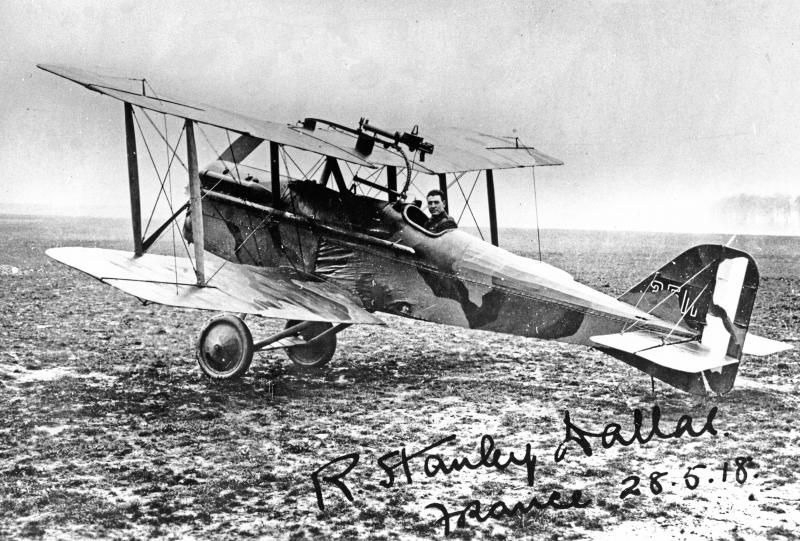
As a continuation from pre-war practice, the serial number, although going through its own evolution as both the War Office and Admiralty fought over manufacturer capacity to place multiple orders to satisfy the ever-expanding squadron formations, had continued to be painted on the tail fin and/or rudder, and increasingly on the fuselage rear. The original black painted numbers were now diversifying as khaki olive-drab became the norm, leading to white or grey fuselage numbers. The rudder serials were either black, sometimes outlined in white over the coloured vertical stripes, or grey, or white, again with black edging. Many Sopwiths, Strutters, Pups, Triplanes, Camels, Dolphins, and later Snipes, had a white box on the rear fuselage with black numerals and letters. Towards the end of the war there were attempts and experiments regarding camouflage, similar to the disruptive patterns used by the SPAD fighters of the French, Belgian and United States Air Forces. As part of the amalgamation of the RFC and RNAS to form the Royal Air Force, on 1 April 1918 Major Roderick Dallas was given command of No. 40 Squadron RAF, flying Royal Aircraft Factory S.E.5as. He had come from No. 1 (Naval) Squadron flying Triplanes, which being a naval squadron had been personalised and had non-standard marking additions; and at some point he ended up in S.E.5a serial number D3511, which was painted in experimental 3 colour disruptive camouflage, even partly obscuring the tail serial number. (For those interested in this camouflage, the title picture shows Dallas in this aeroplane, and Corgi Aviation archive produced an excellently modelled 1/48 diecast model of this aircraft, which although discontinued can still be obtained from 3
rd
party websites).
The Sopwith TF.2 Salamander was a British ground-attack aircraft which first flew in April 1918. It was a single-engined, single-seater, based on the Sopwith Snipe fighter, with an armoured forward fuselage to protect the pilot and fuel system from ground fire during low level operations. It was ordered in large numbers although only two were in France in October 1918. At some point in 1919, there was an even gaudier disruptive camouflage experiment.
Leave a Reply