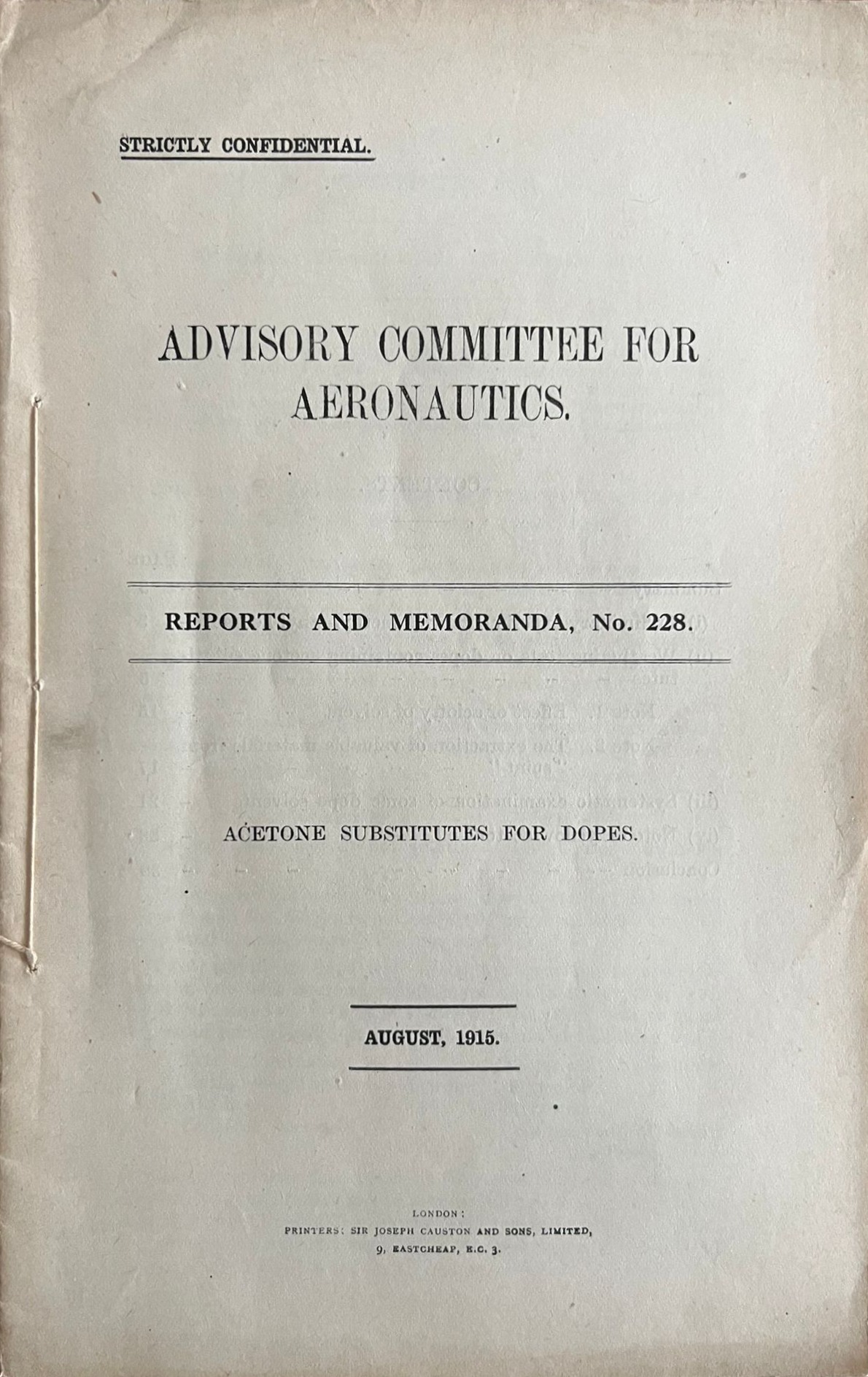
The artifact
Advisory Committee For Aeronautics report into dope alternatives
The stories behind the artifact
The Advisory Committee for Aeronautics was founded on 30
th
April 1909 to undertake, promote, and
institutionalize aeronautical research. In 1919 it was renamed the Aeronautical Research Committee, later becoming the Aeronautical Research Council. The Aeronautical Research Council was disbanded in 1979.
Following the establishment of this committee, other countries created similar agencies, notably the French L’Etablissement Central de l’Aérostation Militaire in Meudon (now ONERA), the Russian “Aerodynamic Institute of Koutchino” and the U.S.A.’s National Advisory Committee for Aeronautics, founded in 1915.
The idea for the creation of the ACA originated with the then Secretary of State for
War, R.B.Haldane (later First Viscount Haldane), who was supported in his efforts by Brittain’s Prime minister, H. H. Asquith.
Richard Burdon Haldane, 1st Viscount Haldane, (30
th
July 1856 – 19
th
August 1928) was a Scottish
lawyer, philosopher, influential Liberal and later Labour politician and statesman. He was Secretary of State for War between 1905 and 1912 during which time the “Haldane Reforms” of the British Army were implemented. As Secretary of State of War, he was instrumental in founding MI5, MI6, the Territorial Army, the British Expeditionary Force, and crucially, the Royal Flying Corps. Outside of his contribution to the future of British military doctrine, Haldane was a significant figure in education, contributing to the founding of institutions such as Imperial College London and the London School of Economics.
]
His efforts have left a lasting impact on both the UK’s defence and educational
landscapes.
As an intellectual he was fascinated with German thought. That led to his role in seeking detente with Germany in 1912 in the Haldane Mission. The mission was a failure and tensions with Berlin forced London to work more closely with Paris.
Raised to the peerage as Viscount Haldane in 1911, he was Lord Chancellor between 1912 and 1915, when he was forced to resign because of allegations of German sympathies. He later joined the Labour Party and again served as Lord Chancellor in 1924 in the first Labour administration. Apart from his legal and political careers, Haldane was an influential writer on philosophy, in recognition of which he was elected a Fellow of the British Academy in 1914.
Asquith announced the committee’s appointment in a statement to the House of Commons on 5 May 1909, in which he stated:
“With a view to securing that the highest scientific talent shall he brought to hear on the problems which will have to be solved in the course of the work of the two departments, the National Physical Laboratory has been requested to organize at its establishment at Teddington a special department for continuous investigation, experimental and otherwise, of questions which must from time to time be solved to obtain adequate guidance in construction.
“For the superintendence of the investigations at the National Physical Laboratory and general advice on the scientific problems arising in connection with the work of the Admiralty and War Office in aerial construction and navigation, I have appointed a special Committee….”
Haldane was criticised for what some considered the undue preponderance of academics on the committee (7 of the original 10 members were Fellows of the premier British learned society for science, the Royal Society, founded in 1660). To these criticisms Asquith replied in the House of Commons:
“It is no part of the general duty of the Advisory Committee for Aeronautics either to construct or invent. Its function is not to initiate, but to consider what is initiated elsewhere, and is referred to it by the executive officers of the Navy and Army Construction Departments. The problems which are likely to arise … for solutions are numerous, and it will be the work of the Committee to advise on these problems, and to seek their solution by the application of both theoretical and experimental methods of research.”
The Advisory Committee For Aeronautics proceeded to coordinate research in the following years and produced a series of annual reports, the first of which summarised the purpose of the committee as “the scientific study of the problems of flight, with a view to their practical solution”. It was kept out of the political ambit of any one ministry, reporting directly to the Prime Minister and receiving its funds from the “Civil Service Estimate”. This arrangement changed with the creation of the Royal Air Force, after which it reported to the Secretary of State for Air.
“Annual Technical Reports” were produced by the committee from 1910 until 1919, at which time its name was changed to the “Aeronautical Research Committee”. From 1920 reports were made to the Air Ministry. Alongside this, regular, monthly dated technical papers known as “Reports & Memoranda” were produced, of which I have a large collection, from 1913 to 1920, including the one discussed here.
The Aeronautical Research Committee’s scope was both military and civil applications.
This artifact, Reports and Memoranda No. 228, concerns and is title Acetone Substitutes for Dopes, and dated August 1916. It is marked Strictly Confidential in the top left corner, and these series of reports were published by Sir Joseph Causton and Sons, Limited, 9, Eastcheap, London E.C.3. In summary, the report that pure acetone as a solvent for dopes may be replaced by methyl-ethyl- ketone, obtained as a bye-product in the manufacture of acetone or by “methyl acetone” and similar commercial products derived from the fractional distillation of crude wood-spirit. Samples of these liquids from different sources have been examined and the behaviour of dopes in which they were employed has been shown to be satisfactory.
Acetone (2-propanone or dimethyl ketone) is an organic compound with the formula (CH3)2CO. It is the simplest and smallest ketone (R−C(=O)−R’). It is a colourless, highly volatile, and flammable liquid with a characteristic pungent odour. Acetone is miscible with water and served at the time as an important organic solvent in industry, home, and laboratory settings.
In 1914, the Weizmann process was developed to produce acetone on an industrial scale, which was crucial for the British war effort. This process utilized the bacterium Clostridium acetobutylicum to ferment starches into acetone and butyl alcohol. The rapid expansion of this process from laboratory to industrial scale was unprecedented and set a precedent for future biotechnological processes. The discovery of the Weizmann process had significant implications beyond science, as it demonstrat ed the potential for countries to replace petroleum-based chemical industries with fermentation- based ones, especially those with scarce natural oil.
The acetone shortage in 1915 was a critical issue for the British war effort, as acetone was a key ingredient in the production of cordite, the smokeless propellant used in artillery shells. This led directly to the Shell Crisis of 1915, which was raised as an issue in Parliament. The
traditional method of producing acetone involved destructive distillation of wood, which was limited by wartime resource constraints. However, the development of a bacterial fermentation process by Chaim Weizmann in 1915 allowed for the production of acetone from starches like maize or potatoes, providing a domestic and scalable solution to the shortage. This innovation was crucial in sustaining munitions production during the Great War, ensuring that the British could maintain supplies of much needed shells to the various fronts.
The list of contents for the report were as follows:-
- (i) Preliminary experiments with methyl-ethyl-ketone
- (ii) Weathering tests on dopes containing acetone substitutes
- Note 1. Effect of acidity on solvent
- Note 2. The extraction of valuable materials from “suint”
- (iii) Systematic examination of some dope elements
- (iv) Note on yellow acetone oil
- Conclusion
Preliminary experiments with methyl-ethyl-ketone, was written by by Guy Barr, B.A., B.Sc- August, 1915.
I am not going to re-produce the report here, but if anyone has sufficient interest and wishes to contact me via the Contact! Box on the website, then I will reproduce the 0rginal report and send it out to you.
Leave a Reply