The artifact
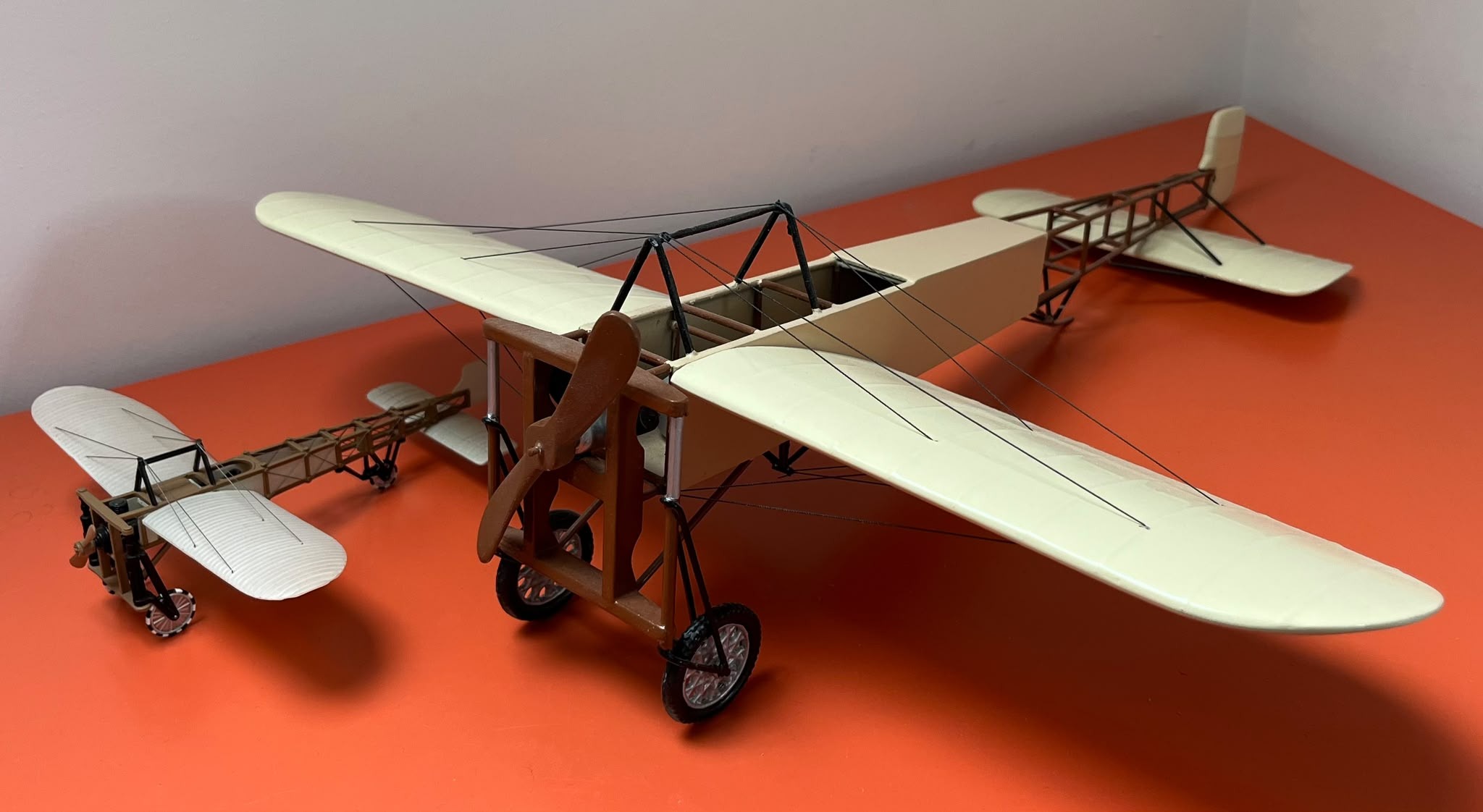
A large scale model Bleriot XI commissioned by Shell in 2009.
The stories behind the artifact
On 25
th
July 1909, at approximately 4.40am, and waved off by waved off by a large crowd, Louis Blériot took to the air in an aeroplane built to his own design. He flew steadily for around 30 minutes, and after circling twice, he landed again, breaking the Bleriot XI monoplane’s undercarriage in the process but coming to a rest at around 5.12am. He had covered the 24-mile distance at a speed of 40mph and an altitude of 250ft in 36 minutes and 30 seconds.
News of this short flight immediately flashed around the world, as he had taken off in France, and landed in England, sending shockwaves throughout not only Great Britain and her Empire, but also Europe, and further afield, across the entire globe. the English newspaper The Daily Express led its story of the flight with the headline “Britain is no longer an Island.” One of aviation’s first major challenges had been to fly non-stop across the English Channel. This feat was had now been achieved by the by Frenchman.
Blériot’s achievement not only sealed his place in aviation history, it also sealed his fame and fortune, as well into the first decade of the new century, when publicity stunts had become world-wide news, the possibility for money-making from such an event had become apparent to many individuals and organisations.
So, this article is the first of a series to be written on artifacts produced to celebrate the huge achievement.
Louis Blériot, who had been a successful inventor and manufacturer of car headlamps, was fascinated with aeronautics and used the money he made from his automobile business to design and build aircraft. By 1909, Blériot Aéronautique had developed the Model XI, a tractor-configuration monoplane, which was light and powerful enough for Blériot to attempt the Channel crossing. Blériot was competing with another noted French aviator, Hubert Latham, for not only the prestige of the first non-stop Channel crossing by air, but for a £1,000 cash prize put up by the Lord Northcliffe, influential owner of the Daily Mail newspaper.
At about 4am on the 25
th
July, Blériot filled the tank of the Model XI’s 3-cylinder, 25-horsepower, air-
cooled Anzani engine with fuel donated by Shell for his record-breaking attempt. He was up early to make his bid, as Latham, like Blériot, was camped out on the beachfront near Calais seeking to make history. In fact, Latham in his Antoinette monoplane had already attempted the crossing on 19 th
July,
but engine failure had forced him to ditch in the sea.
At 4.41am, waved off by a large crowd, Blériot took to the air and headed towards England. Despite turbulence and poor visibility, the Model XI’s reliability and Blériot’s determination paid off, for nearly 30 minutes later Dover Castle came into view.
The fuel and lubricants were supplied by the Shell oil company. The origins of the Shell company, and even the use of the name, are fascinating. In 1833, Marcus Samuel, a businessman born into a family of Baghdadi Jews in Whitechapel, London, ran a successful import-export antiques business, M. Samuel & Co., trading with the coalition in the Far East. in London, Marcus decided to expand his business. He already sold antiques but decided to try selling oriental seashells as well, capitalising on their popularity in the interior design industry at that time. The demand was so great that he began importing the shells from the Far East, laying the foundations for an import-export business that would ultimately become one of the world’s leading energy companies.
When Marcus Samuel Senior died in 1870, he passed the business on to his two sons, Marcus Junior and Samuel, who followed on their father’s business model of expansion. Marcus Samuel, 1st Viscount Bearsted, (5
th
November 1853 – 17
th
January 1927), known as Sir Marcus Samuel between
1898 and 1921 and subsequently as Lord Bearsted until 1925, eventually became a Lord Mayor of London and the founder of the Shell Transport and Trading Company. M. Samuel & Co launched the first Japanese gold sterling loan issued in London in 1897, and was largely concerned in the introduction of Japanese municipal loans, and in the development of the coal trade in Japan. Both Marcus Samuel Jnr and his brother, Samuel Samuel, were educated at Edmonton in North London, and in Brussels, and travelled extensively in Asia before settling down in business, visiting Ceylon, Straits Settlements, Siam, the Philippines, China and Japan.
Samuel realised the potential of the oil market during a prospecting trip to the Caucasus in 1890. In 1891, he secured a nine-year exclusive deal with the Rothschilds, to sell kerosene east of Suez. Samuel had commissioned the design and construction of a safer generation of floating tanker, safe enough to transit the Suez Canal. The first of thes new boats was the Murex, that set sail from West Hartlepool for Batum on 22
nd
July 1892, where it acquired its load of kerosene. The ship transited the
Suez Canal on 23
rd
August, and proceeded onward to his storage facilities in Singapore and
then Bangkok, for retail distribution. Samuel then built ten additional ships, also named for seashells. In 1895, he received a concession in east Borneo, where oil was discovered in 1897.
With the maiden voyage of the Murex, the Samuels brothers had achieved a revolution in the transport of oil. Bulk transport substantially cut the cost of oil by enormously increasing the volume that could be carried. The brothers’ main competitor at the time was Standard Oil, a company famous for its blue cans of kerosene that, when empty, could be used for anything from roofing to bed pans. To stand out they created the Shell brand and painted their cans bright red. The tactic worked and, by 1896, their kerosene trade was earning more than all their other businesses combined.
In 1897 Marcus and Samuel renamed their company the Shell Transport and Trading Company and launched their first refinery at Balik Papan in Dutch Borneo. The refinery later had to be destroyed when the USA declared war on Japan in World War II.
In 1901 when oil was found in Texas, Marcus Samuel junior pulled off the deal of a lifetime and won the transport and distribution rights from his company’s main competitor, Standard Oil. However, by 1902, overproduction in Texas had slashed the available supply to virtually nothing. At the same time, a smaller competitor called Royal Dutch had begun to construct its own tankers and set up its own sales organisation in Asia. As a result, half of the Shell’s fleet sat idle.
So, in 1907, the decision was taken to merge Shell Transport and Trading Company with Royal Dutch and form the Royal Dutch Shell Group. The day the telegram was received announcing the merger – 23
rd
April – is now celebrated every year as Shell’s birthday.
The merger with Royal Dutch signalled a period of rapid expansion as Shell (the Group’s name quickly became shortened to Shell) opened operations throughout Europe and in many parts of Asia. There was also substantial exploration and production in Russia, Romania, Venezuela, Mexico and the US. The years that followed also gave Shell many exciting opportunities to demonstrate the quality of its products in the fast-developing market for petrol (gasoline). These included record-breaking races, flights and journeys of exploration. For example, in 1907 Prince Borghese won the Peking to Paris motor rally using Shell Spirit motor oil. In the Antarctic, explorers Ernest Shackleton and Captain Scott used Shell fuel, while Bleriot’s inaugural cross-Channel flight was made using Shell Spirit. Shell was a crucial partner to the Allies in both World Wars. During the Great War, Shell became the main fuel supplier of the British army and also offered all of its ships to the British Admiralty, including the Murex.
The inter-war years were a time of rapid expansion for oil companies as the use of motor cars and demand for petrol increased. Shell fuelled the first trans-Atlantic flight made by Alcock and Brown in 1919, developed new and improved drilling techniques and, in 1929, founded Shell Chemicals to advance the refinement of chemicals from oil.
When World War II began, Shell’s London office was dedicated to supporting the war effort and the company’s refineries in the USA produced aviation fuel to support the Allied air forces. All Shell tankers came under Government control and many Shell staff showed great bravery in keeping them going, including the flying ace Douglas Bader who worked in the aviation department of Asiatic Petroleum before joining the RAF in 1939. War was also a catalyst for great innovation, with major advances in both fuel and chemicals research, including the development of fuels for new generations of aircraft such as the Spitfire.
In 2009, to celebrate the centenary (100 years) anniversary of Shell’s support for the Channel crossing, the model-making company Custom Wings Models were commissioned by the fuel producer to make some models of the Bleriot XI.
A sample model was made using non-standard construction methods from the usual solid wood models and the structure was largely fabricated, brazed and spoked wheels with rubber tyres made. This led to a large order of 2000 models for worldwide distribution by Shell. The project took more than 8 months to successfully complete – and all models shipped and delivered to Shell in time for the centenary celebrations.
These models were not designed to be re-sold, but were given as gifts to Shell clients and customers world-wide. Occasionally they turn up on eBay and other collectors markets.
It is mixed media, being made of some diecast and some plastic parts, with bracing and rubber tyres, and is approx. 1/10 scale. I have pictured it here with a Hallmark 1/48 scale model Bleriot XI for size comparison, and the whole history and collecting around early aviation diecast models will be the subject of a future article.
Leave a Reply