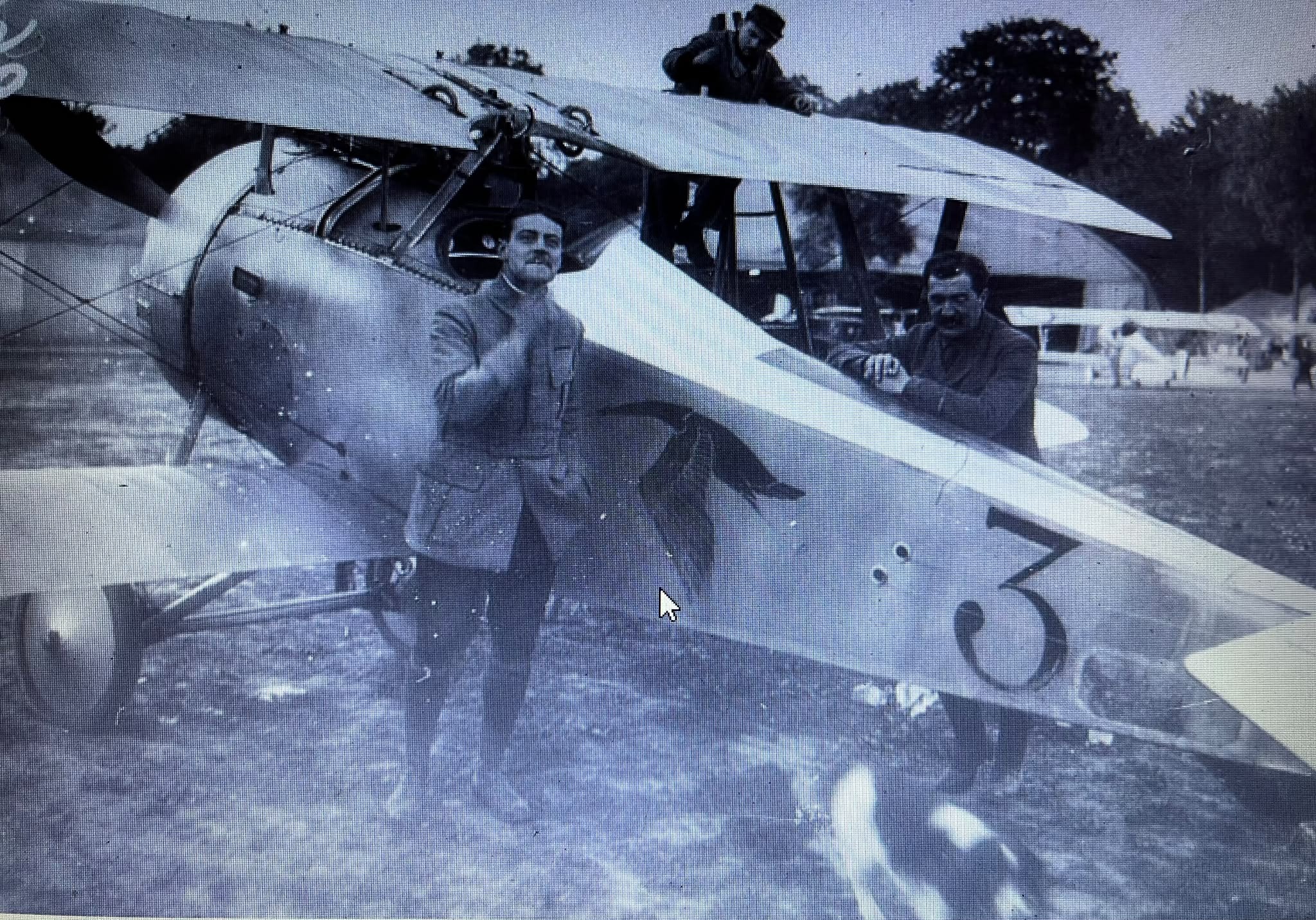
Or ‘Les Cigognes (The Storks)’
Early in the Great War the French Air Force started to group together its escadrilles (squadrons) into groups des chasse. French escadrilles were numbered but prefixed by letters denoting the type of aeroplanes that squadron flew, so M 3 for example was Morane Saulnier No.3.
Escadrille 3 was actually formed before the war began; back in July 1912, Avord, near Bourges, in the Centre-Val de Loire region of France. It is 20 kilometres (12 mi) east of Bourges, by the banks of the river Yèvre. As Escadrille B13, equipped with Bleriot XI monoplanes. It began the Great War with the Bleriot monoplanes; however, on 18
th
March 1915, it was re-equipped with Morane-
Saulnier monoplanes and redesignated Escadrille MS3. Capitaine Antoinin Brocard assumed command on 28th April 1915. By 20th September, it had once again re-equipped, this time with Nieuport 11 Bébé scouts; its new designation was Escadrille N3.
On 16th April 1916, the unit had been amalgamated into Groupement de Combat de la Somme, along with Escadrille N26, Escadrille N73, and Escadrille N103. Escadrille N37, Escadrille N62, and Escadrille N65 were also temporarily assigned to the Groupement; the seven units were placed under command of Brocard. On 16
th
June 1916, Capitaine Alfred Heurtaux took command
of Escadrille N3. In September 1916, the Commanding General of the French 6th Army commended the unit for having downed 38 enemy aircraft and three observation balloons between 18 th
March and 18th August 1916.
On 1 November 1916, the temporary Groupement of the four original units was formalized as Groupe de Combat 12. It became more commonly known as les Cigognes (the Storks), on account of the flying stork emblems painted on the majority of the Nieuport fighters that flew in it. Brocard was a former pre-war Dragoon officer who had graduated from St. Cyr military academy. He transferred from the 3
rd
Infantry Regiment into the fledgeling French air service. He became a
military pilot in May 1913 and by 1915 had risen to command MS3.
Like Richthofen the following year, Brocard was able to hand-pick pilots of his choice, so pilots that were to become national heroes or household names in France were flying for him, names such as Deuillin, Dorme, Fonck, Guynemer and Heurtaux.
Escadrille N3 began to make headlines as the war headed into its second year, in the Spring of 1916; on the 12
th
March Georges Guynemer had shot down a German LVG C.II reconnaissance two- seater
piloted by Unteroffizier Friedrich Ackermann and his observer, Leutnant der Reserve Friedrich Marquardt, based at Beuvraignes airfield. Guynemer flew down behind his victims, landed in a nearby field to inspect the wreckage and retrieved a copper reserve fuel tank as a trophy. (there will be more abount this combat, Guynemer’s 8
th
victory, in a future article; and there is a short video of
Guynemer on my arisen page on this website). He was wounded in combat two days later.
On the 31
st
March, Albert Deuillin, another ex- Dragoon who had transferred to the air forces, and had previously been with MS62, claimed his first victory over Verdun. He was wounded in the arm. On the 4
th
May, Alfred Heurtaux, another graduate of St. Cyr and another former cavalry officer, shot down his first aeroplane, another LVG C.II two-seater, by the end of the month he had shot down another 4 to claim ace status. Sous Lieutenant René Pierre Marie Dorme joined N3 from N94 on 25 th
June 1916, and by 22
nd
August had also gained ace status, shooting down his fifth and sixth victories
over the Somme battlefield. Guynemer returned to the squadron and immediately shot down his 9 th
kill on 22
nd
June. By the end of the year, he had shot down an astonishing 25 confirmed aircraft; just over a year later he would be dead.
A more important event occurred during the Summer, Escadrille N3 became Escadrille SPA3, as it transitioned to the new, faster, sturdier, SPAD VII, with more importantly, a machine gun designed to fire through the propeller. In its first 6 months operating the new SPAD fighter, SPA3 alone claimed more than 200 victories in the air. On the 26
th
September, Alfred Heurtaux shot down Kurt Wintgens,
the 19 victory ace, in his now outdated Fokker EIV monoplane, near Villers-Carbonnel. This was his ninth confirmed victory. By the end of the year his ‘score’ would be 16. On the 4
th
December, René
Dorme shot down his 17
th
victim, but himself was wounded 2 weeks later.
Sous Lieutenant René Pierre Marie Dorme was born in Abaucourt les Souppleville, on 30
th
January
1894. He joined the French Army in 1913, and was serving as a cannoneer in North African Tunisia, When war was declared. He transferred to the air service, where he began training as an aerial observer on the 1
st
February 1915. However, on the 13
th
, his orders were changed to send him to
pilot training, due to the lack of pilots for the ever expanding air force. On 6th May 1915, he graduated with his Military Pilot’s Brevet. After advanced schooling, he was posted to Escadrille 94 on 5 June 1915.
He was injured in a crash before he flew over the front lines, so did not get into combat until March 1916. He was posted to Escadrille 3 to fly Nieuport fighters in June 1916, before they transitioned to the new SPAD VII fighters. With both types of aircraft, he adorned his personal mounts with a Cross of Lorraine on the upper deck, the numeral ’12’ accompanying the squadron stork insignia on the fuselage, and the nickname ‘Papa Dorne’ on the side of the cockpit.
Dorme scored 23 confirmed victories between July 1916 and May 1917, with approximately the same number of combat claims unconfirmed. During this victory string, Dorme was awarded the Médaille Militaire on 4
th
August 1916, and the Legion d’honneur on 18th October 1916. However,
he was seriously wounded in combat on 20
th
December 1916 by an explosive bullet, and was out of
action until the following March.
By February 1917, Georges Guynemer had been promoted to Capitaine, then in March he claimed three victories in one day on 16
th
March, then 9 days later four in a single day on the 25
th
. His legend
amongst the French populace was growing. By June his total had surpassed 40. Also in March, Xavier de Sevin was put in charge of Escadrille SPA26. Another St. Cyr graduate and came to the Groupe from Escadrille N12. In April, René Fonck joined SPA103, under the command of Capitaine Jean d’Harcourt. There will be further articles on Fonck and his complex character, who became the Allies top ace with the highest number of confirmed kills. On 5
th
May Fonck gained his first confirmed kill
with his new squadron, which was his third victory in total (his first ‘claim’ was never confirmed back in July 1916, when he was piloting a Caudron G III observation two-seater, Escadrille C47); when he downed a Rumpler reconnaissance aircraft near Berry-au-Bac.
At the end of May, the Groupe lost René Dorme. He was killed in died in combat on 25
th
May
1917,
]
when the German fighter pilot Heinrich Kroll of Jagdstaffel 9 shot him down in flames. Kroll, who was flying an Albatros D.III, noted in his diary that Dorme had fought from 5,300 metres) down to 800 metres before his aircraft dived into the ground. Kroll also noted that Dorme was identified by his watch, which was found on his remains. At the time of his death, Dorme had 23 aerial victories officially confirmed. Unconfirmed claims amount to 19 more. Dorme was notoriously poor in filing combat claims, sometimes only doing so when prompted by squadron mates who had witnessed his victories. Like many of his contemporaries on all sides; the haphazardness of his victory list has led to speculation that he scored as many as 43 victories, or perhaps even 70 victories, which seems excessive considering the number of aeroplanes regularly in the air at that time. Guynemer, sad and angry at his friend’s demise, immediately went on the hunt for retribution. Over Goyencourt he shot down an LVG two-seater. The two seaters fighter escort, three single seater fighters turned on him, but enraged he shot two down, the third nose-dived for safety. Lowe on ammunition, he turned for home, but still managed to shoot down a Rumpler.
Dorme was not the only casualty, as the air war became a grim and bitter fight for control of the air, with equally matched aeroplanes being flown by equally skilled and brave aviators, with many starting to feel the strain of prolonged patrols in the air, often at altitude, and multiple combat actions, often on the same day. Heurtaux was wounded in the arm. Claude Haegelen was also wounded.
Claude Marcel Haeglen was born on 13 September 1896 in Belfort, France. On 15
th
September 1914,
he volunteered for military service as an infantryman. On 27
th
May 1915, he was forwarded for pilot
training. He graduated training with a Military Pilot’s Brevet on 10
th
January 1916. On 10
th
April, he
was posted to Escadrille F8, flying Farmans. After service with this reconnaissance squadron, he went to fighter training on 8th February 1917, and was assigned to Escadrille 3 a month later. He shot down two German aeroplanes, on 27
th
and 28
th
May, being wounded later on the 28
th
May. During
his lengthy convalescence, he was promoted out of the enlisted ranks to become a Sous
lieutenant on 25
th
January 1918. On 11
th
March 1918, he returned to active service, when he was
posted to Escadrille Spa.100. Joining in this unit’s “wolf pack” tactics, Haeglen would gain another 20 victories by the time of the Armistice, including 12of the dreaded observation balloons, which were hard to shoot down, and ringed by AA batteries and covering fighter patrols. After the war, he became a test pilot for the Hanriot company and gained a reputation as an aerobatic pilot. In 1931 and 1932 he won the Coupe Michelin long-distance flying competition flying the Lorraine Hanriot LH.41/2 aircraft. On the second one, he set a world record for 2000 km with a speed of 263.900 km/h.
Armand Pinsard was also shot whilst on patrol, on the 12
th
June, after his sixteen confirmed victory.
Like Haeglen, towards the end of the war he became an expert in downing balloons. Born in 1887, in Nercillac, Department of Charente, in the cognac country of France; he joined the military in 1906 and fought in Morocco as a cavalryman in 2nd Regiment de Spahis. He was decorated there with the Moroccan Medal. He then transferred to aviation in May 1912, becoming one of the rare professional military men to become a prewar pilot. He trained as a pilot at Chateau Fort on a Borel pusher two-seater aircraft, and proved to be a natural aviator.
He was awarded the Médaille Militaire for his performance flying a Morane in the French army manoeuvres of 1913. He was assigned to Escadrille MS23 when the Great War started.
In October, he participated in a bombing raid that attempted to kill the German Kaiser. He was commissioned in November 1914 because of this bombing raid. It was about this time that he pioneered the use of an aircraft to place an espionage agent behind enemy lines, an act that brought him a second citation. However, on 8
th
February 1915 he fell into German hands when his plane was
forced down behind German lines. It took him a month to recover from injuries received in the accident. Thirteen months and multiple escape attempts later, Pinsard tunnelled under a 4 metre prison wall to freedom on 26th March 1916. It took him another two weeks to cross the lines into neutral Switzerland and to repatriate himself.
His reward for his daring escape was training as a fighter pilot, and an assignment to Les Cigognes. By July 1916, he was flying a Nieuport with Escadrille N26. On 7 August, in a pioneering close air support role, he made no fewer than six firing passes on German troops attempting to counte-rattack a French unit. Then he and his three wingmen went on to strafe a train loaded with German troops. He was made a Chevalier of the Légion d’honneur for this action.
On 1st November 1916, he claimed his first victory. combat. His second came on the 23
rd
January
1917, flying as Commanding Officer of Escadrille N78. He became an ace on 6th March with his fifth kill and would continue to fly Nieuports into battle until his 16th victory on 5 June 1917. Just one week later, Pinsard crashed and suffered serious injuries. He would be confined to hospital for several months. Upon his recovery, he was appointed commanding officer of Escadrille SPA23. He painted his SPAD black and entitled it, Revanche IV (“Revenge IV”).
The final year of the war saw him gain his 17th victory on 20
th
February 1918. On 4th May, he began
shooting down observation balloons. Quite wat triggered his ire towards balloons is not documented, but nine of his last 10 confirmed victories were the dreaded balloons. that saw him down nine observation balloons in his final decade of wins. Rather remarkably, he had help downing only one of the heavily defended gasbags, mainly attacking them solo. His twenty-seventh victory came on 22nd August 1918.
On the 28
th
July Alfred Auger was shot down and killed when he took on four enemy fighters single
handed. Heurtaux took over command of SPA3. To celebrate, Guynemer shot down his fiftieth victim, a Deutsche Flugzeug-Werke two-seater, usually known as DFW. He was the first French ace to reach the 50 milestone, and the French press and public alike showered him with adoration, gifts, and offers of marriage.
However, in a blow to the entire nation, Guynemer failed to return from a combat mission on 11th September 1917.At 08:30, with new pilot Jean Bozon-Verduraz, Guynemer took off in his Spad XIII, serial number S.504, to patrol the Langemark area. At 09:25, near Poelkapelle, Guynemer sighted a lone Rumpler, another type of German observation two-seater, and dove toward it. Bozon-Verduraz saw several Fokkers above him, and by the time he had shaken them off, his leader was nowhere in sight, so he returned alone. Guynemer never came back. He was confirmed missing in action by his squadron commander, Major Brocard; this was officially announced in Paris by the French War Department on 25th September 1917. In the announcement, one of Guynemer’s flying comrades (whose name was withheld due to security reasons) provided additional details of his final combat:- “Guynemer sighted five machines of the Albatros type D-3. Without hesitation, he bore down on them. At that moment enemy patrolling machines, soaring at a great height, appeared suddenly and fell upon Guynemer. There were forty enemy machines in the air at this time, including Baron von Richthofen and his circus division of machines, painted in diagonal blue and white stripes. Toward Guynemer’s right some Belgian machines hove in sight, but it was too late. Guynemer must have been hit. His machine dropped gently toward the Earth, and I lost track of it. All that I can say is that the machine was not on fire.”
Further details were later added by Major Brocard, in an article in Paris Le Matin.
“The last fight of the French aviator occurred four or five miles inside the German lines northeast of Ypres and opposite the British lines. Captain Guynemer was accompanied by Lieutenant Bozon Verduraz who says that they were flying at a height of 4,500 metres when Guynemer sighted an enemy two-seater which he attacked. Almost at the same moment Verduraz saw four German monoplanes approaching and turned toward them instantly so as to draw them off. They circled around for a while and then disappeared. Verduraz then returned to the place where he had left Guynemer engaged with the German biplane, but Guynemer had vanished.”
Unofficial confirmation of Guynemer’s death came from a captured German pilot who was shot down behind Canadian lines on the evening of 29
th
September. The prisoner stated that a German
NCO from the 413th Regiment (204th Division) had witnessed Guynemer’s crash and identified his body. He also certified that Guynemer had died from a bullet through the head and had sustained other injuries including a broken leg and a finger shot away. The German party retrieving the body was driven away by Allied artillery fire before they could bury or remove the body. A US Red Cross communique (15
th
October) stated that the death of Guynemer was “definitely confirmed.”
This Red Cross report provided further details:
Information received by the Red Cross says Guynemer was shot through the head north of Poelcapelle on the Ypres front. His body was identified by a photograph on his pilot’s license found in his pocket. The burial took place at Brussels in the presence of a guard of honuor composed of the 5th Prussian Division. Such is the story told by a Belgian who has just escaped from the Germans. The burial was about to take place at Poelcapelle when the bombardment preceding the British attack at Ypres started. The burying party hastily withdrew taking the body with them. [A] German General [present was] an aviation enthusiast with a great admiration for Captain Guynemer’s achievements. At his direction the body was taken to Brussels in a special funeral car… [Guynemer] was carried by non-commissioned officers and was covered with floral tributes from German aviators… Prussian Guards stood at salute upon … [the car’s] arrival and during the burial which was given all possible military honors. The French Government has been invited to place in the Pantheon, where many great Frenchmen are buried, an inscription to perpetuate the memory of Captain Guynemer as ‘a symbol of the aspirations and enthusiasm of the Army.’ A resolution to this effect has been introduced in the Chamber of Deputies by Deputy Lasies.
The two-seater Rumpler-type aircraft attacked by Guynemer, according to Bozon-Verduraz, has never been conclusively identified. Research published in 2005 suggests that it could have been a machine flown by Leutnant der Reserve Max Psaar (observer) and Fl. Georg Seibert (pilot) from FA(A)224. Kurt Wissemann of Jasta 3 was officially credited with the downing of Guynemer. Wissemann would himself be killed in action little more than two weeks later on 28 September 1917.
Guynemer had officially been credited with 54 victories at the time of his death. The whole country mourned.
Up stepped the pretender to the throne, On the 14
th
of September, René Fonck killed the pilot of a
German observation plane and watched as the plane inverted and dropped the thrashing observer almost through the wing of Fonck’s Spad. He visited the scene of the crash, even removing the barograph, an instrument to measure atmospheric pressure, out of the cockpit of what would be is twelfth victim, so that its readout would confirm his combat report. On 30
th
September, he and
Adjutant Dupre jointly shot down a German two-seater Rumpler C.IV, serial number 6787/16 of FA 18. It was widely reported in the press that killed pilot was Leutnant Kurt Wissemann, who was reported in the German press to have shot down Guynemer, and that Fonck had boasted of avenging the death of his “good friend”. This legend has been questioned by the official German records, indicating that Wissemann of Jasta 3 had been killed two days before in a different fight, in which he was flying a single-seater, probably against pilots from No. 56 Squadron of the Royal Flying Corps. But it made good press and got widespread attention.
By the end of the third year of conflict, with the country drained or ‘bled white’, the army in mutiny, and airmen exhausted, he had raised his tally to nineteen, was commissioned as an officer, and had received the Légion d’honneur.
By 1918, as the Groupe moved to the Verdun front, he was scoring steadily and his total rose. Known for his clinical professionalism, he applied mathematical principles to combat flying, and his engineering knowledge regarding the capabilities of the aircraft he flew was unsurpassed by his fellow pilots. Fonck took few chances, patiently stalking his intended victims from higher altitudes. He then used deflection shooting with deadly accuracy at close range, resulting in an astonishing economy of ammunition expended per kill. More often than not, a single burst of less than five rounds from his Vickers machine gun was sufficient. His preferred method of aerial combat was not to engage into dogfights, but to carry out surgically merciless executions. He eyesight and perception of the sky was also excellent; he was also reputed to be able to spot enemy observation aircraft from very far away, where most other pilots would have seen only clouds.
The issue was as far as the French public were concerned, who were desperate for heroes in an increasingly industrialised killing machine, Fonck never captured the hearts of the French public as Guynemer had. Whereas Guynemer was seen in romantic terms as the fragile hero, almost single handedly shooting down the Bosche invaders, Fonck’s approach to tactics was professional and researched. He was withdrawn and shy. He spent hours thinking out tactics and practising his marksmanship. Instead of drinking or socializing with the other pilots, he planned his flying missions and tactics, ironed his uniforms, and stayed physically fit through calisthenics. He seemed to overcompensate for his shyness by constantly mentioning his exploits. As a result, he came across as distant and arrogant. Although his comrades respected his skills, they found it difficult to get close to him, and even when they did, friends such as Marcel Haegelen, considered him a braggart and shameless self-promoter. It is likely Fonck may have resented the fact that Guynemer, partially through folklore, personality, and as one of France’s sons who paid the ultimate sacrifice and gave his lifeblood for France remained more popular in the French press even after he surpassed him in victories. Fonck was never even slightly wounded, indeed legend has it one bullet ever entered any of the aeroplanes that he flew.
Many Americans had been flying with the French air service since 1915, and had formed Escadrille Lafayette (No. 124, flying Nieuports then SPADs), but there were several that flew with Groupe 12. Amongst their number was Charles Biddle, who will be the subject of a future article, Frank Baylies, Oliver Chadwick, Edwin Parsons, – all of these to be discovered in detail in future writing, as the Americans were coming! And coming in numbers onto both land and arial battlefields.
Fonck then managed the extraordinary feat on the 14
th
August of shooting down three German
aircraft in roughly ten seconds. By this time, he has surpassed Guynemer’s total of victories. During the Summer as the rate of attrition on the Western Front increased, and seemingly even at this late stage of the war, as it turned out, no end to the fighting in sight, Escadrille SPA167 joined the Groupe. They were commanded by Bernard de Romanet.
Bernard Henri Barny de Romanet (28
th
January 1894 – 23
rd
September 1921) was born in Saint-
Maurice-de-Satonnay, Saône-et-Loire, and was educated at the Collège des Minimes, Chalon-sur- Saône, and then at the Collège des Montgré in Villefranche-sur-Saône, before going on to study at the Lycée Lamartine at Mâcon.
He joined the French Army in October 1913, serving in the 16e Régiment de Chasseurs, a cavalry unit, at the beginning of the war, later transferring to the 56e Régiment d’Infanterie. He transferred into the French air service in July 1915. Six months later, in January 1916, de Romanet received his brevet (permit) as a pilot. His first assignment to Escadrille C51 was as a Caudron reconnaissance pilot. He trained as a fighter pilot in February 1917 and made the transition to flying single- seater Nieuport fighters for Escadrille N37. His first victory was scored on 3rd May 1917, when he attacked two Albatros scouts, and drove one of them down. He did not officially score his second victory until the 31
st
March 1918. He became an ace on 30
th
June 1918, but by the 22
nd
August, he
had a score of 10 confirmed victories. That was his last victory and last day with Escadrille N37. He was then charged with forming Escadrille SPA167, flying SPAD XIII, took over as commanding officer, and scored eight more victories while leading it, as part of Groupe 12.
After the war de Romanet became a successful sporting pilot, breaking the World Air Speed record on two occasions in 1920. Barny de Romanet died in a flying accident on 23
rd
September
1921, testing the aircraft he was to fly in the 1921 Coupe Deutsch de la Meurthe race, the new Lumière-De Monge racer. Flight reported:
FLIGHT, No. 666 (No. 39, Vol. XIII), 29
th
September 1921, Page 651.
“It is with the most profound regret that we have this week to place on record the accident which resulted in the death of one of France’s finest and most popular pilots, Count Bernard de Romanet. It appears that on September 23 de Romanet took the de Monge machine up for a trial flight. He had previously tested the machine as a biplane, but this is said to have been the first flight made with it as a monoplane; and it proved to be the last. According to reports, de Romanet took off well and climbed to a height of a few hundred metres. He then flattened out, and, it is thought, opened out the engine. The machine is stated by eye-witnesses to have “leapt forward” and to have proceeded at a great pace, judged to be over 300 kilometres (186 miles) per hour. The fabric of the left wing was seen to lift and fly back from the wing. The machine heeled over to the left, but for a few seconds it looked as if de Romanet would regain control, as he managed to right the machine. It then, however, got into a dive, and is stated to have dived straight into the ground. Needless to say, the unfortunate pilot was killed instantly by the terrible shock.
With regard to the cause of the accident, it is stated in our French contemporary L’Auto that it is though that the stitching of the fabric was at fault, the distances between the stitches which attached the fabric to the framework being 12 centimetres instead of the usual 2 centimetres. Le Marquis Bernard de Romanet came of a very old French family. He was born at Macon on January 28, 1894, and at the age of 18 he commenced his military service in the cavalry. He was made an officer during the War, and distinguished himself, first in the cavalry and later as a pilot. Bernard de Romanet was an officer of the Legion of Honour, and held the Croix de Guerre with 18 palms and the Medaille Militaire. At the end of the War he took to civil aviation, and was always a prominent figure in speed races, being the crack pilot of the Spad-Herbemont machines. At Monaco he won the speed race of 1920, and he put up a splendid flight in last year’s Gordon-Bennett race, in spite of a broken oil pipe which forced him to land smothered in oil.
Some time ago de Romanet had a slight accident while testing a land machine with floatation gear. He alighted on the Seine, but the machine turned turtle instantly, and he was rescued by a motor- boat. While testing the de Monge machine for the Aerial Derby one of his wheels broke, without, however, causing serious damage to the machine. He was an interested spectator at the Derby, in which, but for the mishap, he would have been a competitor. His death will be regretted not only among his many friends, but in the world of aviation generally, for he was a great pilot, a great gentleman, and, last but not least, a real sportsman.”
He shot down his thirteenth victim on 14
th
October, and another on the 18
th
October, this time a
Fokker DVII.
Fonck shot down his 75
th
confirmed victory on 1
st
November, to ensure he ended the war as the
highest scoring Allied ace, but still five short of von Richthofen’s total. Ten days later the Armistice was declared, bringing a close to wartime flying and fighting. Fonck also seemed to lack insight into the effect his personality had upon his image or career. However, he and he alone carried the flag of the French Air Force at the victory parade on the Champs-Elysées. Fonck returned to civilian life after World War I, and published his war memoirs ‘Mes Combats’in 1920. The fame he got from the war allowed him to be elected Member of the French Parliament, representing the Vosges from 1919 to 1924. He stayed in aviation, and Fonck persuaded Igor Sikorsky to redesign the Sikorsky S-35 for the transatlantic race or Orteig Prize. On 21
st
September 1926, the aircraft crashed on take-off when the
landing gear collapsed, killing two of his three crew members. Charles Lindbergh won the prize seven months later in 1927.
Fonck eventually returned to military aviation and rose to Inspector of French fighter forces from 1937 to 1939. His inter-war contact with the likes of former World War I foe Hermann
Göring and Ernst Udet, whom he considered kindred spirits as Great War aviators, cast a shadow upon Fonck’s reputation during the German occupation of France, as did allegations of collaboration with the Nazis and the Vichy government. In January 1941, Fonck in 1940, as France found itself occupied for the second time that century, he was a member of the National Council of Vichy France. On 10 August 1940, Vichy Foreign Minister Pierre Laval announced that Fonck had recruited 200 French pilots to fight on the Nazi side. However, the truth was more complicated. Marshal Philippe Pétain wished to exploit Fonck’s relationship with Göring in order to meet Adolf Hitler. He ordered Colonel Fonck to talk to Göring. A meeting was planned at Montoire, but after discovering evidence about the pro-Nazi politics of Pierre Laval, Fonck tried to convince Pétain not to attend. Initially Pétain appeared to heed Fonck’s advice, but for some reason he eventually decided to disregard Fonck’s warnings and met Hitler at Montoire on 24 October 1940. Fonck’s loyalties were thus questioned by the Vichy regime, and he returned home to Paris, where he was eventually arrested by the Gestapo and imprisoned in the Drancy internment camp.
After the war, a French police inquiry about his supposed collaboration with the Vichy regime completely cleared Fonck. The conclusion was that his loyalty was proved by his close contacts with recognised resistance leaders such as Alfred Heurtaux during the war. He was awarded the Certificate of Resistance in 1948. The citation reads: “Mr. Fonck, René, a member of the fighting French forces without uniform, took part, in territory occupied by the enemy, to glorious fights for the liberation of the nation.”
Fonck remained in Paris, but also frequently visited his native Lorraine, where he had business interests.He died of a stroke in his Paris apartment, Rue du Cirque, at the age of 59, in 1953, and is buried in the cemetery of his native village of Saulcy-sur-Meurthe
As metioned, as Alfred Heurtaux served in the resistance, after also serving as Inspector of French fighting forces, as Fonck had done, and then back in the French air force to serve on active duty at the start of World War II. He was arrested by the Germans for his resistance activities and sent to Buchenwald concentration camp, but survived the war.
Albert Deullin served as chief pilot of CFRNA (French-Romanian Company for Air Transport), employing many veterans pilots from former the former Groupe de Chaise. GC 19. Flying old Salmson 2A2 from military surplus, the company opened flying routes from Paris to eastern European cities, including Istanbul. In 1923, the company flew on the early commercial airplanes such as the Caudron C.61. He died in a flying accident at Villacoublay on 29
th
May 1923.
Leave a Reply