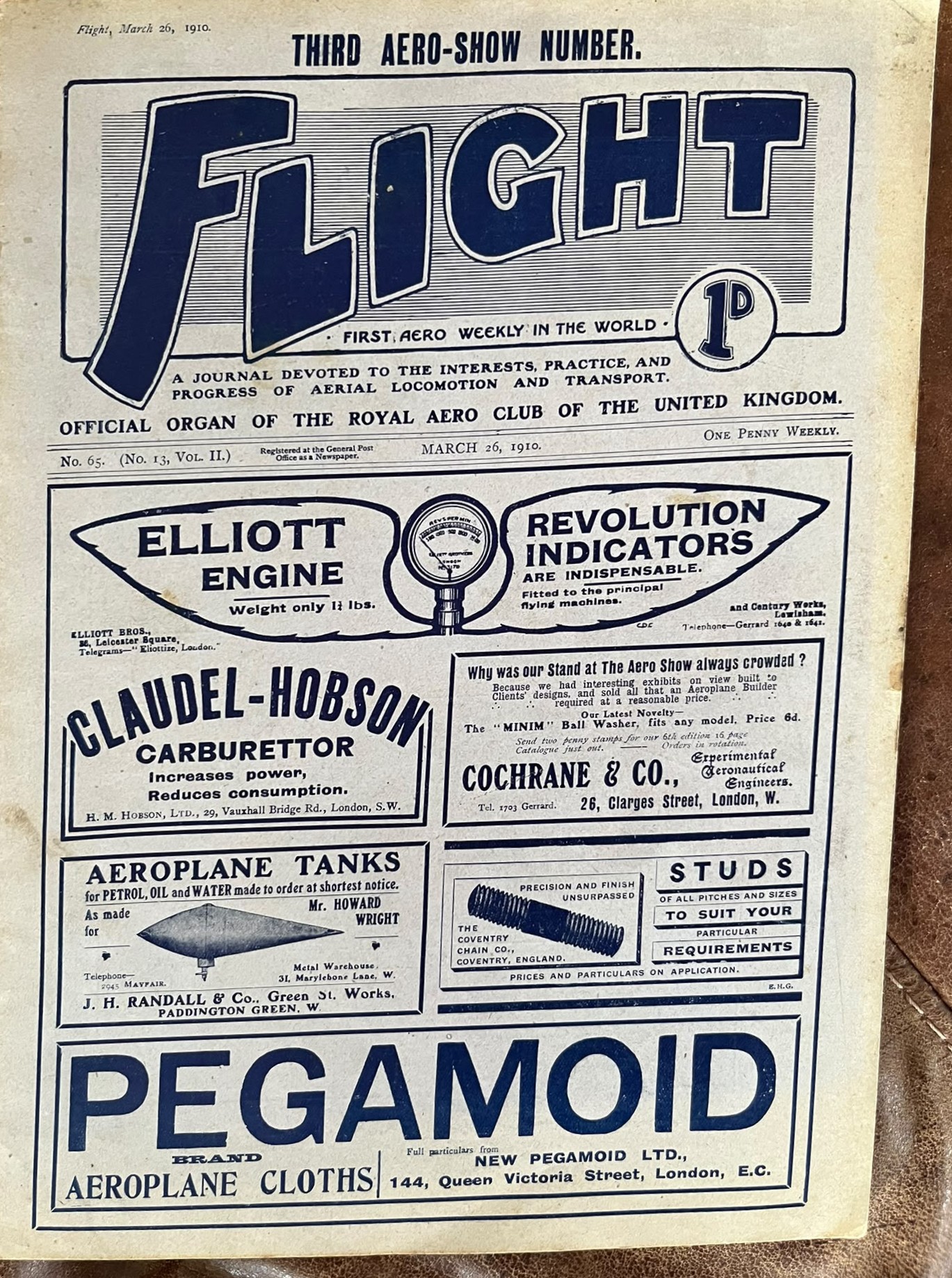
The artifact
Flight magazine 26
The stories behind the artifact
Stanley Spooner. The founder and first editor of Flight. He was also the creator and editor of The Automotor Journal, originally titled The Automotor Journal and Horseless Vehicle, designed for engineers and people with an invested interest in the new mode of transport, the automobile. (There will be a future article on Spooner and his role in championing the new forms of transportation in Edwardian England.)
Starting in January 1900, the journal started a separate section relating to aviation and aeronautical matters. The 5th April 1908 issue of The Automotor Journal included a diagram of patent drawings of a plane made by the Wright brothers. Stanley kept in contact with them via his friend Griffith Brewer, who was the first Englishman to fly in an aeroplane when Wilbur Wright took him for a flight in Camp d’Auvours , east of Le Mans, Paris, on 8
th
October 1908; and he later became the Wright’s sales agent
in the UK.
(There will be a future article on Brewer and his role in championing the new forms of transportation in Edwardian England.)
Eventually, Spooner decided that a journal focused solely on matters relating to flying should be published—and so, the Flight newspaper was established as an offshoot of The Automotor
Journal. Flight first appeared on 2 January 1909 as the official journal of the Aero Club of the United Kingdom (later the Royal Aero Club), and proudly printed under the logo the claim to be the ‘first aero weekly in the world.’
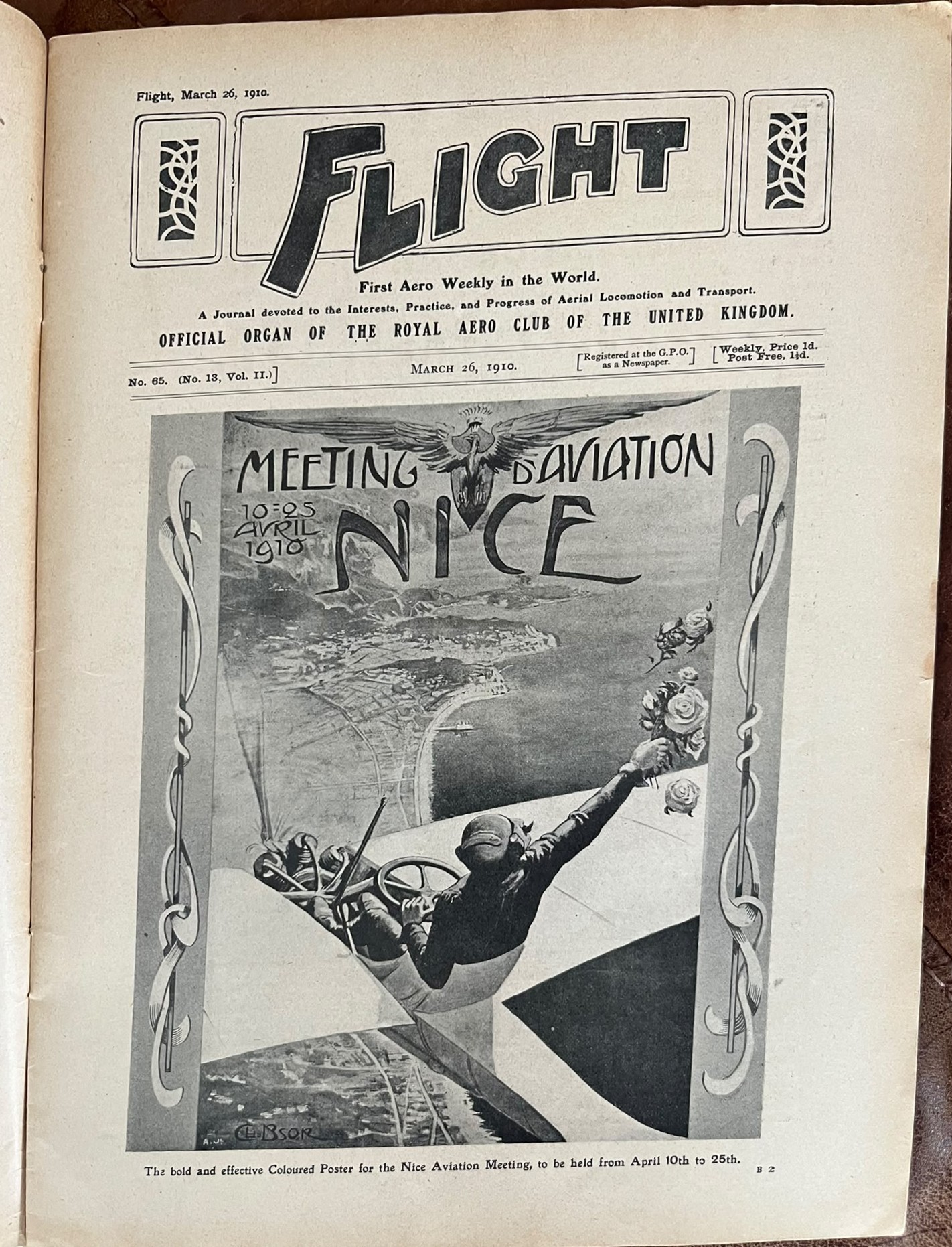
By 1910 both Flight and The Aeroplane were competing for shelf space in every hanger or workbench in England. Flight was the more technically minded of the two, and called itself a journal devoted to the interests, practice, and progress of aerial locomotion and transport, as people realised this dynamic new mode of transport was here to stay, and was growing at a rapid rate. This copy is dated March 26, 1910, and is No.65 (No.13, Vol. II). It was actually registered at the General Post Office as a Newspaper, which came out weekly, priced at one penny. It was printed and published by The St. Martin’s Publishing Co., Ltd, who’s address was 44, St, Martin’s Lane, London W.C. The front covers of these early editions were always given over to valuable advertising space, to generate income for the newspaper. So, competing for attention alongside Elliott rev counters are; Claudel-Hobson carburettors, Randall’s petrol and water tanks, Coventry Chain Co. studs, Cochrane’s washers, and Pegamoid canvases. Inside the cover and first pages are what were to become household names advertising their services: Bleriot, Shell, Handley Page, Henry Farman. The front page of the newspaper proper is a mono plate of the full colour poster for the Nice Aviation meeting, which was (as yet to be) held from 10
th
to 25
th
April. This now iconic
image, designed by Charles- Léonce Brossé, is a masterpiece of early aviation art.
It captures the spirit of the 1910 Nice Air Show and the pioneering era of aviation. The poster features a pilot scattering roses from an aircraft flying high above the coastline of Nice, symbolizing the coat of arms of Nice. It has been widely reprinted and reproduced in the decades since it was first seen.
Brossé’s design is a testament to his artistic skill and the creativity of early aviation pioneers. The first article is a report on the National Physical Laboratory in Teddington, and their experimental research in aeronautics and aviation on behalf of His Majesty’s Government. This concerned such diverse issues as the effect of wind pressure on structures, resistance of models in a uniform current of water, aeronautics, wind channels, testing the strength and elasticity of fabrics for balloons and airships, petrol motor tests, and even chemistry experiments with light alloys for use in manufacture. All of this shows that despite the apparently haphazard nature of the development of this new form of science, work was diligently going on to improve performance, efficiency and safety. There is a small announcement on the bottom of page 227 regarding entries for the Nice meeting, already mentioned here. Despite the front plate proclaiming 10
th
April as the start date, here it states
the opening aviation meeting of the year will be from 12
th
April until the 24
th
. It had at the time of
printing attracted 14 entrants: Rougier, Latham, Grade, Reimsdyck, Sands, Mortimer Singer, Van den Born, Métrot, le Blon, Duray, Effimof, Chavez, Olieslagers, Swanson. The meeting to be held on Napoule Racecourse.
The next article consists of two pages on the new “Short” biplane, which is continued from the previous week’s edition. It is to be concluded in the following week’s edition; which is a great way to sell newspapers, but frustrating for historians like myself having to try and source two extra editions for research. Interspersed with these two pages are advertisements for the Bristol & Colonial Aeroplane Co, and there “Zodiac” biplanes and monoplanes, and Greens aero engines which have been adopted by H.M. War Office; and then follows a two-page advertorial for Greens engines which, again, is concluded from the previous edition.
Of interest in the “Short” piece is the following paragraph:-
‘ it is interesting to note that Short brothers have come to the conclusion that wires offer less resistance than is popularly supposed to be the case. Some of our readers may remember that Esnault-Peltiere publicly stated how, after having tried a Wright type of glider of his own construction, he abandoned the biplane principle in favour of the monoplane system solely because of excessive head resistance caused by the wires necessary in biplane construction. He attributed this resistance to the vibration of the wire and seemed to be distinctly of the opinion that a single wire had resistance equivalent to a rigid strut an inch or more in diameter.’
There then follows four basic line drawings, under the heading ‘Flyer Silhouettes from Olympia.’ Then a table of aeroplanes at the 1910 exhibition. The four are as follows, with details of their construction:-
Humber Biplane – an unusual three-seater biplane with the sole engine, a 50 h.p. Humbeer, attached to the bottom wing leading edge. The pilot sat in the middle of the bottom wing, with a seat either side for two trainees. It had controls in triplicate. Priced £1,000.
Mulliner Monoplane – a British built single seat monoplane similar to an earlier Bleriot, with a 35 h.p. J.A.P eight- cylinder engine. Priced £500.
Bristol Zodiac biplane – a Farman type pusher, with a 50 h.p. Darracq engine. Priced £1,000. Humber monoplane (Lovelace type) – another Bleriot inspired design, with a 50 h.p. Humber 4- cylinder engine. Priced £750.
There is a nice Classified Trade Directory followed by ‘Aviation News of the Week.’ So I will reproduce that in full here under the various headings, as there are some household names in the news, and some names long forgotten to history.
Flying at Eastchurch.
Mr. P. Grace flew from Eastchurch to Leysdown on Sunday last on his Voisin machine and at times reach a height of 100 feet. Unfortunately, on arriving at Leysdown the motor stopped and the machine was slightly smashed in its too sudden descent. On Monday, Mr. Grace was out on his Short- Wright machine and flew for 3 ½ minutes. The Short-Wright and Sommer machines belonging to the Hon. C.S. rolls which were on view at Olympia arrived at Eastchurch on Monday morning.
Mr. Haldane on Flight.
Speaking at the annual meeting of the British Science Guild at the Mansion house last week, Mr. Haldane said that we had been behind in the science of navigating ships through the air. But a start had been made which, he thought, was full of promise. There was at Teddington, as part of the National Physics Laboratory, an organisation containing architects who had put us, in point of science, at all events, at least abreast of every other nation. It was quite true the ships were not yet built, or very few of them, but they were on their way. Some already existed, and more would exist very shortly. But the point was the organisation had been perfected and brought up to the highest point which experience and knowledge could teach.
Ae.C.F. Pilote-Aviateurs. At their last meeting the Aero Club of France granted a large number of pilot-aviateur certificates, including those to Mr. Moore-Brabazon, Liet. Calderara, Liet. Cammerman, Madame de la Roche, Reimsdyck, Morelle, Van den Born, Le Blon, Rene Gasnier, Christiaens, Duray, Jules Tyck, Sands, and Maurice Herbster.
Pilote-aeronaute certificates have been granted M.M. Delmas and Leon de Bronckere.
Boat Builders and Aeroplanes.
In view of the recent tendency in motor boat designs towards the hydroplane it is hardly surprising that some builders are turning their thoughts to flying machines. The Tellier works in France, which have turned out some of the speediest motor boats, are responsible for the monoplane seen in the accompanying photographs, and it is being tested by m. Dubonnet, who is famous as a helmsman of racing motor boats. The Tellier monoplane has a span of 11 metres, and the length is the same dimension, while the lifting surface is 24 sq. metres. The Panhard motor drives a Tellier two-bladed propellor and gives the machine a speed of 70 kiloms. An hour.
Dubonnet a Pilote-Aviateur.
At its first trial the Tellier monoplane has proved itself an entire success. On the 16 th
inst. Dubonnet
flew for 40 minutes at Draveil and on the following day for a quarter of an hour, while on Saturday last he succeeded in making the necessary qualifying flights for his Ae.C.F. certificate as pilote- aviateur.
Rougier at Monte Carlo.
For his seventh flight at Monte Carlo, on the 17
th
inst. Rougier took his usual course to Cap Martin
across the sea, and then turning flew at a height of 200 metres towards Nice for some distance, going over the rocks at Monaco to Eze, and then returned after a trip of a quarter of an hour. The next day he arranged to fly to Nice and back, but although he made a good start he found the wind too strong, and therefore returned to his shed. For two minutes he hung in the air without being able to make any advance against the wind.
Mignot at Rheims.
Having taken his Voisin to the plains of Bethany, M. Mignot has made some successful flights, and on the 8
th
inst. he flew for 30 mins, mostly at a height of 15 metres. Flying at a height of about 30 metres, Mignot on the 16
th
inst. Kept on until he was obliged to come down by the gathering
darkness, by which time he had covered about 20 kiloms.
Sommer Getting Busy. M. Sommer seems to be gathering quite an extensive school of pupils round him at Mouzon, and they seem to find the handling of this machine particularly easy. On the 14 th
inst., he gave a lesson to Bouvier, who afterwards flew for 5 kilometres. He gradually progressed, and on the 17
th
was flying for 20 minutes, most of which was across country. Verstaeten, another pupil of Sommer, has been flying each day. On the 17
th
M. Sommer gave a first lesson to Legagneux, who has
been engaged to fly a Sommer biplane fitted with a Gnome engine, purchased by M. Gremont. Four Pilots in Eight Days.
As an instructor, Van den Born would appear to take the palm, for he has added to the honours already won by succeeding in training four of his pupils to pass the tests for the Ae.C.F. pilot’s certificate in eight days. The four are Jules de Lavine, Count Malynski, who has also been taking lessons on a Wright machine, Nicolas Kinet, and Jules Christiaens.
Doings in Johannisthal.
In addition to Keidel, who made some flights with passengers on his Wright machine on the 18 th
inst.,
Brunnhuber succeeded in making a trip of 2 kiloms. On his Antoinette monoplane. Of Keidel’s trials, the best was one of 7 ½ kiloms. In 7 minutes.
Grade at Leipzig.
Apparently the aerodrome at Leipzig, where Herr Grade was giving some exhibition flights on Sunday last, is not all that it might be. After a couple of trials lasting three or four minutes each, Grade started on a cross-country trip, but for some unexplained reason suddenly came down in a forest of fir trees. Naturally the monoplane was badly broken, but Herr Grade himself was unhurt. Molon at Havre.
At Havre, on the 16
th
inst., a large crowd turned out to see Molon fly, and they were not
disappointed; for, in spite of the fact that a violent wind was blowing, he flew on in his Bleriot for 1 hour 4 mins. On the previous days he was flying for 35 mins.
There follows two pages of correspondence, covering subjects as diverse as using rockets to power disabled planes finding themselves over unsuitable landing grounds; new models of designs; a spat between manufacturers over who supplied the fittings first; dihedral angles in detail; anemometers; an Indian biplane, silver spruce procurement, and the h.p. of model petrol engines. The last letter is of particular interest so I will reproduce it in full:-
Monoplanes V Multiplanes.
‘[428] In a recent issue appeared an article entitled Monoplane v. Multiplane, by Mr. A. V. roe, and as one who has watched his experiments, I should like to write in support of his machine.
I think it is more efficient than any of his foreign rivals, having proved its capability of carrying a load of 50 lbs. per horse-power, whereas I believe that the next best results worked out- with a Farman- at under 35 lbs. per horse-power.
Mr. Roe has flown with an engine of less horsepower than anyone else, either at home or abroad, and in this also he deserves credit for working in an original field.
I have been several times to France lately, and have seen all the leading types, yet every visit makes me more enthusiastic about the future of this British-built triplane. Trusting that you will find room for this appreciation of British enterprise. C. R. L. KENWORTHY.
[It will be interesting to watch Mr. Roe’s progress with his new machines, that are to have 40 h.p. engines in order to be sufficiently powerful to carry passengers. -ED]
There then follows a few pages of small ads and various sized adverts.
Leave a Reply