Or ‘They enchant all the ladies and steal all the scenes….’
The artifact
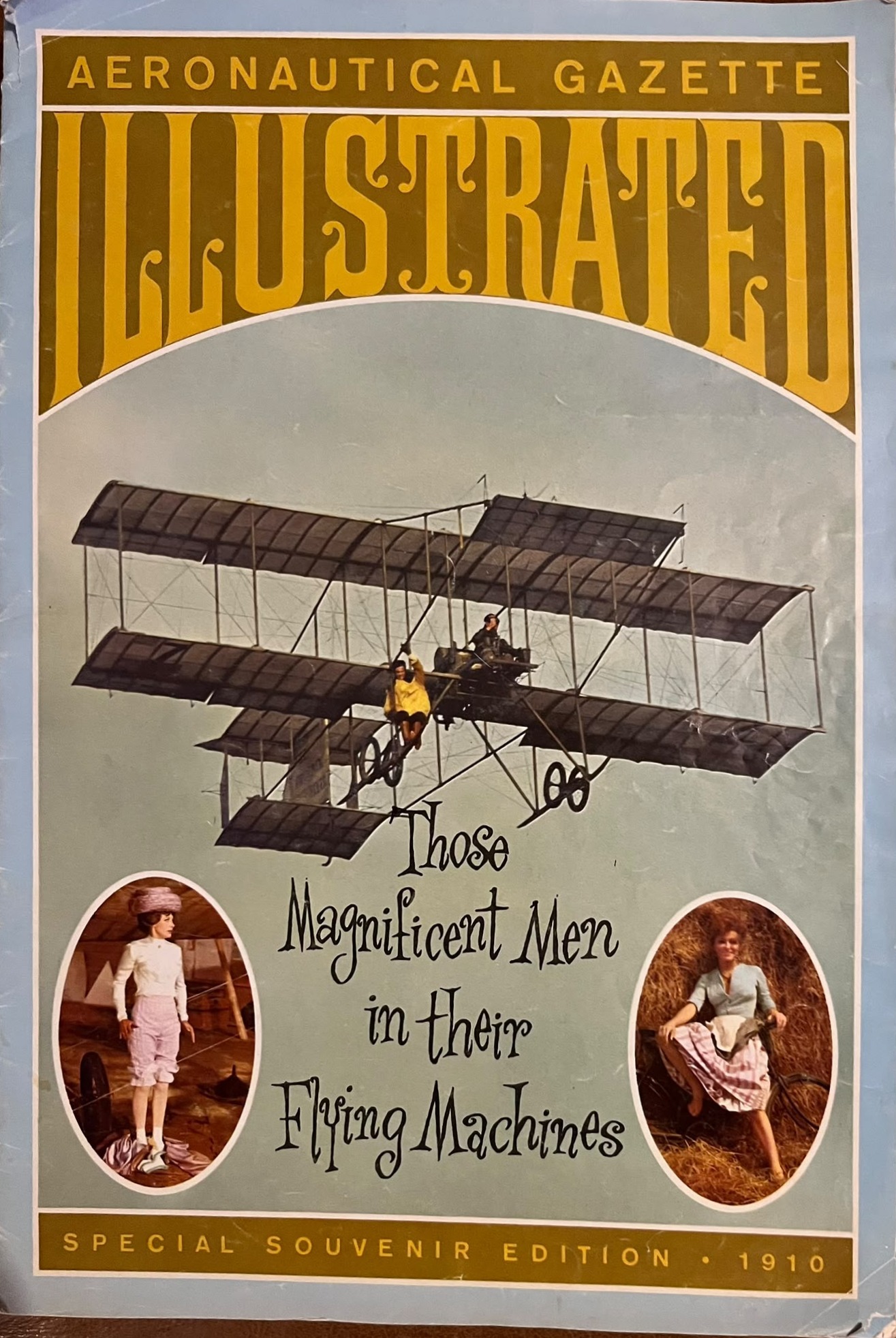
Colour brochure to support the film, in the style of an Edwardian magazine, 1965
The stories behind the artifact
‘Those Magnificent Men in their Flying Machines or How I Flew from London to Paris in 25 Hours and 11 Minutes’, is a 1965 British period comedy film that satirises the early years of aviation. Directed and co-written by Ken Annakin, the film stars an international ensemble cast, including Stuart Whitman, Sarah Miles, James Fox, Robert Morley, Eric Sykes and Terry-Thomas. However, the real stars are the reproduction aeroplanes that are the centre of the story.
The film is set in 1910, against a fictitious air race from London to Paris, with a £10,000 (equivalent to £1,000,000 in today’s money) prize set by Lord Rawnsley, (a thinly veiled reference to Lord Northcliffe), with the aim to showcase that Great Britain is "number one in the air". As actually happened in early years air races, the competitors that assembled were a motley assortment from all over the world, with as many national stereotypes thrown in as was acceptable in the 1960’s.
The film's flying scenes featured dozens of period-accurate, life-sized working aeroplanes. It was shot in 65 mm Todd-AO by cinematographer Christopher Challis, and features a film score composed by Ron Goodwin.
Released in the United Kingdom by 20th Century-Fox on 16th June 1965, the film was both a widespread critical and commercial success. It was nominated for three BAFTA Awards, winning for Best British Costume Design – Colour, as well as an Academy Award nomination for Best Original Screenplay. The film also received three Golden Globe Award nominations, including for Best Motion Picture – Musical or Comedy.
Ken Annakin was adamant that the aeroplanes should not only be central to the story, threading the sub plots together, but also as authentic and accurate as possible. The filming schedule allowed only six months for the creation of the replica aircraft, and not only that, they would also be required to take to the air. Ordinarily this would have been a daunting task for any film crew, however to make replicas of Edwardian aeroplanes, when powered flight was only a few years in the making, doubly so. Also, five aeroplanes would be required, and for aesthetic reasons should be totally different to each other and as diverse as possible, and also as ungainly as possible to add to the comedic effect of the film.
These five aircraft were: a Latham Antoinette monoplane, an Avro triplane Mk. IV, an Eardley Billing biplane, a Bristol Boxkite, and a Santos Dumont Demoiselle monoplane. The only major concession for filming, reliability and safety reasons, was that modern aero-engines be fitted of sufficient power, and suitably camouflaged with props and camera angles. Some innovations in the controls were also made after the flying and filming began, to obtain better results and responses from the aeroplanes. Air Commodore Allen Wheeler, who at the time was director of the Shuttleworth Trust, with his experience was appointed to supervise the production and flying of the aircraft. He appointed several individuals or companies with relevant experience to oversee the individual aeroplanes; the Hants & Sussex Aviation Co. to look after the Antoinette; the Hampshire Aero Club were responsible for the Avro; Harold Best-Devereux for the Billing; F.G. Miles Engineering Co. Ltd to look after the Bristol; and Personal Plane Services for the Demoiselle.
Other aeroplanes that were used in the film flying services were the Vickers 22, which was a Bleriot type monoplane; this had been built previously by Doug Bianchi of Personal Plane Services, who were baby-sitting the Santos Dumont; and both the Deperdussin and Blackburn monoplanes that were owned by the Shuttleworth Trust.
There was also a collection of aircraft, contemporary to the Edwardian era and designed to highlight the pioneer and unconventional nature of early flight, when several design concepts were being explored. Full scale non-flying replicas were built, and were even seen to ‘fly’ with the assistance of clever camera angles and a set of overhead cables. These included the Phillips Multiplane (a twenty wing ‘Venetian-blind’ type made by Personal Plane Services), the Dixon nipper (a tail-first aircraft made by Denton & Partners); the Edwards Rhomboidal biplane (by Airgeneers); the Passat Ornithopter (aptly made by Westland, the helicopter manufacturer); the Lee Richards Annular biplane (again from Dentons) and the Picat Dudreuil monoplane (again from the Shuttleworth Trust.)
The aeroplanes were used to create an early-20th-century airfield at the Brookley Motor Racing Track (which ironically was fashioned after Brooklands, where early automotive racing and aviators shared the facilities for testing). All of Brookley's associated trappings of structures, aircraft, and vehicles (including a rare 1907 Rolls-Royce Silver Ghost, subsequently estimated to be worth US$50 million) were part of the exterior set at Booker Airfield, High Wycombe, Buckinghamshire.
(This airfield was also used a few years later to film Aces High, and an article on which is available elsewhere on this site.)
The completed set featured a windmill as a lookout tower, as well as serving as a restaurant (the "Old Mill Cafe"). A circular, banked track was also built and featured in a runaway motorcycle sequence in the film. In addition, the field adjacent to the windmill was used as the location for a number of aerial close-up shots of the pilots. Hangars were constructed in rows, bearing the names of real and fictional manufacturers: A.V. Roe & Co., Bristol: The British and Colonial Aeroplane Company, Humber, three Sopwith hangars, Vickers. The fictional company name was Ware-Armitage Manufacturing Co (a British in-joke, as Armitage Ware was the UK's largest manufacturer of toilets and urinals). A grandstand was added for spectators.
Wheeler insisted on authentic materials, but as already stated, allowed the use of modern engines and modifications necessary to ensure safety. Of the 20 types built in 1964 at a cost of £5,000 each, six could fly, flown by six stunt pilots and maintained by 14 mechanics. The race take-off scene where seven aircraft are in the air at once included a composite addition of one aircraft. Flying conditions were monitored carefully, with aerial scenes filmed before 10 am or in early evening when the air was least turbulent, as the replicas, true to the originals, were flimsy, and control, especially in the lateral plane, tended to be marginal. When weather conditions were poor, interiors or other incidental sequences were shot, instead. Wheeler eventually served not only as the technical adviser, but also as the aerial supervisor throughout the production, and later wrote a comprehensive background account of the film and the replicas that were constructed to portray period aircraft. Whilst each aircraft was an accurate reproduction, some "impersonated" other types. For instance, The Phoenix Flyer was a Bristol Boxkite built by F.G. Miles Engineering Co. at Ford, Sussex; but was actually representing a Curtiss biplane of 1910 vintage. Annakin had apparently expressed a desire to have a Wright Flyer in the film. The Bristol (a British derivative of the French 1909 Farman biplane) was chosen instead, because it shared a common general layout with a Wright or Curtiss pusher biplane of the era, and had an excellent reputation for stability, important when being filmed, especially in close up. For the impersonation, the replica had "The Phoenix Flyer" painted on its outer rudder surfaces and was also called a "Gruber-Newton Flyer" adding the name of its primary backer to the nomenclature; although the American pilot character, Orvil Newton (Whitman) inaccurately describes his aircraft to Patricia Rawnsley (Miles) as a "Curtiss with an Anzani engine."
F. G. Miles, chiefly responsible for its design and manufacture, built the replica Bristol Boxkite with the original standard twin rudder installation and powered the replica with a Rolls-Royce- manufactured version of the 65 hp Continental A65. In the course of testing, Wheeler had a third rudder inserted between the other two (some original Boxkites also had this fitting) to improve directional control, and substituted a more powerful 90 hp Rolls-Royce C90 that still barely delivered the power of the original 50 hp Gnome rotary at the power settings used for the Boxkite. The replica achieved a 45mph top speed. The Boxkite was tractable, however, and the scene in the film when the aircraft loses a pair of main wheels just after takeoff but lands smoothly, was repeated 20 times for the cameras. In the penultimate flying scene, a stuntman was carried in the Boxkite's undercarriage and carried out a fall and roll (the stunt had to be repeated to match the principal actor's roll and revival). Slapstick stunts on the ground and in the air were a major element and often the directors requested repeated stunts; the stuntmen were more than accommodating; it meant more pay.
The Eardley Billing Tractor Biplane replica flown by David Watson appeared in two guises, in more or less authentic form, impersonating an early German tractor biplane, and also as the Japanese pilot Yamamoto (Ishihara)'s mount, modified with boxkite-like side curtains over the interplane struts, a covered fuselage, and colourful "oriental" decorations.
The artifact itself is really nice. Printed as soft cover film promotion brochure, in the style of an Edwardian programme, as a fictitious magazine ‘Aeronautical Gazette Illustrated. It is full of full colour images, the first pages dedicated to the aviators (and actors portraying them) with full colour pictures of their aeroplanes, and a text ‘back story.’ A centrefold portraying the Great Rescue, the air to air action sequence from the film. Ladies of fashion, showing Sarah Miles and Zena Marshall in their Edwardian splendour. A page entitled Recognition Dept. which is in essence the cast and production credits. Another page entitled Inspiration Dept. with a large photo and profiles of producer Stan Margulies, Annakin, and Jack Davies, who collaborated with Annakin on the screenplay.
There is a two-page commemorative souvenir Art Portfolio, which is actually a set of 9 colour sketches by Ronald Searle, showing the main aviators. He also drew the animated opening, intermission and closing credits, which did much to set the tone for the film.
Searle published the first St Trinian's cartoon in 1941, but then became a prisoner of war, and his vivid documentation of the brutal camp conditions of his period after his capture by the Japanese in World War II in a series of drawings that he hid under the mattresses of prisoners dying of cholera. Searle recalled, "I desperately wanted to put down what was happening, because I thought if by any chance there was a record, even if I died, someone might find it and know what went on." But Searle survived, along with approximately 300 of his drawings. During the 1950’s and 60’s he penned several film credits, including Monte Carlo or Bust.
The back inside cover is a fictitious History of Flight article showing Red Skelton, who played the character down through the ages that was obsessed with flight. And finally the back cover is a supposed offer of the £10,000 Prize by Lord Rawnsley, the premise on which the film is built.
Leave a Reply