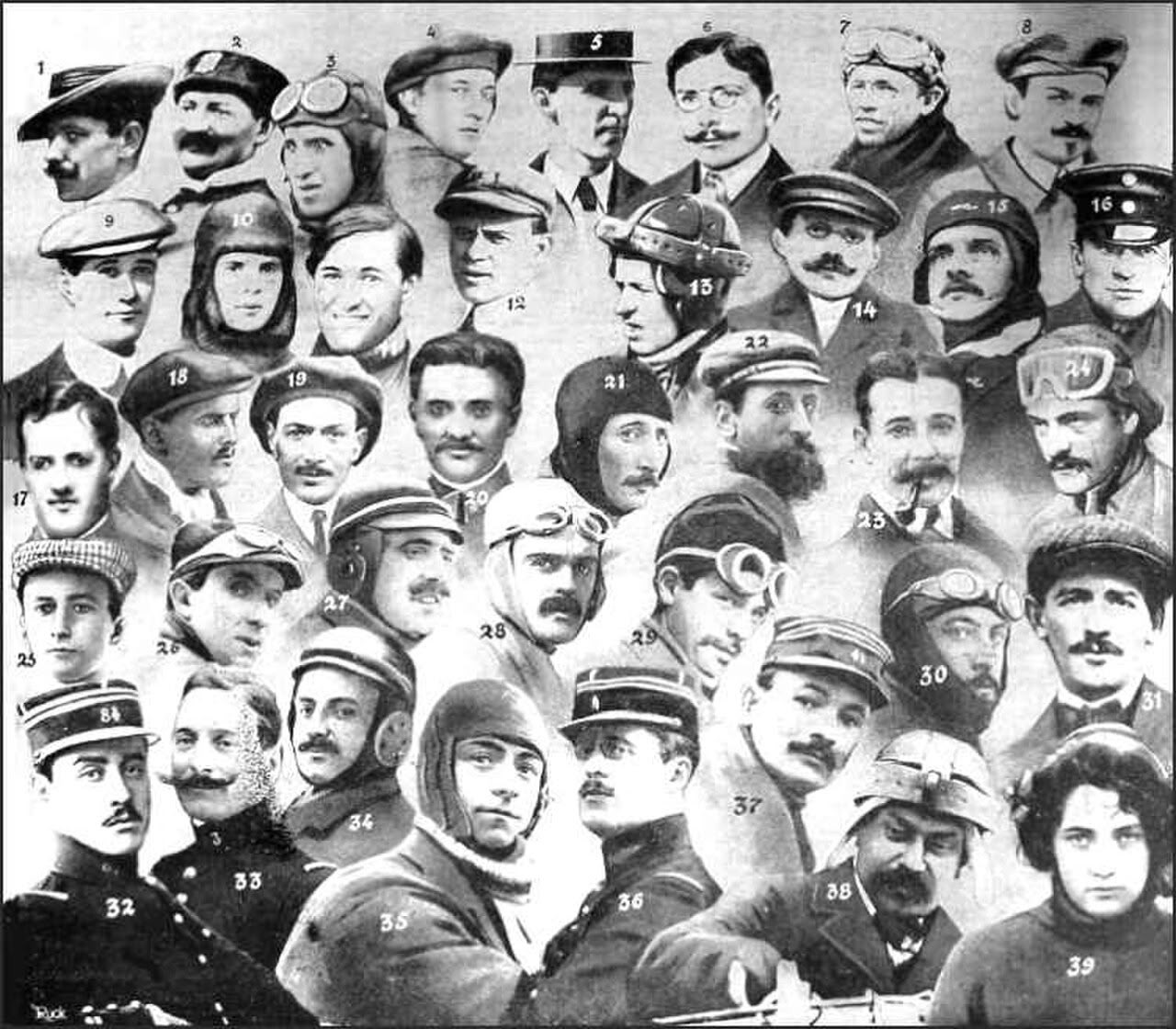
A non-comprehensive list of aviation pioneers, some you will know, some you will not
| Name | Dates | Country (worked) | Pioneer | Achievements |
|---|---|---|---|---|
| Clément Ader | 4th Feb 1841 5th Mar 1925 | France | Science Design Construction Manufacture Aviator | First brief uncontrolled powered flight (“hop”) for 50 m), 20 cm from the ground in steam- powered Éole (9th Oct 1890), designed, constructed and tested Ader Avion II (1893) and Ader Avion III (14th Oct 1897). |
| Diego Marín Aguilera | 1757 1799 | Spain | Science Design Construction | Reportedly glided c. 400 m distance at c. 5 m height using his own invention (15th May 1793). |
| John Alcock† and Arthur Brown | 5th Nov 1892 18th Dec 1919 and 23rd Jul 1886 4th Oct 1948 | England (Great Britain) Scotland (Great Britain) | Aviator | First non-stop transatlantic flight in a modified Vickers Vimy (14/15th June 1919); (†) Vickers Viking, Rouen, France |
| Aldasoro brothers Juan Pablo and Eduardo | 14th Sep 1893 4th Oct 1962 and 27th Oct 1894 10th Nov 1968 | Mexico | Science Design Construction | First Mexican aviators to graduate from the Moissant School; Juan Pablo was the first to fly over the Statue of Liberty (12th Mar 1913). They also contributed to improve aerodynamics by designing a "thick wing" long before other inventors. |
| Ismail ibn Hammad al- Jawhari† | unknown c. 1005 | Kazakhstan | Design Construction Aviator | (†) attempted flight from the roof of the Nishapur Mosque in Khorosan (c. 1005). |
| Feng Ru† | 12th Oct 1883 25th Aug 1912 | China (United States, China) | Design Construction Aviator | Often called the "Father of Chinese Aviation", Feng Ru designed, built, and flew the first Chinese-made airplane in Oakland, California in 1909. He returned to China in 1911 to support the Xinhai Revolution, where he continued aircraft development. (†) Died in an air accident during a demonstration flight in Guangzhou, China, in 1912. |
| Frederick W. "Casey" Baldwin | 2nd Jan 1882 7th Aug 1948 | Canada | Design Construction Manufacture Aviator | Chief Engineer, Aerial Experiment Association (1907–09); first powered flight by a Canadian in the Red Wing (12 Mar 1909); co- designer Red Wing (1908), White Wing (1908), and Silver Dart (1909); with J.A.D. McCurdy (ormed the Canadian Aerodrome Company (1909), Canada's first aircraft manufacturing company. |
| Juan de la Cierva | 21st Sep 1895 9th Dec 1936 | Spain | Aviator and aeronautical engineer | Invented the autogyro (9th Jan 1923). De la Cierva's flapping hinge overcame the problems of early rotor-winged flight. |
| Alexander Graham Bell | 3rd Mar 1847 2nd Aug 1922 | Scoland (United States) (Canada) | Science Design Construction Support | Founder and chair, Canadian- American aeronautical research group Aerial Experiment Association (AEA) (30th Sep 1907 – 31st Mar 1909); in 1908 and 1909, the AEA designed, constructed, and flew four powered aircraft: the Red Wing, White Wing, June Bug, and Silver Dart. |
| Mabel Bell | 25th Nov 1857 3rd Jan 1923 | United States (United States) (Canada) | Support | Financial sponsorship, Aerial Experiment Association (1907– 09). |
| Giuseppe Mario Bellanca | 19th Mar 1886 26th Dec 1960 | Italy (Italy) (United States) | Design Construction Manufacture | Bellanca Flying School (1912–16); designed first enclosed monoplane cabin (1917); founded Bellanca Aircraft Company (1927). |
| Oskar Bider† | 12th Jul 1891 7th Jul 1919 | Switzerland | Aviator Support | First crossing of the Pyrenees (24th Jan 1913); Swiss airmail flight (9th Mar 1913); first crossing of the Alps (13th May 1913); (†) Nieuport 21, Dübendorf, Switzerland. |
| Louis Blériot | 1st Jul 1872 1st Aug 1936 | France | Design Construction Manufacture Aviator | First airplane (Blériot VII) with a modern layout : monoplane, conventional tail, fully covered fuselage, front propeller / enclosed engine (1907. First to use a combination of hand/arm- operated joystick and foot- operated rudder control.] First heavier-than-air crossing of the English Channel in a Blériot XI (25th Jul 1909). First actual industrial aircraft manufacturer – By the end of September 1909, orders had been received for 103 Blériot type XI. |
| Herbert G. Brackley | 4th Oct 1894 15th Nov 1948 | England United States Japan | Aviator | First flight from Newfoundland to New York (1919); organised the Japanese Naval Air Arm (1921- 1924); first Air Superintendent of Imperial Airways (1924) |
| Eduardo Bradley | 9th Apr 1887 3rd Jun 1951 | Argentina | Design Construction Aviator | First crossing of the Andes in a (coal gas-filled) balloon (24th Jun 1916); set numerous ballooning records: duration (28 hours 10 minutes); distance 900 km (559 mi). |
| Marcel Brindejonc des Moulinais† | 18th Feb 1892 18th Aug 1916 | France | Aviator | Finished first in the Geisler Challenge Trophy (1913); long distance champion ; (†), Vadelaincourt, France (shot down). |
| Artur de Sacadura Cabral† | 23rd May 1881 15th Nov 1924 | Portugal | Aviator | Director, Naval Aviation Services (1918); first aerial crossing of the South Atlantic with Gago Coutinho using a Fairey III-D (30th Mar – 17th Jun 1922); († disappeared) , English Channel crossing. |
| George Cayley | 27th Dec 1773 15th Dec 1857 | England | Science Design Construction | Experimented in aeronautics at age 13 with a Chinese top (1796); first design of a fixed-wing aircraft (1799); used a whirling arm to test aerofoils at varying angles (1804); presented a paper outlining specific design parameters for building a glider (1810);] designed, constructed, and had flown (short hop) a tri- plane (1849). |
| Giuseppe Cei† | 25th Jan 1889 28th Mar 1911 | Italy (Italy) (France) | Aviator | Flew around the Eiffel tower (19th Mar 1911); (†) (Bleriot airplane), near Puteaux, France. |
| Hezârfen Ahmed Çelebi | 1609 1640 | Turkey | Design Construction Aviator | Reportedly achieved sustained unpowered flight for 3.36 km (2 mi) (c. 1638). |
| Lagari Hasan Çelebi | 17th century | Turkey | Design Construction Aviator | Reported to have achieved flight (20 seconds to an elevation of roughly 300 meters) using a winged rocket powered by gunpowder (c. 1630s). |
| Henri Coandă | 7th Jun 1886 25th Nov 1972 | Romania (France) (Great Britain) (Romania) | Science Design Construction | Designed Coandă-1910 with a propeller-less aero-reactive engine, exhibited Paris Air Show (Oct 1910), followed by a claimed but generally discounted first flight (16th Dec 1910); designed the Bristol-Coanda Monoplanes in Great Britain; discovered Coandă effect (1930). |
| Samuel Franklin Cody† | 6th Mar 1867 7th Aug 1913 | United States (United States) (Great Britain) | Design Construction Aviator | Developed and flew human-lifting kites; kite instructor for the Royal Engineers (1904); aided development of the British Army Dirigible No 1 Nulli Secundus (1907); first flight of a piloted airplane in Great Britain (16th Oct 1908, 1,390 ft); issued Royal Aero Club certificate No.10 (14th Jun 1910); (†) Cody Floatplane, with passenger William Evans, Aldershot, England. |
| Alfred Comte | 4th Jun 1895 1st Nov 1965 | Switzerland | Design Manufacture | Swiss pilot's licence (1908); partner and chief pilot Ad Astra Aero (1920); designed and built aircraft (1923–35) |
| Gago Coutinho | 17th Feb 1869 18th Feb 1959 | Portugal | Aviator | First aerial crossing of the South Atlantic using a Fairey III-D with Artur de Sacadura Cabral (30th Mar – 17th Jun 1922); developed a sextant-type instrument to create an artificial horizon. |
| Glenn Curtiss | 21st May 1878 23rd Jul 1930 | United States (United States) (Canada) | Design Construction Manufacture Aviator | Director of Experiments, Aerial Experiment Association (1907– 09); designed the June Bug (1908) and won the Scientific American Trophy (4th Jul 1908) by making the first official one- kilometre flight in North America; co-designer Red Wing (1908), White Wing (1908), and Silver Dart (1909); founded his own company (1909) which became the Curtiss Aeroplane and Motor Company (1916); designed, built, and flew the first successful flying-boat (12th Jan 1912); established Canada's first aviation training school in Toronto (1915); awarded the Langley Gold Medal (1913). |
| Giacomo D'Angelis | 1844 unknown | France (India) | Design Construction Aviator | First reported flight in Asia (Madras, India) (10th Mar 1910) in a self-constructed biplane. |
| Félix du Temple | 18th Jul 1823 4th Nov 1890 | France | Science(?) Design Construction Aviator | With his brother, built a monoplane which (accelerating down a slope) “staggered briefly into the air” (1874), considered by some to be the first powered take-off] or hop of a powered fixed-wing aircraft. |
| Bertram Dickson | 21st Dec 1873 28th Sep 1913 | United Kingdom | Aviator | First British serviceman to fly [1910]; gained Aero-Club de France licence no. 81 on 12th April. Dickson took part in the Lanark flying meet in August 1910, where he won the £400 prize for the greatest aggregate distance flown. (†) died 1913 of injuries from 1910 midair collision |
| Armand Dufaux and Henri Dufaux | 13th Jan 1883 17th Jul 1941 and 18th Sep 1879 25th Dec 1980 | Switzerland | Design Construction Aviator | Working together patented a design for a helicopter (1904), constructed and demonstrated a working model (13–17th Apr 1905); designed and built the first Swiss airplanes, including the biplane Dufaux 4 and Dufaux 5; Armand set a new over-water distance record of 66 km (41 mi) crossing Lake Geneva (28th Aug 1910). |
| J. W. Dunne | 1875 24th Aug 1949 | Ireland | Science Design Construction Aviator | Discussed aeronautics and aviation with H.G. Wells (c. 1901); member Royal Engineers, working on design and construction of the first British military airplane (1906–08); in secret military trials, and with a career goal of improving stability during flight, Dunne's aircraft flew approximately 40 metres (1908);] development of his V-shaped swept wing design. |
| Amelia Earhart† | 24th Jul 1897 7th Jul 1937 | United States | Aviator Support | First female aviator to fly solo across the Atlantic Ocean and set many other records; she was one of the first aviators to promote commercial air travel, wrote best- selling books about her flying experiences, and was instrumental in the formation of The Ninety-Nines, an organization for female pilots. (†) disappeared during a flight on a Lockheed Electra 10E from Lae Airfield to Howland Island. |
| Eilmer of Malmesbury | c. 984 | unknown | Design Construction Aviator | Reportedly flew 200 metres from a tower using rigid wings (c. 1005). |
| Eugene Ely† | 21st Oct 1886 19th Oct 1911 | United States | Aviator | First airplane (Curtiss Model D) take-off from a ship (USS Birmingham (14th Nov 1910); first landing (Curtiss Model D) on a ship (USS Pennsylvania) using a tailhook (18th Jan 1911); (†) , Macon, Georgia, flight exhibition. |
| August Euler | 20th Nov 1868 1st Jul 1957 | Germany | Design Manufacture Aviator | Built Voisin Freres aircraft (1908); first German pilot's license (1909); German flight duration record (3hr 6min 18sec) (1910). |
| Ernest Failloubaz | 27th Jul 1892 14th May 1919 | Switzerland | Construction Aviator Support | Constructed and piloted the first aircraft in Switzerland (10 May 1910); first Swiss pilot's licence (10th Oct 1910). |
| Henry Farman | 26th May 1874 17th Jul 1958 | France | Design Construction Manufacture Aviator | Winner (in the Voisin-Farman No.1) of the Deutsch-Archdeacon Prize (13th Jan 1908); with brothers Richard and Maurice founded Farman Aviation Works (1908). |
| Ferdinand Ferber† | 8th Feb 1862 22nd Sep 1909 | France | Design Construction Aviator Support | Attempted (unsuccessfully) to replicate the Wright 1901 Glider from photographs; designed a series of aircraft (Ferber I through Ferber IX) for the Antoinette Company; designed, constructed, and flew the first tractor configuration biplane (May 1905); (†) Voisin biplane, Boulogne, France. |
| Anton “Anthony” Fokker | 6th Apr 1890 23rd Dec 1939 | Dutch East Indies (Germany) (Netherlands) (United States) | Design Construction Manufacture Aviator(?) | Designed, built, and flew the "Spin" (31st Aug 1911); involved with the Luftstreitkräfte during WWI; constructed a machine gun synchronizer (22nd Apr 1915), leading to an aviation period known as the Fokker Scourge; founded the US-based Atlantic Aircraft Corporation (1924) |
| Gerrit Johannes Geysendorffer | 1st April 1892 26th Jan 1947 | Netherlands | Aviator | First Dutch licensed airline transport pilot (1921); awarded the 1926 Harmon National Trophy for the Netherlands; captain of the first intercontinental charter flight (1927). |
| Lyman Gilmore Jr | 11th Jun 1874 18th Feb 1951 | United States | Design Construction | (Based largely on self-report and a 1936 interview) Tethered glider flight (1893); free glider flight (1894); (claimed in 1927) controlled steam-powered aircraft flight (15 May 1902); all records, papers, and aircraft were destroyed in a fire; opened first commercial airfield (15th Mar 1907). |
| Tryggve Gran | 20th Jan 1888 8th Jan 1980 | Norway Great Britain | Aviator | First flight across the North Sea (30th Jul 1914), four hours ten minutes from Cruden Bay, Scotland to Klep (near Stavanger), Norway in a Blériot monoplane. |
| René Grandjean | 12 Nov 1884 14 Apr 1963 | Switzerland | Design Construction Aviator | Designed and built aircraft for Ernest Failloubaz and his record- setting flight (1910); first snow take off and landing using skis (2nd Feb 1912); first water take off in a Swiss seaplane (4th Aug 1912). |
| Andrea Grimaldi | c. 1701 | Italy | Design Construction | Italian monk reported to have flown from Calais to London in a bird-shaped airship with a 22-foot wingspan (Oct 1751). |
| Patrick Hamilton† | 3rd Jun 1882 6th Sep 1912 | Great Britain | Aviator | Early aviator, joined Royal Flying Corps ((†) when the Deperdussin Monoplane he was flying with his observer Athole Wyness-Stuart from Wallingford to Hitchin, England, crashed. |
| Lawrence Hargrave | 29th Jan 1850 6th July 1915 | United Kingdom (Australia) | Science Design Construction Aviator | Invented the Box Kite (1893), greatly improving lift to drag ratio. Reached lift of 16 feet under a train of four of his box kites (1894). Invented a rotary engine (1889), which was much used in early aviation. |
| Augustus Moore Herring | 3rd Aug 1867 17th Jul 1926 | United States | Design Construction | Assisted S.P. Langley (May – Nov 1895); test pilot for Octave Chanute; designed the Herring regulator; designed and constructed a compressed-air motorized biplane and reported a 15-metre hop (10th Oct 1898) and a 22-meter hop (12 Oct 1898); business partner with Glenn Curtiss (1909). |
| Howard Hughes | 24th Dec 1905 5th Apr 1976 | United States | Design Manufacture Aviator Support | Producer of film Hells Angels (1930); founded Hughes Aircraft (1932); set record for flying around the world (91 hours) in a Lockheed Super Electra (1938); received the Congressional Gold Medal (1939) for achievements in aviation. |
| Vecihi Hürkuş | 6th Jan 1895 16th Jul 1969 | Turkey | Design Construction Aviator | Constructed and flew (15 minutes) the first airplane in Turkey (Vecihi K-VI) (28th Jan 1925); founded Turkey's first flying school (27 Sep 1932). |
| Abbas Ibn Firnas | 810 887 | Spain | Design Construction Aviator | A 9th-century polymath covered himself with feathers and wings, and “flew faster than the phoenix in his flight when he dressed his body in the feathers of a vulture” (c. 875). |
| Karl Jatho | 3rd Feb 1873 8th Dec 1933 | Germany | Design Construction Aviator | Made an “aerial leap” (18 metres) in a powered airplane (18th Aug 1903); |
| Hugo Junkers | 3rd Feb 1859 3rd Feb 1935 | Germany | Science Design Construction Manufacture | Engineer, thermodynamicist, pioneer developer of practical all- metal airframe structures, first used in the 1915-16 Junkers J 1, using all-cantilever structural concepts meant to place all strength-bearing components within an airframe's outer envelope and established all- metal aircraft manufacturing techniques. |
| Wilhelm Kress | 29th Jul 1836 24th Feb 1913 | Russia (Austria) | Science Design Construction Aviator | Developed a successful rubber- band powered model of a hang glider (1877); designed aircraft control stick (1900); executed short hops over water in his Drachenflieger (1901). |
| Francesco Lana de Terzi | 1631 1687 | Italy | Science Design | Designed an airship based on the theory of using evacuated metal spheres to create a lighter-than- air vehicle (1670). |
| Samuel Langley | 22nd Aug 1834 27th Feb 1906 | United States | Science Design Construction | Designed and developed the Aerodrome No. 5 as a successful steam engine powered model which flew for 90 seconds covering roughly 3,300 ft (6th May 1896); conversion into a larger piloted aircraft was unsuccessful (1903). |
| Stephen Latchford | 4th Feb 1883 1st Oct 1974 | United States | Science Support | United States diplomat, head of State Department's early aviation committees; aviation specialist during Franklin D. Roosevelt and Harry S. Truman administrations. Also Chairman of United States Section at the International Technical Committee of Aerial Legal Experts. |
| Otto Lilienthal† | 23rd May 1848 10th Aug 1896 | Germany | Science Design Construction Manufacture Aviator | Designed and constructed a monoplane Derwitzer Glider (1891); after nearly 2,000 flights he constructed a two-surfaced glider (1895); (†) Glider crash (9th Aug 1896), Gollenberg, Germany. |
| Charles Lindbergh | 4th Feb 1902 26th Aug 1974 | United States | Aviator Support | First solo non-stop flight across the Atlantic Ocean from New York to Paris in the Spirit of St. Louis (20/21nd May 1927). |
| Mikhail Lomonosov | 19 Nov 1711 15 Apr 1765 | Russian Empire | Science Design Construction | Designed and constructed a model of a coaxial propeller helicopter (Jul 1754) to lift meteorological instruments. |
| Albin K. Longren | 18th Jan 1882 19th Nov 1950 | United States | Aviator Design Manufacture | Early pilot (1911) and barnstormer. Designed and manufactured numerous airplane models including the Longren AK with the first semi-monocoque body. |
| William S. Luckey† | 15th Feb 1875 20th Dec 1915 | United States | Aviator | Began flying at age 52 (1912); Curtiss Exhibition Flyers (1913– 15); winner, Round-Manhattan Race (13th Oct 19130; (†) critically injured (6th Sep 1915) in Sturgeon Falls, ON, Canada. |
| Daniel J. Maloney† | 1879 18th July 1906 | United States | Aviator | American pioneering aviator and test pilot who made the first high- altitude flights by man using Montgomery gliders in 1905. (†) Glider, Santa Clara, California. |
| Hiram Stevens Maxim | 5th Feb 1840 24th Nov 1916 | United States (United Kingdom) | Science Design Construction | Patented a design for a steam- powered “flying machine” (1889, and refined in 1891); successful track-tethered test of a steam- engine powered biplane (Jul 1894); designed and constructed a biplane that never flew (1910) |
| John Alexander Douglas McCurdy | 2nd Aug 1886 25th Jun 1961 | Canada | Design Construction Manufacture Aviator | Treasurer & Assistant Engineer, Aerial Experiment Association (1907–09); first controlled powered flight in Canada "Silver Dart" (23rd Feb 1909; with "Casey" Baldwin (and financial support from Alexander Graham Bell) formed the Canadian Aerodrome Company, Canada's first aircraft manufacturing company. |
| Walter Mittelholzer | 2nd Apr 1894 9th May 1937 | Switzerland | Science Aviator Support(?) | Director and head pilot of Ad Astra Aero, later becoming Swissair; first north-south crossing of Africa (7th Dec 1926 – 21st Feb 1927;] pioneer of aerial photography (Spitsbergen, 1923; Mount Kilimanjaro, 1929; personally flew/delivered a Fokker to Emperor Haile Selassie I (1934). |
| John Joseph Montgomery† | 15th Feb 1858 31st Oct 1911 | United States | Science Design Construction Aviator | Designed and constructed a series of early gliders, first to achieve unpowered controlled flight in the United States (1884). Designed tandem-wing gliders flown from high-altitude balloon launches (1904–1905), including first public flight exhibition in United States (29th April 1905). Developed pitcheron systems for control (first developed and applied in 1886, re-applied in 1911); (†) Glider, Evergreen, California. |
| Edwin Moon† | 8th Jun 1886 29th Apr 1920 | England | Design Construction Aviator | Designed, constructed, and flew a monoplane ("Moonbeam") (early to mid-1910); (†) Flying boat, Felixstowe, England. |
| J. T. C. Moore- Brabazon | 8th Feb 1884 17th May 1964 | England | Aviator | Holder of Royal Aero Club Certificate No. 1. First United Kingdom citizen to make a flight in Britain. |
| Alexander Mozhayskiy | 21st Mar 1825 1st Apr 1890 | Finland | Science Design Construction | Designed and constructed a steam-engine powered airplane that reportedly flew (hopped) (20–30 metres) with the assistance of a ramp (1884). |
| Clyde Pangborn | 28th Oct 1895 29th Mar 1958 | United States | Aviator | First non-stop trans-Pacific flight (5th Oct 1931). |
| Cecil Pashley | 14th May 1891 1969 | Great Britain | Flight trainer Aviator | Founded the South Coast Flying club. Trained British pilots during world War I and World War II. |
| Richard Pearse | 3rd Dec 1877 29th Jul 1953 | New Zealand | Design Construction Aviator | Reportedly achieved powered (but poorly controlled) flight (31st Mar 1903). |
| Horatio Phillips | 1845 1924 | England | Science Design Construction | Aeronautic theory: advancement of wind-tunnel design (1880s), development of aerofoil design, patented as “blades for deflecting air” (1884and 1891); designed multiplanes with multiple sets of lifting surfaces, patented (1890), constructed (1893); first powered “hop-flight” (500 ft) in Great Britain (1907). |
| Percy Pilcher† | 16th Jan 1866 1st Oct 1899 | England | Science Design Construction Aviator | Designed and constructed hang- glider (The Bat), first to achieve unpowered controlled flight in Great Britain (12th Sep 1895); (†) crash-related injuries suffered on 30th Sep 1899, glider (The Hawk), near Stanford Hall, England. |
| John Cyril Porte | 26th Feb 1884 22nd Oct 1919 | Ireland (Ireland) (Great Britain) | Design Construction Manufacture Aviator | Aero Club de France aviator certificate (28th Jul 1911); test pilot (1913–14); began to design and construct (with Glen Curtiss) an aircraft capable of transatlantic flight (1914); testing was successful, but the flight was cancelled due to the outbreak of World War I. Royal Naval Air Service, Squadron Commander, RAF Hendon (1914); secret U.S. visit as an official envoy testing aircraft for the British Government (Sep 1915). Commander, RNAS Airstation Felixstowe, conducted flying-boat research; designed and constructed the Porte Baby (1916). |
| Augustus Post | 25th Dec 1873 4th Oct 1952 | United States | Flying Supporting | Original founder of Aero Club of America which later became the National Aeronautic Association. Thirteenth man to fly solo, in 1908. Served as aid to Glenn Curtiss and co-authored The Curtiss Aviation Book published in 1912. Participated in Aerial Experiment Association. Served as official timer for Orville Wright’s record setting 57 min. flight at Ft. Myer, Virginia on 9th Sep, 1908. |
| Harriet Quimby† | 11th May 1875 1st Jul 1912 | United States | Aviator | Pioneering aviator, journalist, and film screenwriter. In 1911, first woman in the United States to receive a pilot's license; 1912 first woman to fly solo across the English Channel. (†) in the Third Harvard-Boston Air Meet, Harvard Aviation Field, Quincy, Massachusetts, both her and a passenger fell from plane to their deaths. |
| Edvard Rusjan† | 6th Jun 1886 9th Jan 1911 | Austria- Hungary (Slovenia) (Croatia) | Design Construction Aviator | Designed, constructed, and flew the first airplane in Slovenia (25th Nov 1909); (†) , Belgrade, Serbia; first Serbian air exposition. |
| Charles Samson | 8th July 1883 5th Feb 1931 | United Kingdom | Aviator | One of the first four British naval officers to train as a pilot; first to fly an airplane (a Short S.27 biplane) off a moving ship (HMS Hibernia (May 1912); commanded a sqn. Of armoured cars in France 1914. |
| Alberto Santos Dumont | 20th Jul 1873 23rd Jul 1932 | Brazil (France) | Science Design Construction Manufacture Aviator Support | Winner, Deutsch Prize (19th Oct 1901); first powered winged aircraft flight in Europe (13th Sep 1906); winner, Archdeacon Cup (23rd Oct 1906) and Aéro-Club de France Prize (12th Nov 1906); designed a light-weight monoplane Demoiselle and released the second variant (No. 20) from copyright or license (late 1909). |
| Ivan Sarić | 27th Jun 1876 23rd Aug 1966 | Austria- Hungary (Serbia) | Design Construction | First public flight in Serbia (then Austro-Hungary) (16th Oct 1910). |
| Thomas Selfridge† | 8th Feb 1882 17th Sep 1908 | United States (United States) (Canada) | Design Construction Aviator | Secretary, Aerial Experiment Association (1907–09; U.S. Army Lieutenant who assisted the AEA in engineering, designing and piloting the Red Wing; first U.S. Military officer to pilot a powered aircraft White Wing (19 May 1908);[ first fatality of powered flight (17th Sep 1908). |
| Igor Sikorsky | 25th May 1889 26th Oct 1972 | Russian Empire (Russia) (United States) | Science Design Construction Manufacture Aviator | Designed and constructed the first four-engine aircraft, the Russky Vityaz cabin biplane, flew (13th May 1913); and the Ilya Muromets, prototype for a commercial airplane (1914); first brief flight in a practical helicopter (14th Sep 1939). |
| Sir Charles Kingsford Smith† | 9th Feb 1897 8th Nov 1935 | Australia (Great Britain) (United States) (Australia) | Aviator | First transpacific flight from the United States to Australia in the Southern Cross (31st May – 9th Jun 1928); first non-stop Australian transcontinental flight (Aug 1928); first trans-Tasman flight (10/11th Sep 1928); († disappeared) Lady Southern Cross, over the Bay of Bengal. |
| Sir Thomas Sopwith | 18th Jan 1888 27th Jan 1989 | England | Design(?) Construction Manufacture Aviator | Royal Aero Club license No. 31 (22nd Nov 1910); won £4000 Baron de Forest prize for the longest flight from England to the Continent in a British-built aeroplane, (169 miles (272 km) in 3 hours 40 minutes) in a Howard Wright 1910 Biplane (18th Dec 1910); established the Sopwith Aviation Company with Fred Sigrist (1912); and a Sopwith floatplane won the second Schneider Trophy race 1913). The company produced more than 18,000 aircraft during World War I. Post war co-founded Hawker Aircraft. |
| Eduard Spelterini | 2nd Jun 1852 16th Jun 1931 | Switzerland (France) (Switzerland) (Denmark) | Science Aviator | Licensed by the Académie d'Aérostation météorologique de France as a balloon pilot (1877); Swiss pioneer of ballooning and aerial photography; multiple crossings of the Alps; assisted in medical research (1902). |
| Emile Taddéoli† | 8th Mar 1879 24th May 1920 | Switzerland | Design Construction Aviator | Swiss flight certificate No.2 (10th Oct 1910); pioneer of flying boats (SIAI S.13); chief seaplane pilot for Ad Astra Aero; first seaplane crossing of the Alps (12th Jul 1919); (†) (Savoia flying boat) demonstration flight, Romanshorn, Switzerland. |
| Shivkar Bapuji Talpade | 1864 1916 | India | Design Construction | Reportedly launched an unmanned airplane (Marutsakhā) (1895) |
| Czesław Tański | 17th Jul 1862 24th Feb 1942 | Poland | Science Design Construction Aviator | First successful model glider in Poland (1894); first glider flight in Poland (1896); first biplane flight (1911). |
| Nicholas A. Teleshov | 1828 1895 | Russia | Science Design Construction | Received patent (with Gustave de Struve) for a steam-engine powered “flying machine” capable of carrying 120 people (i.e., commercial passenger aircraft) (1864), and for a navigable balloon (1883). |
| E. Lilian Todd | 1865 26th Sep 1937 | United States | Designer Construction | First female aircraft designer (c. 1906). |
| Juan Trippe | 27th Jun 1899 3rd Apr 1981 | United States | Manufacture(?) Support | Founded several airlines including Colonial Air Transport (1926) and the Aviation Corporation of the Americas (1927) which would become Pan American Airways. |
| Jules Védrines† | 21st Dec 1881 21st Apr 1919 | France | Aviator | First pilot to fly at more than 100 miles per hour (160 km/h) (2nd Feb 1912), won Gordon Bennett Trophy race in 1912 flying a Deperdussin Monocoque. (†) St Rambert d'Albon near Lyon en route for Rome flying a Caudron C-23. |
| Alfred V. Verville | 16th Nov 1890 10th Mar 1970 | United States | Design Manufacture Support | Designed the Verville-Packard R-1 (1919), which won the first Pulitzer Speed Trophy (1920); the M-1 Massenger (1921); the Verville-Sperry R-3 (1922), the second aircraft with retractable landing gear (after the Dayton- Wright RB-1 Racer); member, U.S. Navy Bureau of Aeronautics (1946–61). |
| Aurel Vlaicu† | 19th Nov 1882 13th Sep 1913 | Romania | Design Construction Aviator | Designed, built, and flew a glider (1909); a powered airplane Vlaicu Nr. I (17th Jun 1910); (†) Vlaicu Nr. II, near Câmpina, attempting to cross the Carpathian Mountains in flight for the first time. Vlaicu Nr. III, the world's first metal-built aircraft, was under construction at the time of his death, but was completed in early 1914 by his collaborators. |
| Gabriel Voisin | 5th Feb 1880 25th Dec 1973 | France | Design Construction Manufacture Aviator | With brother Charles, built gliders for Ernest Archdeacon (1902); designed and constructed the first French powered aircraft (Voisin 1907 biplane) to achieve sustained controlled flight (1st Oct 1907); founded Appareils d'Aviation Les Frères Voisin, the first aircraft manufacturing company (1906). |
| Traian Vuia | 17th Aug 1872 3rd Sep 1950 | Romania (France) | Design Construction Aviator(?) | Flight in tractor monoplane (France) (6th Mar 1906). |
| Preston Watson† | 17th May 1880 30th Jun 1915 | Scotland | Design Construction Aviator | On the eve of the 50th anniversary of the Wright Brothers’ historic flight (1953) and thirty-eight years after Watson's death, his brother James claimed that Preston had achieved powered flight before the Wrights. He recanted in 1955 stating he had never claimed it was powered flight. |
| Francis Herbert Wenham | 1824 1908 | United Kingdom | Science Constructor | The first scientist to deduce the main properties of cambered aerofoil. Built gliders and with John Browning the world's first wind tunnel in 1871. |
| John Weston | 17th Jun 1872 24th Jul 1950 | South Africa | Design Construction Flying Support | Regarded as "the grandfather of South African aviation” and “South Africa's first aviator”; 1907 to 1909, designed and constructed first aircraft built in South Africa; founder of Aeronautical Society of South Africa (AeSSA); 1911 to 1912, gave numerous flying demonstrations throughout southern Africa to popularise flight. |
| Gustave Whitehead (Weißkopf) | 1st Jan 1874 10th Oct 1927 | Germany (United States) | Design Construction Aviator | Designed and constructed a powered airplane (mid 1901); claims to have made the first (1899), second (14th Aug 1901), and third (17th Jan 1902); controlled powered airplane flights. This claim has long since been in dispute. |
| Jan Wnęk | 1828 10th Jul 1869 | Poland | Design Construction | Allegedly designed, constructed, flew a controllable glider (1866). |
| Wright brothers Orville and Wilbur | 19th Aug 1871 30th Jan 1948 and 16th Apr 1867 30th May 1912 | United States | Science Design Construction Manufacture Aviator Support | Together, designed and constructed biplane kite (1899); invented wing warping for flight control (c. 1899) and the aeronautical concept of three-axis control. Designed and constructed the 1900, 1901, and 1902 Gliders; and the powered 1903 Flyer; used data from systematic wind tunnel testing to design efficient air foils and propellers; first powered, controlled, sustained flight (Orville) for 12 seconds covering 37 metres (17 Dec 1903) and documented; (Wilbur) first complete circle in a powered manned airplane (20th Sep 1904); (Wilbur) Wright Flyer III circular flight of 38.9 km (24 m) (23rd Jun 1905). |
| Czesław Zbierański | 6th Dec 1885 31st May 1982 | Poland (Poland) (United States) | Design Construction Aviator(?) | With Stanislaw Cywiński designed and constructed Poland's first airplane (May 1911), flown (25th Sep 1911). |
Leave a Reply