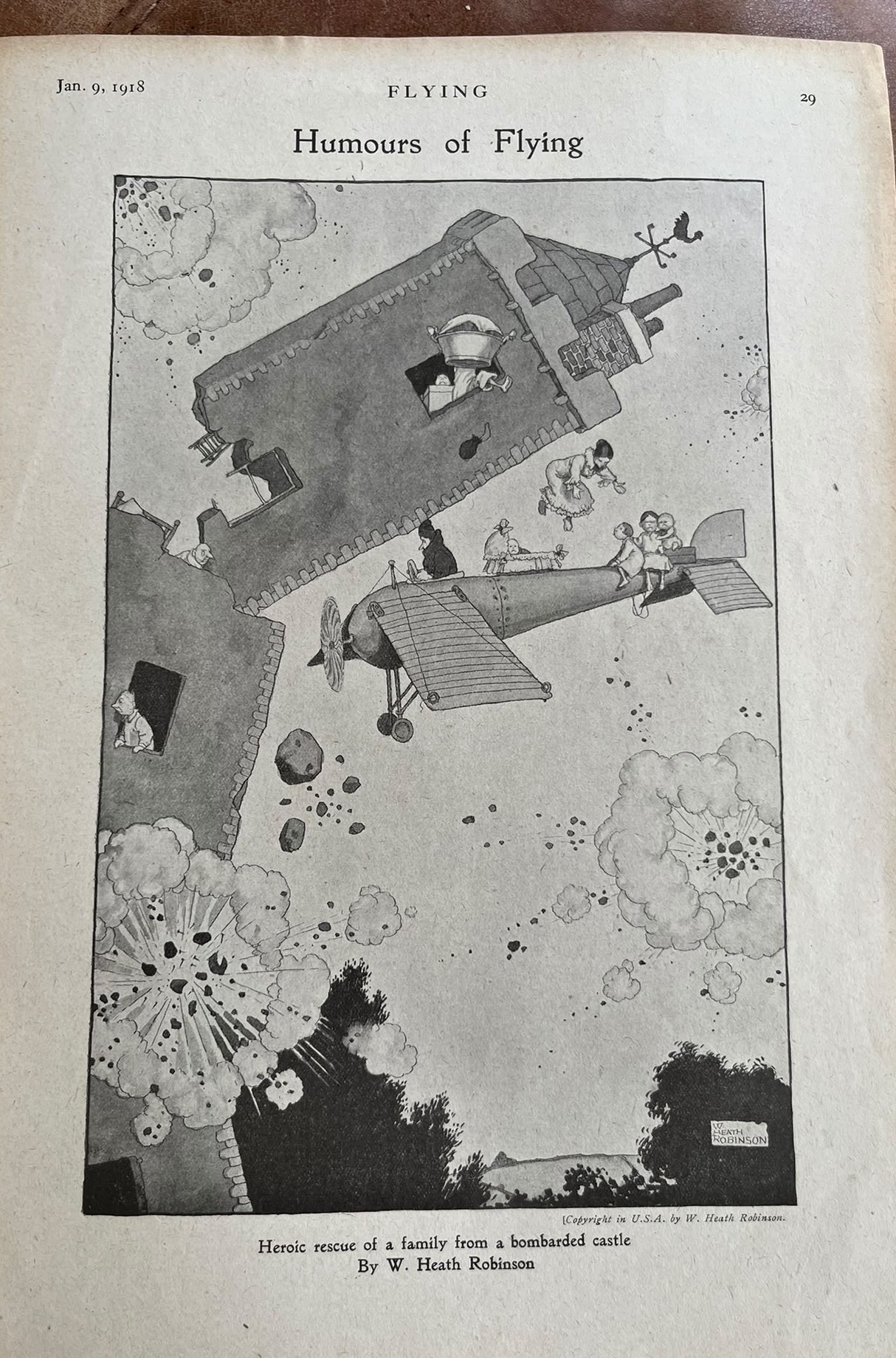
Or ‘Humours of Flying.’
The artifact
A selection of cartoons in Flying newspaper, by W. Heath Robinson, 1918
The stories behind the artifact
The name "Heath Robinson" became part of common parlance in the UK for complex inventions that achieved absurdly simple results, following its use as services slang during the Great War; as innovation and the sudden acceleration in technologies forced sometimes make do solutions. The earliest citation in the Oxford English Dictionary for the use of "Heath Robinson" as a noun describing any unnecessarily complex and implausible contrivance is from 1917. The phrase "Heath Robinson contraption" perhaps most commonly describes temporary fixes using ingenuity and whatever is to hand, often string and tape, or unlikely cannibalisations. Its continuing popularity was likely linked to Britain's shortages during the Second World War and the need to "make do and mend".
William Heath Robinson (31st May 1872 – 13th September 1944) was an English cartoonist, illustrator and artist, who specialised in drawing ever more fantastic, elaborate or even ridiculous and comical inventions, ostensibly to achieve simple objectives.
William Heath Robinson was born in Hornsey Rise, into a family of artists in Stroud Green, near Alexandra palace, in North London, in 1872. His grandfather Thomas, his father Thomas Robinson (1838–1902) and brothers Thomas Heath Robinson (1869–1954) and Charles Robinson (1870–1937) all worked as illustrators. His uncle Charles was an illustrator for The Illustrated London News. His early career involved illustrating books, and Robinson was one of the leading illustrators selected by Percy Bradshaw for inclusion in his The Art of the Illustrator (1917–1918). He served as a consultant at The Press Art School, a school teaching painting, drawing, and illustration by the increasingly popular postal method, known as correspondence courses. The consultants commented on the work submitted by the students. In the course of his work, Robinson wrote and illustrated three children's books, The Adventures of Uncle Lubin (1902), Bill the Minder (1912) and Peter Quip in Search of a Friend (1922). Uncle Lubin is regarded as the start of his career in the depiction of unlikely machines.
In 1903 he married Josephine Latey, the daughter of newspaper editor John Latey. In 1908 the Robinsons moved to Pinner, Middlesex, with their two children, Joan Ida and Oliver John, both born Islington, and where they had Alan Heath and Quentin Thomas. Heath Robinson drew designs and illustrations for local institutions and schools. Heath Robinson was too old to enlist into the armed services; however, he did take on two German POWs to garden after the Armistice. In 1929 the Heath Robinsons returned to London where his two oldest children were now working.
During the Great War, he drew large numbers of cartoons, depicting ever-more-unlikely secret weapons being used by the combatants, and the American Expeditionary Force in France. Amongst these were a number of aviation-themed, which were printed intermittently in ‘Flying’, the weekly newspaper, in 1918.
The machines he drew were not designed to be efficient or factually accurate, but the more unwieldy or unlikely the better. They were frequently powered by steam boilers or kettles, heated by candles or a spirit- lamps and usually kept running by balding, bespectacled men in overalls. There would be complex pulley arrangements, threaded by lengths of knotted string; gear levers connected to multiple rods and other pieces of machinery also figured. Robinson's cartoons were so popular that in Britain the term "Heath Robinson" is used to refer to an improbable, rickety machine barely kept going by incessant tinkering. (The corresponding term in the U.S. is Rube Goldberg, after the American cartoonist born just over a decade later, with an equal devotion to odd machinery. Similar "inventions" have been drawn by cartoonists in many countries, with the Danish Storm Petersen being on par with Robinson and Goldberg.)
At the outbreak of the war in 1914, he wrote:- ‘The much advertised frightfulness and efficiency of the German Army gave me one of the best opportunities I even enjoyed.’ He was prolific in his output, which was a good thing as his work was printed in the Illustrated London News, the Sketch, Bystander and latterly, Flying, which concentrated on his aerial cartoons, of which there were plenty; the public fear of aerial bombardment by the new-fangled terror weapons of the dastardly Hun – the Zeppelin and aeroplane, with their already rickety and fragile construction and image, gave him motivation and scope for numerous sketches.
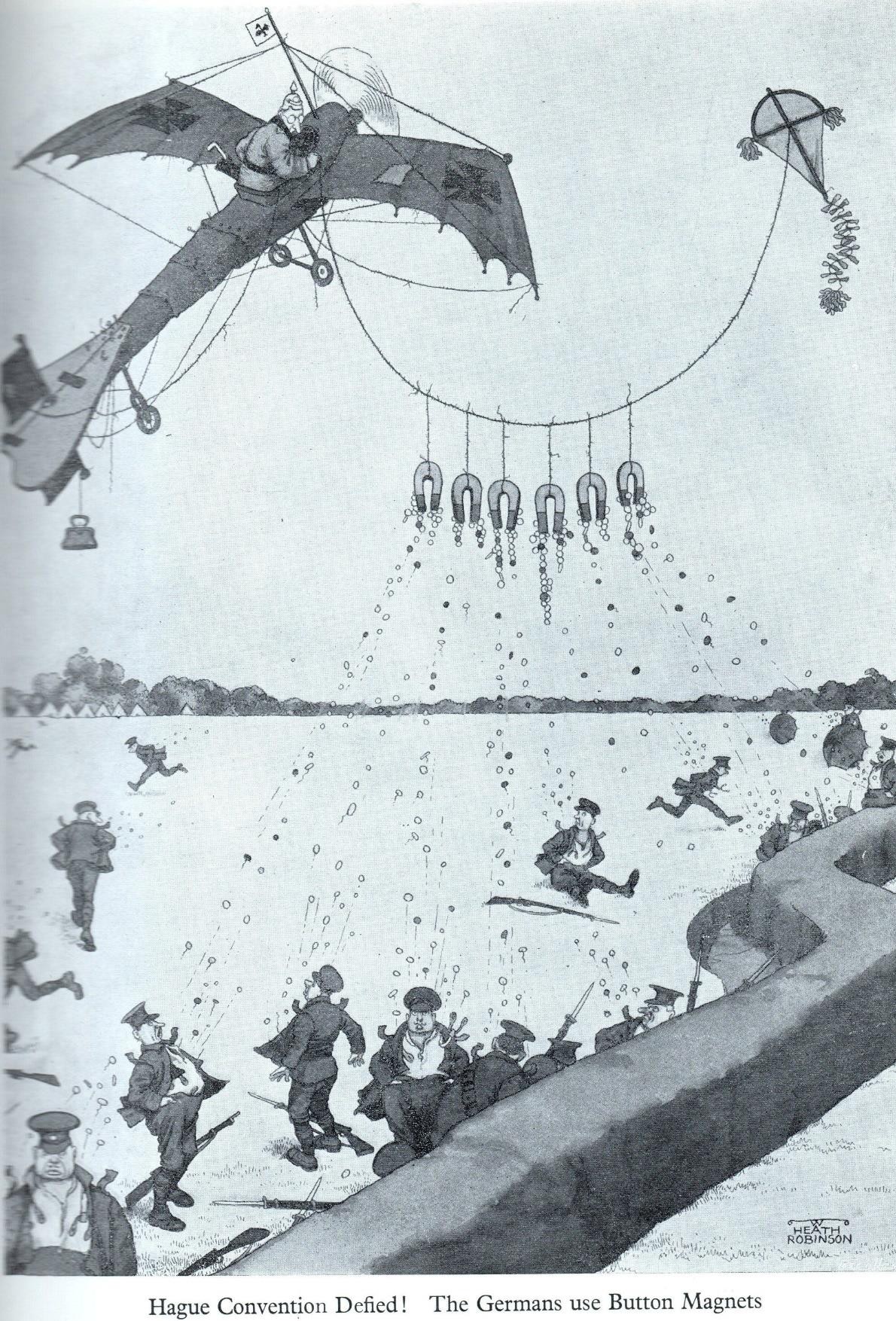
These cartoons and sketches were compiled by the publisher Duckworths of Richmond, and they produced four volumes of his illustrations. These proved so popular they persistently sold out and were reprinted. They were named and published as: Some ‘Frightful’ War Pictures (1915), Hunlikely! (1916), The Saintly Hun: a Book of German Virtues (1917) and Flypapers! (1919).
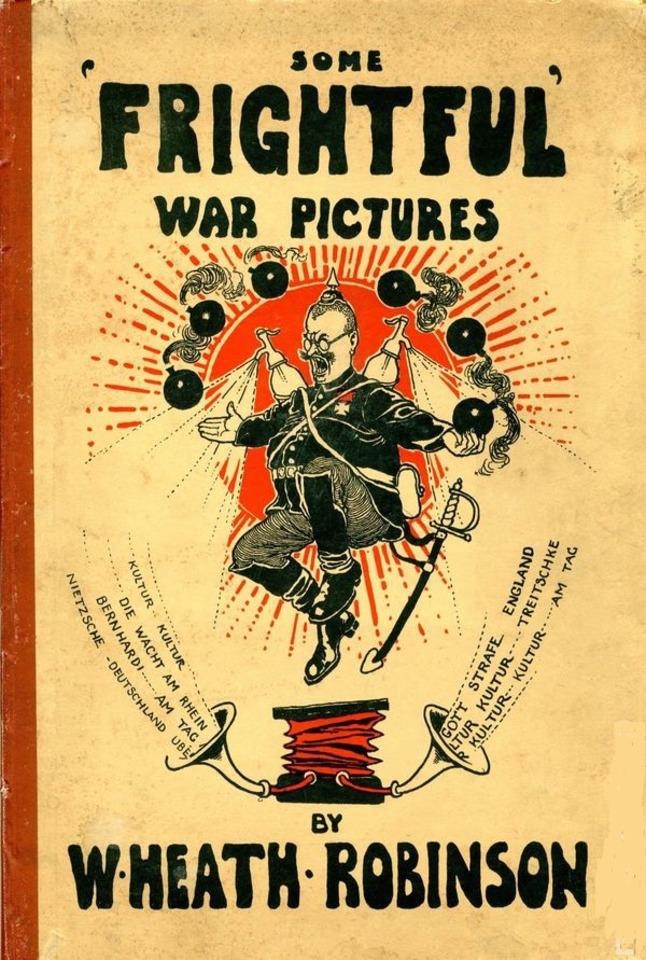
Some ‘Frightful’ War Pictures (1915)
He received fan mail from all over the world, as well as ideas and proposals, some literally on the back of an envelope. Many of those on active service, and especially those stuck in isolated bases away from the delights and distractions of the world, took time to write in their gratitude and the next big thing for him to lampoon.
(There are several articles and artifacts covering RFC/RNAS/RAF official and unofficial gazettes and newsletters on my page).
In 1918, as well as concentrating on aviation cartoons, the American Expeditionary Force offered Heath Robinson a special commission to document their army and air service over in France. Between the wars, he entered the 1932 Olympics. He was again called upon in 1939, and there is a body of work that covers his cartoons early in the war, where a new generation, the sons and daughters of those that served on military and home fronts in the previous ‘war to end all wars’, took great delight in during the hours of boredom in the Phoney War, the Blitz and beyond. However, having three sons in the armed forces, he concentrated on British eccentric inventions rather than lampooning the Germans and their leaders as he felt the Nazis to be too terrible to be portrayed by his sketches.
One of the automatic analysis machines built for Bletchley Park during the Second World War to assist in the decryption of German message traffic was named "Heath Robinson" in his honour. It was a direct predecessor to the Colossus, the world's first programmable digital electronic computer.
In the autumn of 1944 he went into hospital for an exploratory operation, but died on 13 September, and is buried in East Finchley Cemetery.
The spotting table used by the Royal Observer Corps during the Battle of Britain to determine the bearing and altitude of an incoming German raid before calling it in to the sector plotting room was known, affectionately, as "the Heath Robinson."
Leave a Reply