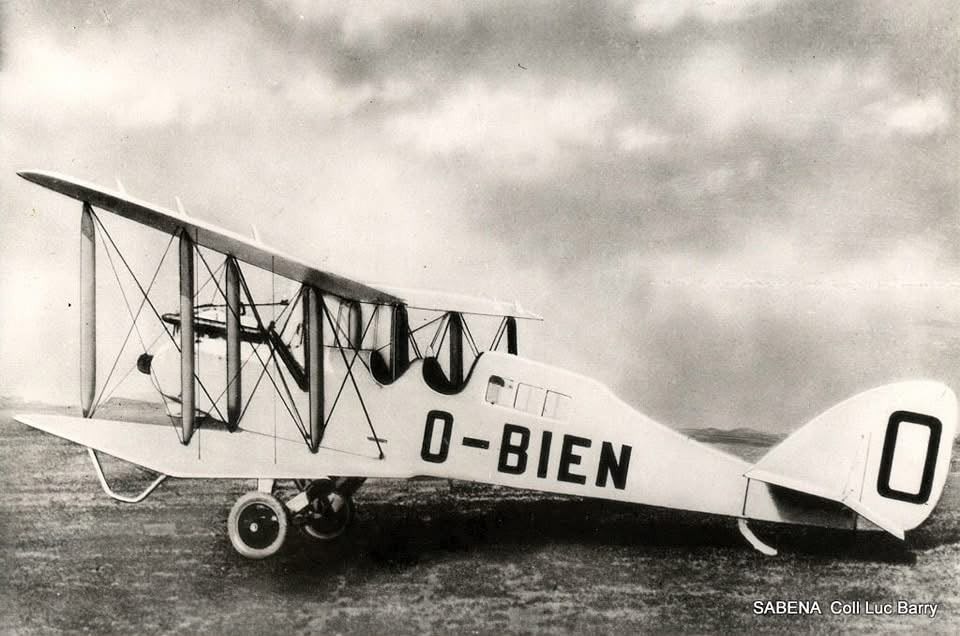
Or the story of Georges Nélis, visionary.
The Société Anonyme Belge d'Exploitation de la Navigation Aérienne (in French, literally translates as 'Belgian Corporation for the Exploitation of Aerial Navigation', in Dutch: Belgische Naamloze Vennootschap tot Exploitatie van het Luchtverkeer), was thankfully for everyone’s sanity, including typists and signwriters, better known by the acronym Sabena, and formed in 1923.
Its origins can be traced back to the Great War. A huge area of Belgium was occupied by the German aggressors from 1914-18, but despite this, had provided a small but mighty air force to the allied war effort, with many of the pilots, if not already household names pre- war, then certainly the poster boys for the Belgian military force during the dark days of war and occupation. There had even been a boys-own style aerial expedition to the Belgian Congo. (This is the subject of another article on this page.)
One of these former poster boys, the fighter ‘ace’ Georges Nélis, was asked by King Albert I to produce a report, which became the 48-page booklet titled "L'expansion Belge par l'aviation" (the expansion of Belgium by air), which was published on 15th January 1919. Nélis foresaw a major role for civil aviation, a progressive idea at the time.
Georges Nélis (22nd May 1886 – 2nd March 1929) was an early Belgian aviation pioneer. He was the first Belgian soldier with a military pilot's licence. He was also founder and director of Sabena, then later SNETA and SABCA, with some justification he is viewed as the "father of Belgian aviation".
After school, Nélis opted for a military career. During his training at the military academy in 1904, he was noticed by General Gerard Leman for his scientific and mathematical insight. Leman became his mentor, and at this time he grew interested in the emerging scientific field of aeronautics and aviation. He was the first (and apparently, only) officer who responded to the call to be trained as a pilot with the Engineers. On the 3rd October, 1910, he was promoted to 1st candidate aviator. General Joseph Hellebaut, although allegedly not a believer in the new invention of the aeroplane as an instrument of war, ordered the "Compagnie des Ouvriers et d'Aérostiers du Génie" to set up a flying school and ordered the purchase of an aircraft.
The aircraft, a French Henri Farman HF.3, was purchased in France, where Nélis travelled to undertake instruction in the operation and flight characteristics of both the aircraft and the engine. Once back in Belgium, he obtained his licence on 21st December, 1910 at the flying school of Jules de Laminne. He became the first Belgian soldier with a military licence.
At the beginning of 1911, the first military airfield in Belgium was established in Brasschaat. This was formed and commanded by Commander Emile Mathieu. Nélis undertook all aspects of the establishments administration, the theory lessons and the supervision of the flight training, which was provided by Pierre Lebon. During this time, Nélis made the first reconnaissance flight and, together with Lebon, the first aerial photographs over Belgium and they participated in the manoeuvres of 1911.
The following year, in 1912, Nélis was appointed chief technician of the flight school. In this position, he experimented with attaching a Lewis machine gun to a Farman. This was the first time any thought of arming the aeroplane with an automatic weapon for offensive or defensive capabilities had been done throughout the whole of Europe, despite all nations sabre rattling and gearing up for the inevitable war.
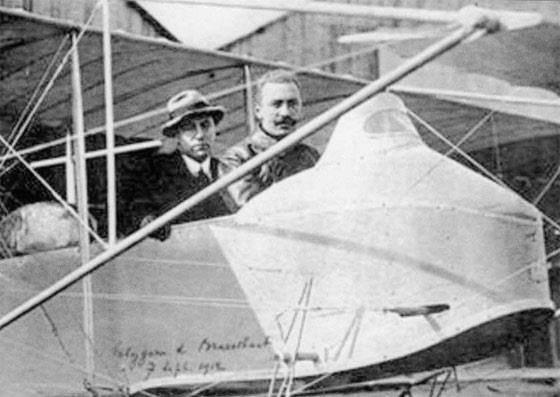
Georges Nélis (right), 7th September, 1912
When the Belgian Air Force – Compagnie des Aviateurs – was founded on 16th April 1913, Nélis was now commander of the flying school in Brasschaat. In this position, Nélis was prominent and vocal as a man on a mission and a man with a vision. He argued for more escadrilles, equipped with more aircraft, than was agreed upon at the start. In an article, he wrote that the Belgian Air Force would not be able to put up more than a token resistance to any of its English, French or German equivalents.
At the start of the Great War, Nélis was appointed commander of the Technical Service and responsible for the maintenance of the aircraft. Maintenance was provided by the Antwerp company Bollekens, which also supplied the majority of the aircraft for the air force. In September 1914, the pair had to retreat within the positions of Antwerp. A month later, both were evacuated to France, where they continued their work at Calais-Beaumarais. Here he married Margueritte Cambier on 27th July 1915, later he became the father to two daughters.
Throughout the war, the Technical Service, and actually the entire Air Force, was very short of parts and new aircraft. They were reliant on mostly their French, but also their British allies, for aeroplanes and ancillary equipment. To counter this, Nélis decides to build some of his own planes, based on the Farman's. Together with Lt. Mathieu Demonty and Bollekens, they built six aircraft, which were known as GN.1 through GN.6. In 1916 he suddenly stopped working with Bollekens, it is not recorded if this was a result of a disagreement, although, according to Nélis, in a later testimony, Bollekens could not keep up with the developments, and the Technical Department no longer wanted to work with citizens. Critics, including Willy Coppens, accused Nélis of removing all knowledge about aircraft construction from Belgium, and that he only wanted to get rid of a competitor for when the war had been won by the Allies. Nélis did indeed have big plans for post-war aviation in Belgium.
‘The creation of a strong civil air fleet is vital to military and economic needs of the country. Civil aviation should provide a reserve for the air force, while making it possible for relations between people and nations separated by thousands of miles …. to become as close and as frequent as between immediate neighbours in former times.’
The proposals were given government backing, and so an organisation named Syndicat National pour l'Etude des Tansports Aériens, (or SNETA) was formed. April 1919 saw the Belgium’s first commercial international flight, when Nélis carried two passengers on a round trip from Brussels, to London, then on to Paris then back to the Belgian capital’s new airport, Haren, to prove feasibility. More experimental flights were made to London (to both Hounslow Heath Aerodrome and Croydon Airport), Paris (Paris–Le Bourget Airport) and Amsterdam (Amsterdam Schiphol Airport). Amongst the pilots of SNETA was Ivan Smirnov. (There will be a future article on Smirnov on this page.)
The initial fleet was made up of surplus airplanes from the war, some that had been left at various airfields. The first nine acquired airplanes were a mix of British, French and German planes; three French Breguet 14’s, three British de Havilland (Airco) D.H.9’s, and three German Rumpler C.IV’s, all ex two-seater bombers/reconnaissance aircraft. All were put on the civil register on 19th March, 1920.
Later the company also acquired some more updated aircraft, including a French Farman F.60 Goliath and a Bleriot SPAD 33; they also obtained a couple of German Fokker D.VII’s which were old single- seater fighter aeroplanes.
On 25th May, the company collaborated with the British aircraft manufacturer, Handley Page, and set up a direct mail service from London to Haren. On 1st July 1920, the first regular service in the Congo began.
In August 1919, the company had started planning for operations in the Belgian Congo through its subsidiary Comité d' Etude pour la Navigation Aérienne du Congo, (or CENAC), and later as Ligne Aérienne du Roi Albert, (LARA). Captain Michaux, an engineer named Allard, and another pilot, Tony Orta, travelled to Africa to set up another experimental service. Tony Orta had been in the Congo before, as one of the pilots that had journeyed to Lake Tanganyika early on in the Great War, as part of a flight of four short 827 seaplanes aimed at wresting control of the lake from the Germans. (despite numerous difficulties, this escapade was successful, and there is a separate article on the adventure elsewhere on this page.)
Initial flights were made from Léopoldville (now known as Kinshasa) to N’Gombe, on the banks of the lake. using the new Lévy-Le Pen flying boats. The company purchased six of these modern three- seater biplanes, of pusher design, with a 300 h.p. Renault engine. This was a 360 mile route, no mean feat given the jungle conditions. The new airline was named, as previously noted, as Ligne Aérienne du Roi Albert, (LARA), after King Albert. On the 3rd March 1921, another route, this time the 390 miles between N’Gombe and Lisala, was opened. On 1st July, another, much longer route was opened; this one from Leopoldville to Stanleyville (now Kisangani), which was a massive trip over 1,000 miles. What before had been a journey that had taken over two weeks by river boat, could be completed inside 3 days by flying boat.
Back in the Belgian homeland, SNETA had suspended its operations during the winter of 1920/21, and procured some more modern aeroplanes, more suited to civil operations. These included the Bleriot SPAD 33, which was a single engined (260 h.p. Salmson CM.9 9-cylinder air-cooled radial) but could hold four passengers in a cramped, but enclosed cabin, and potentially a fifth passenger in the open cockpit next to the pilot; the Farman F.60 Goliath, a large twin engined (again the Salmson 9 cylinders) biplane that had been designed as a large bomber, for dropping bombs on the German industries and cities, but were now converted to seat 12 or 14 passengers in a large cabin in relative comfort; a de Havilland D.H.4 and an Italian Ansaldo A.300c, both designed as light, fast, reconnaissance bombers, but useful aircraft to have in the stable, with Ansaldo being able to carry four passengers.
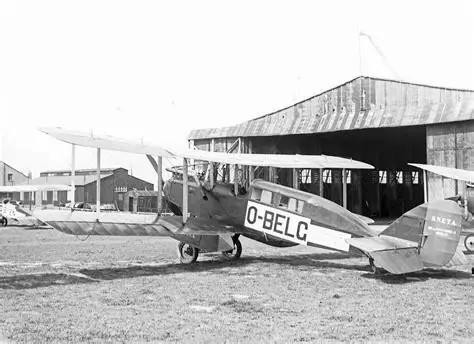
SNETA de Havilland D.H.4, 1920.
In the first quarter of 1921 flights were resumed, in conjunction with Dutch carrier KLM a route between Paris, Brussels, Rotterdam and Amsterdam was established. However, on 27th September 1921, a wooden hangar burned out, destroying seven of SNETA's 23 airplanes, and by the first of June 1922, enough information was deemed to have been gathered and all experimental flights were suspended, and the company ceased trading. The following week LARA was wound up in Africa.
During the two-year ‘experiment’, they had carried over 90 passengers and over 4,000 lb’s of mail, both in Europe and Africa, and travelled over 80,000 miles.
The aircraft, assets and personnel were absorbed into the new company, which thankfully became universally known as Sabena, which began operations on 23rd May 1923, as the national carrier of Belgium. The company was jointly owned by the holding company of SNETA, the Government in Brussels and the Government administration in the Belgian Congo. The aircraft numbered 14 in total, a mix of the Ansaldo, a single Farman Goliath and D.H.4, and some Fokker single seaters, D.H.9’s and Rumplers, all ex-warplanes. and were old and badly outdated or not really fit for purpose, for a new airline wanting to transport passengers around the globe.
Over in Britain, more ex-warplanes, the giant two-engined bombers made by Handley Page, the O/400 series, nicknamed ‘Bloody Pulverisers’, and designed to bomb German industry into submission, were sitting around as surplus, as the larger versions, the O/1500s, were trailblazing around the Empire. They were powered by two Rolls Royce Eagle IX engines, powerful enough to swap bombs for passengers. Eager to cash in on the new desire to transport passengers around Europe in increasing numbers, Handley Page converted a number to accommodate up to 12 passengers in an internal cabin in some comfort, with associated luggage and mailbags, and renamed them the Handley Page W.8b. Sabena purchased a single plane, as well as a licence agreement, and under the company Sociétés Anonyme Belge de Constructions Aéronautiques, or SABCA, set up to manufacture their own aeroplanes, and built three more in Belgium.
The Handley page W.8b was a good, solid, aeroplane, but with the speed of development in aeronautics at the time, was soon improved. Known as the H.P. W.8e, the main improvement was a third engine, put into the nose, this time a 360h.p. Rolls Royce Eagle IX, and supplemented by two wing-mounted 230h.p. Siddeley Puma engines. The first off the production line was sold to Sabena, and SABCA built a further eight. There was also the three-engine W.8f, which was built with cabin heating (derived from air circulated around the hot engine exhausts). Only one was built and sold to imperial Airways, however SABCA obtained the necessary licence and built two for Sabena, to give a total fleet number of ten.
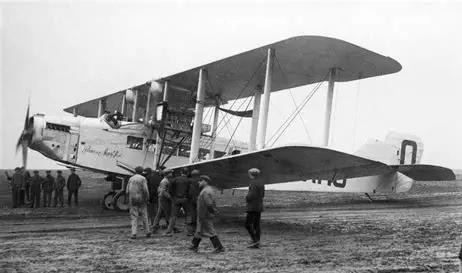
Sabena’s Handley Page W.8e O-BAHO Princesse Marie-José
These were the first tri-motor passenger planes operated by any European airline, and were Sabena’s flag in the ground to announce their arrival on the world stage and their ambition to be the pioneering passenger carrier throughout the globe. The first passenger routes started on 14th July 1924, with a route from Rotterdam, Brussels, Strasbourg, Basle. More routes were to follow.
The experiments in the Belgian Congo, allied to their wartime experience, where the Short 827 seaplanes had been man-handled by local labour overland from the airbase to the lake, had proved to Sabena that larger landplanes, as opposed to flying boats, so the decision was made to open overland (over jungle) routes between the major centres, with all the difficulties that would entail. To that end, in September 1923, surveys were undertaken over possible routes, initially from Leopoldville and Elisabethville (now Lubumbashi). Three of the Handley Page W.8e’s were allocated to Belgium’s African Empire routes; two were shipped out by sea in crates, however the third was to be flown from Belgium all the way down to the Belgium Congo, a plan inspired by Belgian Great War fighter ace Edmond Thieffry. His idea was to potentially survey and then open a trans-Sahara route.
During the war, on 23rd February 1918, Thieffry was shot down and wounded by return fire from a German two-seater aircraft of FAA 227 over Kortrijk. He spent the rest of the war as a prisoner of war in Germany. He tried to escape on 13th April 1918 but was caught after over a week on the run. After the armistice, Thieffry had returned to Brussels by way of Switzerland, finally arriving home on 6th December 1918. He returned to his practice as a lawyer, but remained active in aviation, being one of the founders of Sabena, and as one of the small Belgian air forces ‘aces’ continued to have a public profile. He found himself a crew, and gained support from the King. Sabena gave him one of the W.8’s, serial number O-BAHO, which Thieffry promptly named ‘Princesse Marie-José’, after gaining approval for the enterprise, from his friend King Albert, which overcame objections from the company who doubted the enterprise.
Ahead, lay a 5,000-mile trek, with planned stops, and estimated to take a mere seven days. The crew left from Haren in Brussels on 12th February 1925, with the crew comprising of mechanic Joseph "Jef" de Bruycker and co-pilot Léopold Roger, all heading for N'Dolo airfield at Leopoldville. Thieffry himself acted as navigator. The flight plan called for stops at Marseille, Oran, Colomb-Bechar, Gao, Fort-Lamy, Bangui and Coquilhatville. However strong adverse winds and then a broken propeller necessitated an 18 day wait for a replacement at Bangui, all of which resulted in the journey taking a total of 51 days. Finally, at 11:00am on 3rd April, 1925, after 8,200 kilometres, they arrived at Leopoldville. Despite the length of the journey, flight time had been a little under 75 ½ hours, so it was proved feasible. The first air connection was made, and Thieffry returned to a hero's welcome in Belgium. Sabena had arrived.
Leave a Reply