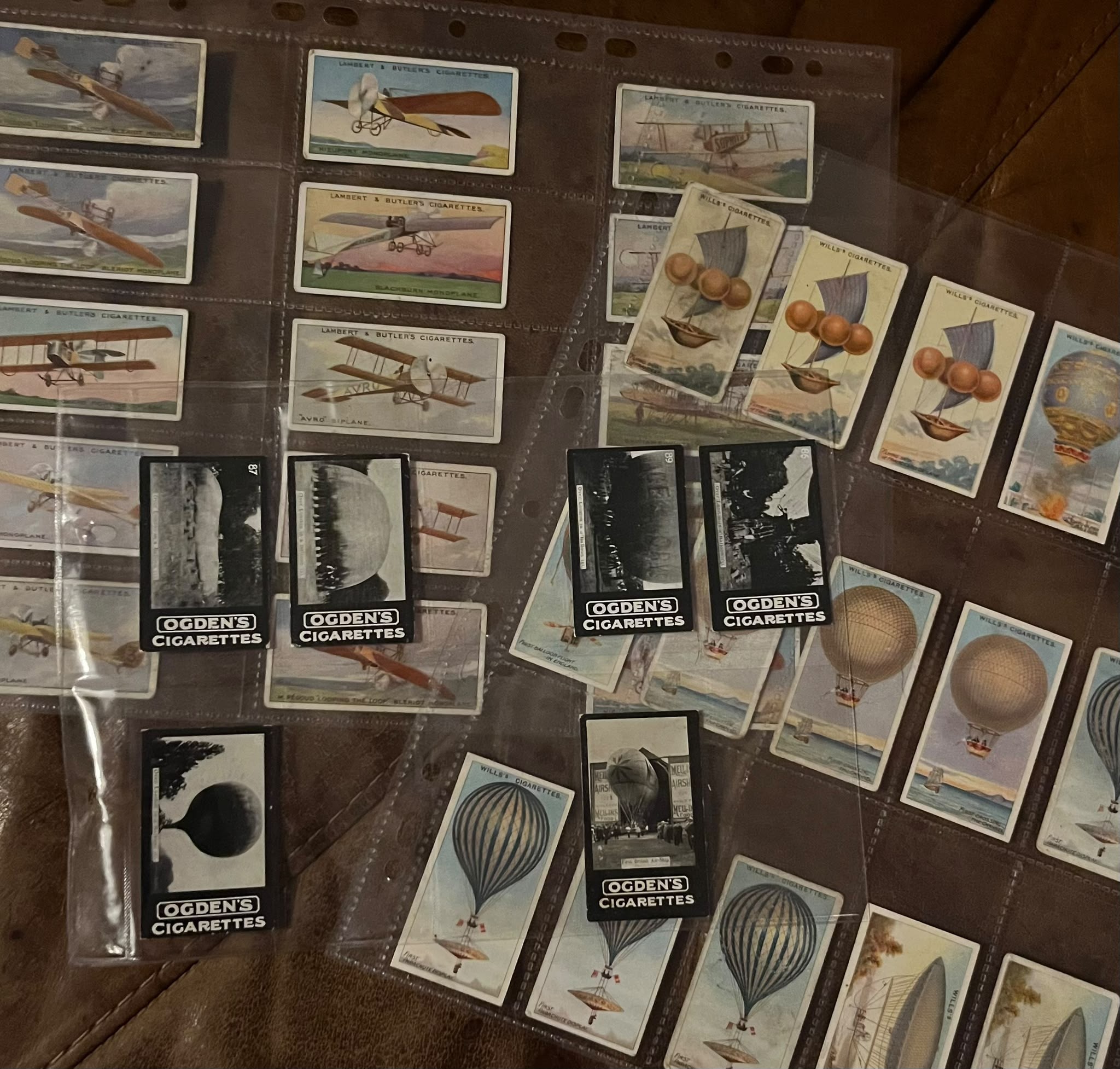
Or ’How smoking can be bad for your wealth’.
Since the dawn of time, man has sought to collect items around him.
This collecting ‘bug’ reached its early zenith in the 19th century, when Victorian-era gentleman of all classes started collecting anything that took their fancy in earnest, even commissioning bespoke collectors cabinets to hold and display their prized possessions.
Amongst these were cards of all types. Common consensus is that card collecting started in France, as an extension from tradesman’s cards. This soon crossed the Atlantic to the United States, where a new market emerged amongst the consumer avarice. Stores started to give away cards with commodity sales, which in turn increased sales. One such commodity was tobacco.
Conceived of in the late nineteenth century with the invention of the cigarette making machine, the Cigarette card was first used as a means of protecting and stiffening what were relatively flimsy cigarettes wrapped in paper packaging. Yet, with industrialisation’s demand for innovation, the entrepreneur James Buchanan Duke saw an opportunity in the card-stiffeners and started a soon-to- be trend of introducing colourful adverts on to the cards in order to further promote his business. With other tobacco manufacturers following suit, Cigarette producers were increasingly under strain to think of new and ground-breaking means of appealing to the ever-evolving and notably male smoking market and in a society thriving off commercialised leisure culture, depictions and information on cultural heroes seemed a promising fit. By 1887 the cigarette card had reached the UK, with Bristolian Tobacco company W. D. & H. O. Wills regularly producing collectable picture cards featuring glamorous film stars, sports stars and military themes. As time progressed, the collectable card was taken up by a diversity of industries including grocery stores, confectionery manufacturers as well as magazines and even understood as collectable objects in their own right.
Duke's father, Washington, had owned a tobacco company which his two sons, (James and Benjamin) took over in the 1880s. In 1885, James Buchanan Duke acquired a licence to use the first automated cigarette making machine, which had been invented by James Albert Bonsack; and by 1890, Duke had expanded sufficiently to supply 40 percent of the American cigarette market (then known as pre-rolled tobacco). In that year, Duke consolidated control of his four major competitors under one corporate entity, the American Tobacco Company. This was in essence a monopoly as by this time he controlled over 90 percent of the American cigarette market. His aggressive business tactics in cutting prices paid to tobacco farmers directly led to the Black Patch Tobacco Wars in 1906– 1908, which could be another article all on its own.
At the start of the 1900s, Duke tried to conquer the British market as he had done the American, eventually forcing the then divided British manufacturers to merge into the Imperial Tobacco Company of Great Britain and Ireland. After two years of intense competition in Great Britain, Imperial Tobacco took the fight to the U.S. market, forcing American Tobacco to look for a settlement. This resulted in an agreement whereby American Tobacco controlled the American trade, Imperial Tobacco controlled the trade in the British territories, and a third, cooperative venture named the British-American Tobacco Company was set up between the two to control the sale of tobacco in the rest of the world.
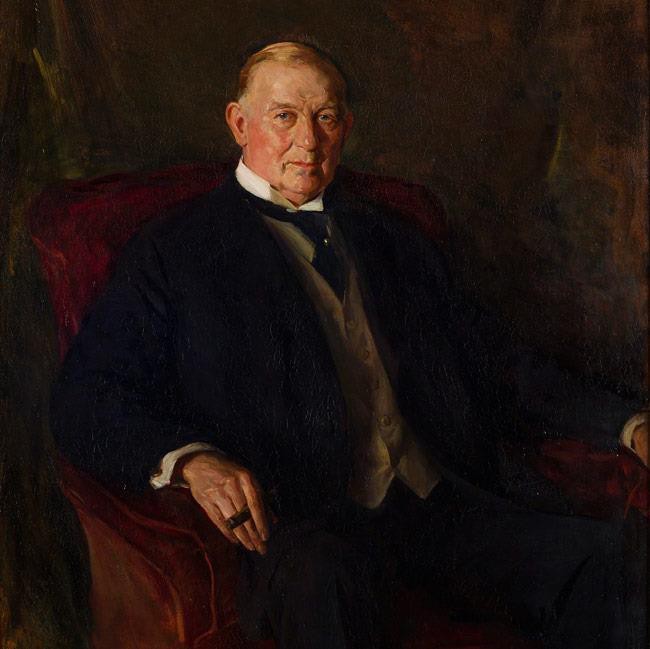
James Buchanan Duke, by John da Costa (1924)
In 1902 Ogden’s Ltd was a major, if financially failing cigarette company, and was ripe for a take over, which Duke swooped in and did. Relying on his American business model, his aim was to import unmanufactured tobacco from his plantations, and with low at the time custom duties, manufacture and sell below current prices in the UK. He then intended to roll over all the individual British brand names one by one.
Again, as per the US model that had been phenomenally successful in a short period of time, he started inserting collectible real photo and black and white cards into Ogden’s packs, with immediate success and an upturn in sales.
Rewind back to 1884, there is some evidence that the English tobacco company Allen & Ginter started supplying cards into cigarette packs, but it was not popular and was discontinued. Wills started looking at similar in the late 1890’s, but it was the Ogden’s cards that really got the public excited. They were produced in sets, denoted A through to F. Originally, they contained diverse subjects from sports figures: golfers, footballers, cricketers; actors/actresses; and current events and local landmarks.
Here is where early aviation gets involved. Series D was a general interest set 200 photographs. They were not numbered, but amongst them was a subset titled Over London in a Balloon, with at least 6 cards showing a standard ‘onion bulb’ type balloon being inflated in stages. The cards are marked on the back from 1-6 in order, however marked on the front slightly more random from 81 to 89.
As an aside I also have a single Ogden’s cigarette card from 1902 that is unlettered, a differing set entirely but has an image of Stanley Spencer’s first airship, which was sponsored by Mellin’s food, a leading brand of infant formula, for the princely sum of £1,500 in return for 25 flights carrying a full – size advertisement. The joys of collecting cigarette cards, there are always new things to learn, new cards to discover, new knowledge to be gained.
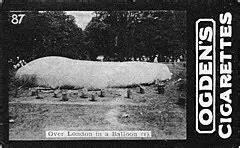
Ogdens cigarette card ‘Over London in a Balloon’ No. 87
Back to Duke, and his attempt to monopolise the British cigarette industry. Their individual companies, headed by Wills, were so concerned about the American threat to their independence, that thirteen of them, formed a new cartel, the Imperial Tobacco Company (Of Great Britain and Ireland) Ltd, and a so-called tobacco war was engaged. Duke’s use of cigarette cards was continued by Ogden’s and copied by Imperial, and the consortium, having the advantage of multiple companies in the consortium, were able to release multiple sets simultaneously, and were soon gaining market share.
Duke was faced with a dilemma, and had the option of engaging in a long and protracted (and costly) turf war; however, ever the businessman, managed to negotiate out of the conflict by agreeing to sell Ogdens to imperial tobacco for three times what he had paid for it, and thus extricated himself from the British tobacco industry with his dignity, reputation (and bank balance) intact. He also negotiated with the British consortium to join forces, and form the British American Tobacco Company, to market tobacco in other countries not part of the Empire. Duke left, but the cigarette cards stayed.
Aeronautics, aviation and flying were in its infancy at this time, yet was making headline news, and the glamorous and dangerous nature of the new science was to make it an exciting subject for card series, with the balloonists and pioneer aviators the celebrities of their day. Despite this, it was not until 1910 that the first major series was produced, and surprisingly focussing on the machines not the men. Bleriot crossing the English Channel, the first aviation meetings of Doncaster and Blackpool, the early races like the London to Manchester, were all headline news, so it was natural for the cigarette companies to cash in. Again, it was W.D. & H.O. Wills, of Bristol and London, at the vanguard, as they produced their Aviation series of 1910.
The Wills cigarette company had been founded in 1786 by Henry O. Wills, and had gone through several names and incarnations in its early years. By 1830, it had become W.D. & H.O. Wills. Under this name, several brands were created, many of which were still in use under the Imperial Tobacco consortium until the second half of the 20th century, until finally the Wills was retired by Imperial Tobacco in 1988.
Henry O. Wills had arrived in Bristol in 1786 from Salisbury, and opened a small but smart tobacco shop on Castle Street with his partner Samuel Watkins. They named their firm Wills, Watkins & Co. When Watkins retired in 1789, the firm became Wills & Co. Next, the company was known from 1791 to 1793 as Lilly, Wills & Co, when it merged with the firm of Peter Lilly, who owned a snuff mill on the Land Yeo at Barrow Gurney. The company then was known from 1793 up until Lilly's retirement in 1803 as Lilly and Wills.
In 1826, H.O. Wills's sons William Day Wills and Henry O. Wills were given control of the company, which in 1830 became "W.D. & H.O. Wills". Interestingly both of the brothers were non-smokers. During the 1860s, a new factory was built to replace the original Redcliffe Street premises, but the firm quickly outgrew it. The East Street factory of W.D. & H.O. Wills, in Bedminster, opened in 1886, and was thought to have enough expansion room for the foreseeable future, however as the popularity of cigarettes grew, it doubled in size within a decade and, early in the 1900s, a further Bristol factory was created in Raleigh Road, Southville.
The firm's first brand of cigarettes was Bristol, made at the London factory from 1871 to 1974. Three Castles and Gold Flake followed in 1878, but the greatest success was the machine-made Woodbine ten years later. Embassy was introduced in 1914 and relaunched in 1962 with coupons. Other popular brands included Capstan and Passing Clouds. The company also made cigar brands such as Castella and Whiffs, several pipe tobacco brands and Golden Virginia hand-rolling tobacco.
When Duke threatened to steamroller the entire British industry, it was Wills who led the fightback, and were one of the 13 companies that formed Imperial Tobacco Company on 10th December 1901, and its consolidation as the predominant producer in the UK; seven of its directors were members of the Wills family. Imperial Tobacco remained one of the world's largest tobacco companies until it was acquired by the Hanson Trust in 1986. A decade later, in 1996, Hanson demerged its tobacco manufacturing assets to a new company floated on the Stock Exchange, the Imperial Group.
Wills major factories and offices were in Bristol, with other facilities in London, Swindon, Newcastle and Glasgow. In 1898 Henry Herbert Wills visited Australia which led to the establishment of W.D. & H.O. Wills (Australia) Ltd. in 1900. More of that later.
The Aviation series was a set of 50 cards, all illustrations in full colour. The set is divided neatly in to two parts; the first cards, 1-25, are a series of balloons, dirigibles and airships; the second half, 26-50, are a series of aeroplanes.
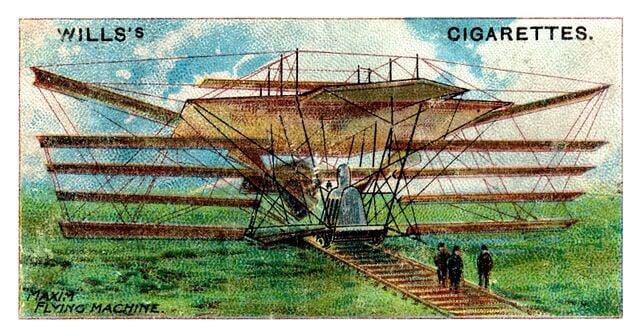
Wills Aviation Series No. 30, 1910
This is a fine set, and is still readily available from online auction sites such as eBay, or specialist dealers, relatively cheaply. Some cards are rarer than others, No. 9, ‘First British War Balloon’ for example, but are still coming up for sale, either as part or full sets. Personally, I have a full set, with the majority of cards, duplicated 4 or 5 times. The reverse of the cards give the number of the card at the top, full information on the image, and the brand name on the bottom. As well as the W.D & H.O. Wills name, the cards were released for the Vice Regal Mixture brand, and also Capstan Navy Cut.
The next aviation set to be released was under the Finlay & Co Ltd brand. They released World’s Aircraft in 1912, a set of 30 cards. Unlike the Wills set, these were simple mono line drawings. You can still find the odd card up for sale, however be warned, most cards in this set go for between £30-£60 each, so collecting the full set will be time consuming and costly. Because they are not as common it is worth listing the full set here, as there are some duplications in aircraft types, but the images are all unique.
The set consists of:
- The Avro Biplane
- The Sopwith Biplane
- A Monoplane Banking
- Henry Farman
- The Gabardine
- The Parseval
- H.M.A. Delta
- Biplane Army Type
- The Short Hydroplane
- The Martinsyde Monoplane
- H.M.A. Eta
- The Astra Torres
- Biplane Maurice Farman
- H.M.A. Beta
- The Bleriot Monoplane
- Deperdussin Monoplane
- The Sopwith Hydroplane (early type)
- Cody Biplane
- Zeppelin Airship
- The Short Biplane
- Bleriot Monoplane
- The Dunne Biplane
- Bristol Tractor Biplane
- The Vickers Monoplane
- The Bristol Monoplane
- Sopwith Biplane
- The D.F.W. Military Biplane
- Henry Farman
- The Vickers Warplane
- The Avro Biplane
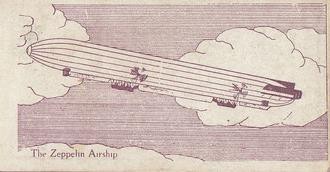
Finlay’s World’s Aircraft series No. 19, 1912
The Great War brought a restriction on the use of paper and card, with priority going to newspaper, however there were some sets with aviation interest produced. Lambert & Butler produced their Aviation series in early 1915. Like the Wills Aviation series, they were produced in full colour illustrations, however this time the set only numbered 25 in total. It included some of the newer aircraft types that the Allies were using at the front; a B.E.2 (No. 25 Government B.E. Biplane) as well as the French Caudron and Breguet Warplanes (No.s 21 and 22). These are still relatively easy to find.
Also during the war, Gallagher Ltd produced two general war sets; The Great War Series (numbered to 100) and The Great War Second Series (101-200). These cards were published by Gallagher and both series comprised eight sets, in themes, each containing twenty-five cards. 'The Great War: Victoria Cross Heroes' series, are often collected on their own, and are a popular notable collection. Both series is particularly sought after by collectors and are known for their historical significance and collectible value. Within the two series there are some cards indirectly with aviation interest; so for example, card No. 35 is titled Observation From Aircraft (1); No. 68 is a medal, the D.S.O; No. 73 is portrays The Air Scout; and No. 88 An Aerial Torpedo. From the second series, No. 167 is a detailed study of the Trajectory of Bombs Dropped On Airship, after Warneford had downed the first Zeppelin in 1915 using bombing.
My area of interest in early aviation nominally ends at circa 1920, however after the Great War, there was a boom in both commercial aviation and smoking, leading to some really nice sets being produced. In 1926, The Aeroplane set was a series of 50 tobacco cards issued by Thomas Bear & Sons Ltd. In 1929, Murray, Sons & Co Ltd released Types of Aeroplanes, a 25-card set, which included modern aircraft such as the Supermarine S.6, a seaplane that had just won the Schneider Trophy for Britain, and modern RAF bomber and fighter types. Into the thirties, as aviation blossomed both militarily, commercially and simply for pleasure, then even more sets were produced. Lambert & Butler produced two sets in 1932/33, both of 25 cards each, entitled A History of Aviation. Next, R. & J. Hill Ltd released their own Aviation Series, which again numbered 25 cards; Lambert & Butler hit back with Famous British Airmen and Airwomen, a 25-card set in 1935. The same year, John Player released Aeroplanes (Civil), a fifty card set; and now collectors were able to store their card collections in specific albums produced by the cigarette companies.
As a point of interest regarding R. & J. Hill Ltd’s Aviation Series, I have their card No. 2, which is the Avro Triplane. I also have card No. 3, which is a Bleriot Monoplane. I am not sure to what extent there was a printing error, but both cards have the same image of the Avro Triplane. This error makes these particular cards very collectible.
So, you would think this article would end here, but no. Remember the Wills Aviation Series from 1910, a set of 50 neatly split into lighter than air and heavier than air machines? Well, a collector called Andrew Joseph alerted me to the fact that the Australian arm of Wills, had some ‘extra’ cards. Remember back in 1898 Henry Herbert Wills had visited Australia, which led to the establishment of W.D. & H.O. Wills (Australia) Ltd. in 1900? The Wills’ Australia issue of the Aviation series—was actually a set of 75 cards, then, even worse, there was even a second set of 85 cards. According to Andrew’s research, the 75-card series appear to have been issued in 1911, the year after the UK version. Also, because two of the 85-card series make mention of King George V visiting Weymouth to attend a naval event in 1912, circa 11th March, 1912; then 85-card series was issued after that date. It gets even worse, with different brands having slightly different cards. If you would like to go down that particular rabbit-hole, then Andrew has an excellent web-page.
Aviation Tobacco Cards | Pioneers Of Aviation
Leave a Reply