As published in Flying No.124, 4th June 1919
“831” was a creature of impulse, or else had rabies.
Ever since Bagg took her across in ’14 to frighten the Huns and brought her perforated body back a year later she had wicked fits. I f any strange pilot approached she would mutter with her old Gnome engine, give one tremendous roar, and frighten him away with intermittent spits.
Usually after these encounters she would retire to the dark corner of her shed, there to brood and
meditate, but if the strange pilot persisted in his foolishness she showed all deceitfulness of her crooked nature. She would carry him on angel wings far over the wooded landscape; then, delicately poised between the blue heavens and the green woods, she would blow out half a dozen of her inlet valves and nestle down into the treetops. Or, if the desecrating hands attempted to pull her back into a loop she hung upside down for a few minutes to se if he fell out; but if the belt held and pistols and odds and ends missed his head as they fell past, she would complete the loop with one long unalterable dive into aa haystack.
“831” was above all things, considerate for herself. Pilots had been known to creep cautiously into her shed, dance a fandango of rage before h. er, and viciously kick the tyres- “831’s” one tender spot. Bagg alone held the key to her heart. For him she purred with beautiful rhythm, looped, spun, and rolled with ecstatic joy. But for him alone. Tapp arrived one day from the South, where he had spent the weary of the war in teaching “quirks” and collecting “pips.” He could fly anything with wings – just show it to him! “831” caught his eye. But I think “831” saw him first.
A mechanic started up the propeller and one end tapped his head. The group of interested officers made way for his stretcher.
At length, after cutting a few choice roses from the O.C.’s garden with her wing up, she limped across the sward into the air. “831” knew where she was going and took scant notice of Tapp’s frantic pulls on the joy-stick. She nosed out her familiar haystack and hung around a few minutes to see if he would loop, but Tapp, with his hands in his pockets, was far too busy saying things. At last she threw back at him a few admonitive coughs, back-fired violently, and graciously allowed Tapp to land her in the small hayfield.
Tapp lit hiss pipe- oh yes, all experienced pilot carry that- and looked over the beauty spots of “831.” The wind blew the little side-flap of the engine cowling up and down. Tapp swears to this day that “831” winked at him.
At two p.m. Tapp, after knocking out his 6th pipe, stepped into the cockpit and opened the throttle slightly. Then he went round to the front and put some stones before the wheels. He swung the propeller. She ticked over sweetly, and Tapp turned round to measure the field and find the wind direction. As though annoyed at the discourtesy of his back, old “831” kicked open wide her throttle and gave a terrifying roar.
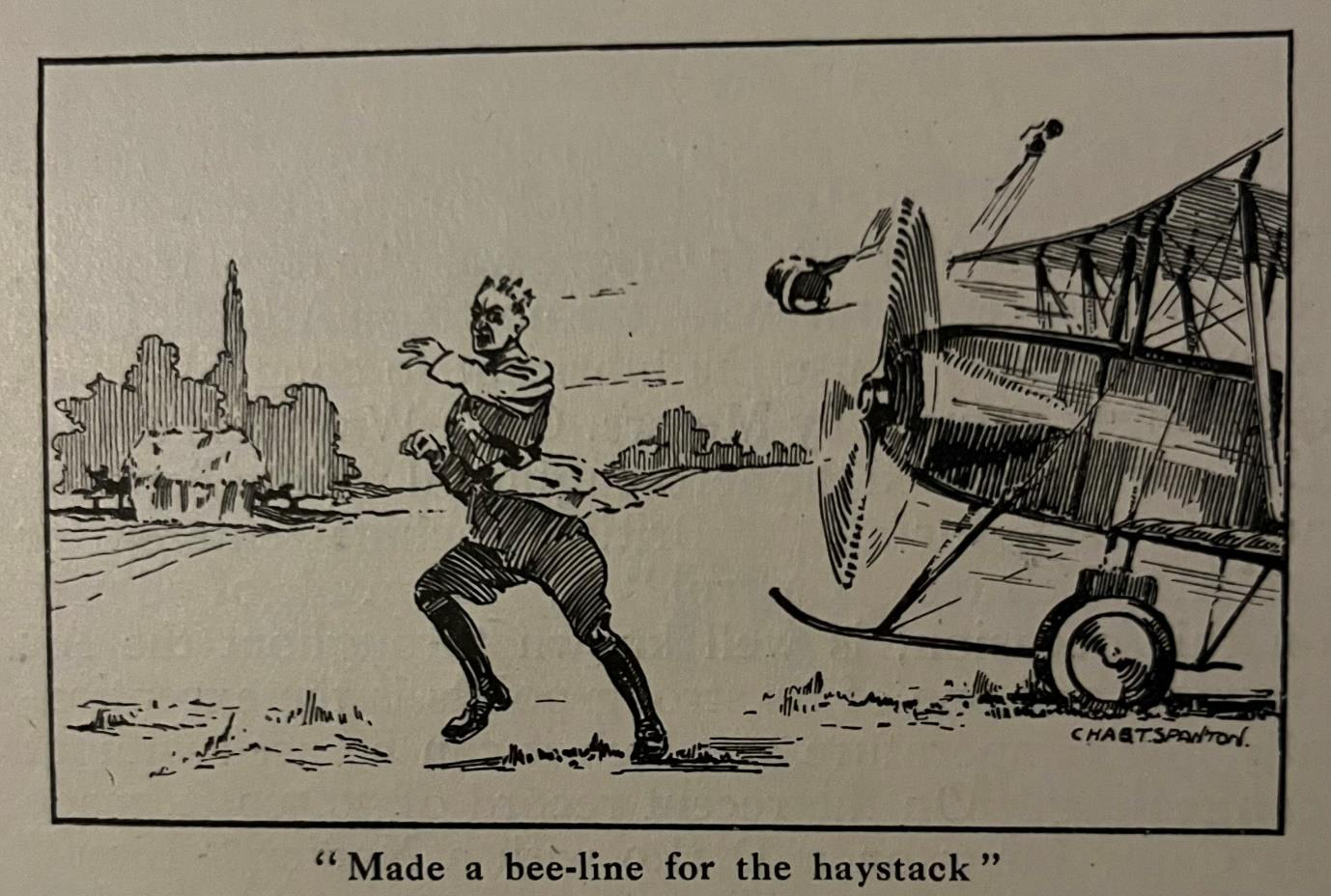
Tapp gave a hurried look behind, yelled once, leaped into the air and made a bee-line for the haystack. “831” sucked his helmet into the propeller and chewed it up. She then reared her tail and, kicking the stones away, careered madly after the fleeing figure. Tapp reached the haystack first and dodged behind it. Holding his trembling knees together he watched, as in a nightmare, the roaring monster bearing down on him.
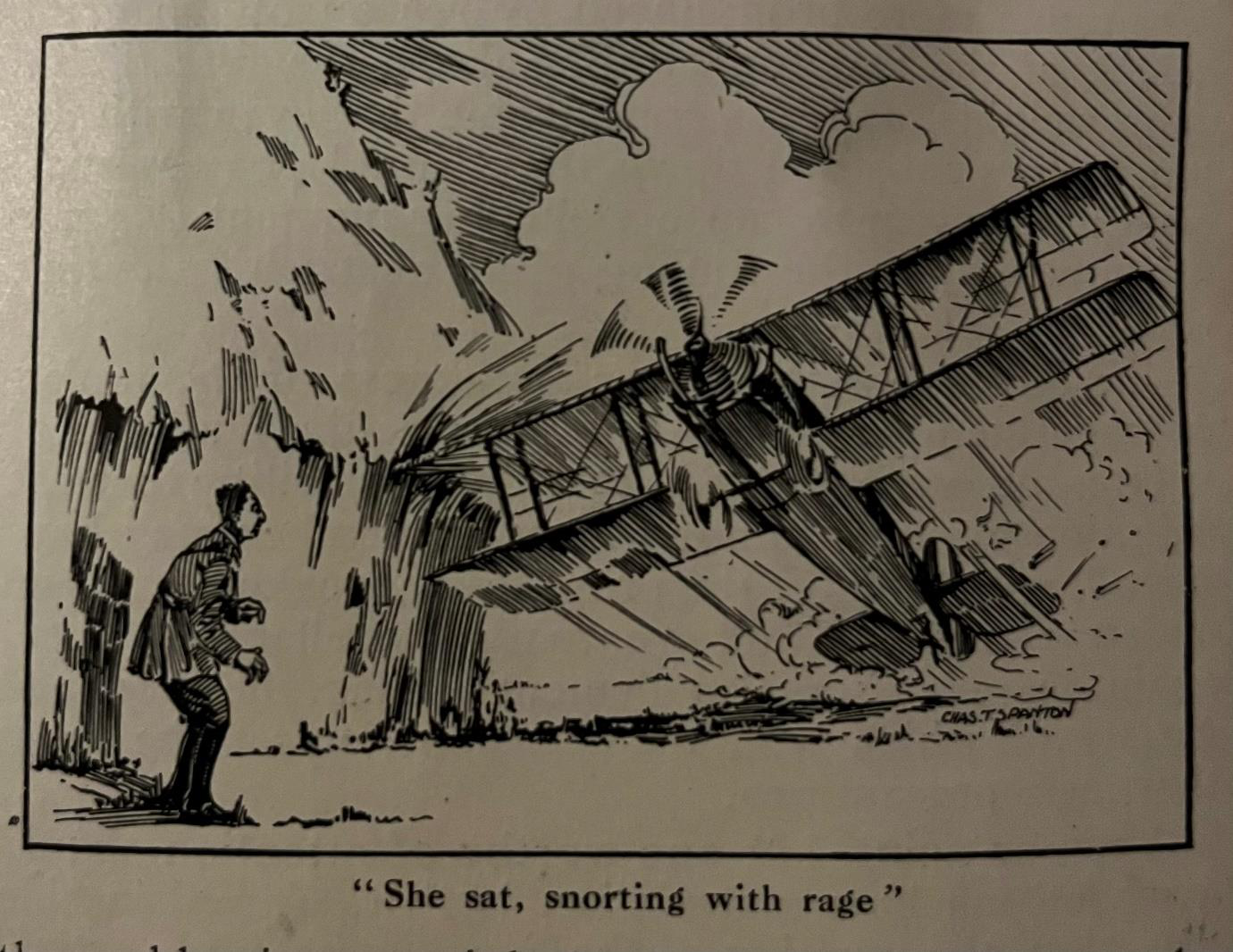
Rocking wildly, “831” reached the haystack. She tipped her right wing against the corner and, wings and wheels, executed a right-hand turn in the approved Charlie Chaplin style. Back on her tail she sat, snorting with rage, until- she saw the terror-stricken Tapp.
Tapp swears she winked at him again. He glanced wildly round and bolted for the hedge.
“831” dropped down on her wheels once more and roared off after him more angrily than ever.
The whirling propeller was but a yard away from the goose-flesh on his back when he fell headlong into the ditch before the hedge. A kindly stone met his head and passed him over to merciful oblivion. “831,” perspiring oil and grease, hit a tuft and cleared the hedge.
In the adjoining field she stopped and reared herself again, grunting, coughing, and sniffing here and there.
Suddenly, she got down on her wheels to business and struck out for a gap in the distant hedge, hopping and skipping her noisy course over the ploughed field, through the gap and beyond.
The anxious group before her shed saw her looming up in the distance, bounding over the ‘drome towards them, blowing out inlet valves more rapidly as she neared her shed.


One hundred feet off she blew out her remaining valve and glided through the open door silently- and alone.
This article appeared in the No.124 edition, dated the 4th June 1919, of Flying, the weekly newspaper.
Remarkably, “831” actually refers to an actual aeroplane; Serial No. 2831, which was a Martinsyde S.1 with an 80 h.p. gnome rotary engine. “2831” was one of a number of 12 S.1’s ordered by the War Office in November 1914.
The Martin-Handasyde Scout 1 was built by Martin-Handasyde Limited. It was built as a single-seat biplane with the Gnome engine in the nose. The illustrations in this article are taken from the original and are remarkably accurate, however as confirmed by the photograph below of the actual “2831,” a An unusual feature was on the undercarriage, where two small nose wheels were mounted on the forward tips of the skids, ahead of the two main wheels, giving it a practical but cumbersome appearance. It may be than on operation service these were removed as an ad hoc field modification, or just artistic licence in the cartoons.
Just after the outbreak of war small orders were placed by the Royal Flying Corps via the War Office, as well as via the Admiralty for the Royal Naval Air Service, among private aeroplane firmsfrom both Britain and France, for untried types aircraft that would be suitable in the single seat role. of single- seater fighters, including the Martinsyde scout. Sixty of the S.1 were built, the first going to France on the 1st March 1915. Various Squadrons received two or three Martinsydes to escort reconnaissance aircraft and bomber missions. They continued in service until the end of 1915, on before being relegated to training. Although initially intended for use in Home Defence operating from the UK, it was found to be inadequate for that too.
It was reported to be unstable, and another notable event regarding an S.1 occurred when Captain Louis Strange was flying one in a combat with a German two-seater, when one of the oddest incidents of the Great War happened. He was changing a drum on his overhead Lewis gun, when the aircraft turned over – and he fell out. However, he held on with one hand to the spade grip of the gun, and another on the drum he had been trying to remove, and somehow managed to hook one leg into the cockpit, then the other. The plane righted itself, and he fell back in, breaking the seat. The German crew, convinced they saw their opponent fall out, claimed a kill, and were (so it was said by the future German Air Service ace, Bruno Loerzer, who was based in the area), ridiculed afterwards, when no wreckage was found.
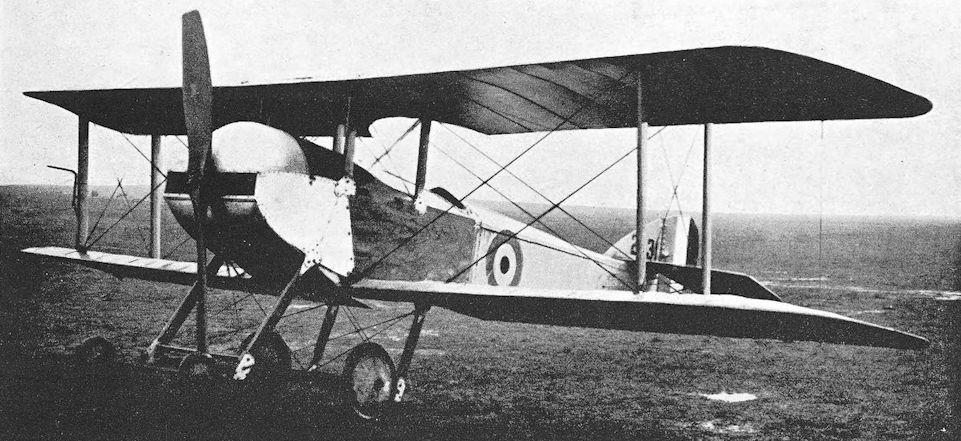
Martinsyde S.1 serial no. 2831
Leave a Reply