Or ‘If it looks too good to be true….’
The artifact
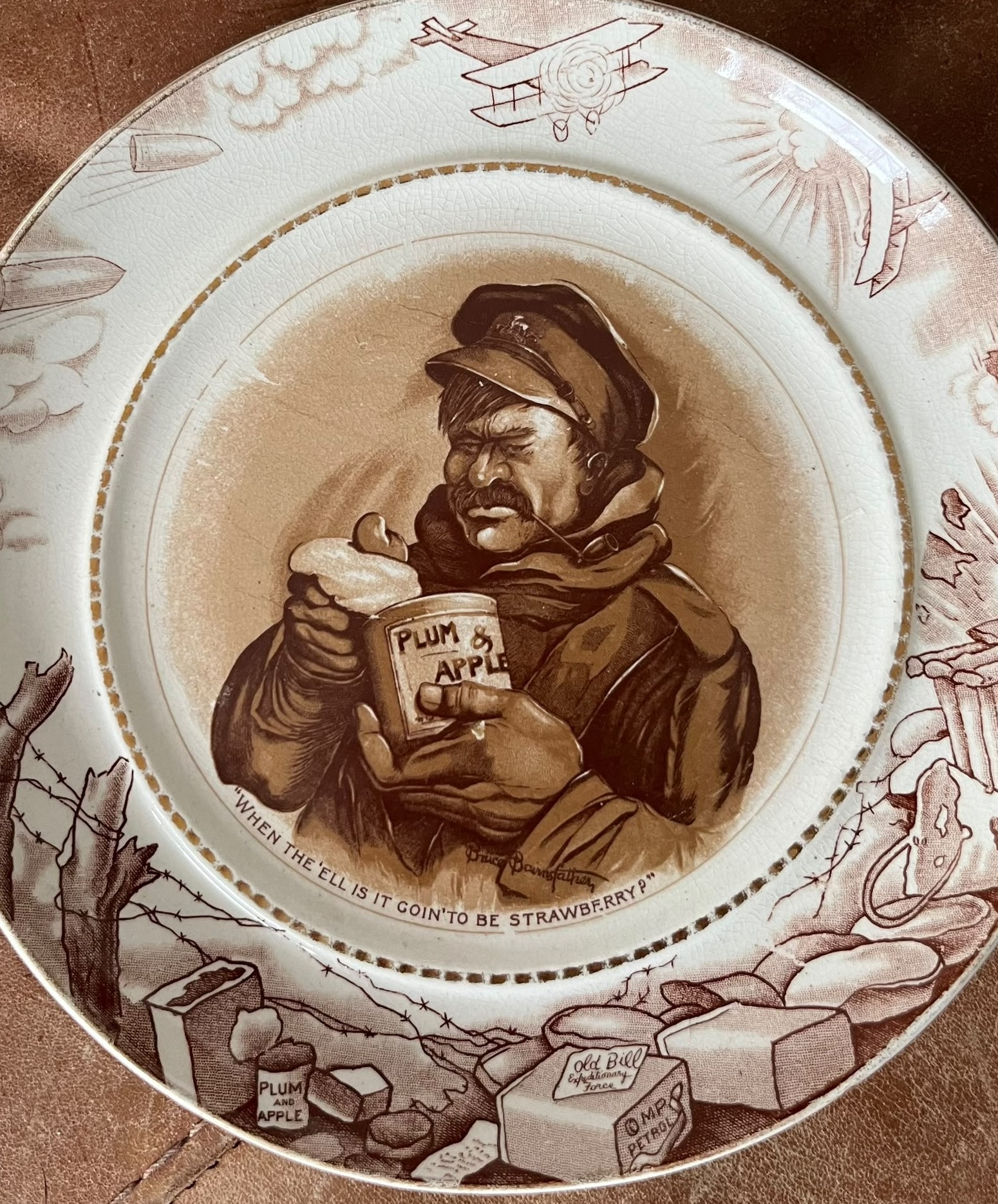
Grimwades Royal Winton ‘Old Bill’ display plate, 1915.
The stories behind the artifact
Charles Bruce Bairnsfather (9th July 1887 – 29th September 1959) was a British soldier, humourist and cartoonist. He is universally known, all though less so in this century, as the creator of the cartoon character named ‘Old Bill.’ Bill, and his pals Bert and Alf, featured in Bairnsfather's "Fragments from France" cartoons published weekly in The Bystander magazine during the early years of the Great War. Bairnsfather was born in India to Major Thomas Henry Bairnsfather (1859–1944), and (Amelia) Jane Eliza, daughter of Edward Every-Clayton and granddaughter of Sir Henry Every. His parents were second cousins.
Bairnsfather spent his early life in India, but was brought to England in 1895 to be educated at the United Services College, Westward Ho!, then at Stratford-upon-Avon. Initially intending a military career, he failed the entrance exams to the Royal Military College, Sandhurst, and the Royal Military Academy, Woolwich. Finally, he was able to pass the much simpler exam for a part-time Militia commission. He was commissioned as a second lieutenant in the 5th Battalion (Warwickshire Militia), Royal Warwickshire Regiment, on 1st March 1907, and looked set for a career in the military.
However, he resigned in the same year, 1907, with a desire to become an artist. He enrolled at the John Hassall School of Art. However, he appears to have dropped out, to work as an electrical engineer. He gained a position at the Old Memorial Theatre, Stratford. Whilst working at the Old Memorial, he came to know the English novelist, Mary Mackay (1st May 1855 – 21st April 1924), who was known by her pseudonym Marie Corelli. Corelli, in turn, introduced him to Thomas Lipton, the tea magnate, and this acquaintance gained him commissions to draw advertising sketches for Lipton tea, Player's Cigarettes, Keen's Mustard, and Beecham's Pills.
At the outbreak of the Great War, Bairnsfather rejoined the regular army, when he joined the 3rd Battalion of the , Royal Warwickshire Regiment as a second lieutenant, on the 11th September 1914. He was promoted to lieutenant on 19th December 1914, and to captain on 2nd February 1915.
He served in France until late in 1915, and was seconded as Brigade Machine Gun Officer on 3rd October 1915. He was hospitalised with shell shock and hearing damage, sustained during the Second Battle of Ypres.
"Well, if you knows of a better 'ole, go to it", Bairnsfather's best-known cartoon, 1915
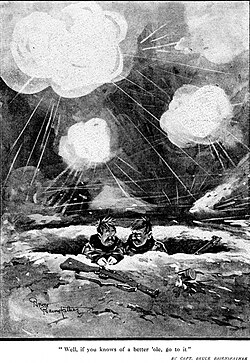
In the Spring of 1916, he was made a staff captain while attached to headquarters. Posted to the 34th Division HQ on Salisbury Plain, back in the UK, he developed his humorous series for the Bystander about life in the trenches, featuring "Old Bill", a curmudgeonly soldier with trademark walrus moustache and balaclava. The best remembered of these (above) shows Bill with another trooper in a muddy shell hole with shells whizzing all around. The other trooper is grumbling and Bill advises: “Well, If you knows of a better 'ole, go to it.”
Many of his cartoons from this period were collected in Fragments from France (1914) and the autobiographical Bullets & Billets (1916). Despite Bairnsfather's immense popularity with the troops at the front and at home, and the civilians who found the belligerent character of ‘Old Bill’ endearing and took him to their hearts; and a massive sales increase for the Bystande; , initially there were bjections within the army and establishment to the perceived ‘vulgar caricature.’ Nevertheless, success in raising morale, at home and on all fronts, led to Bairnsfather's promotion and receipt of a War Office appointment to draw similar cartoons for other Allied forces.
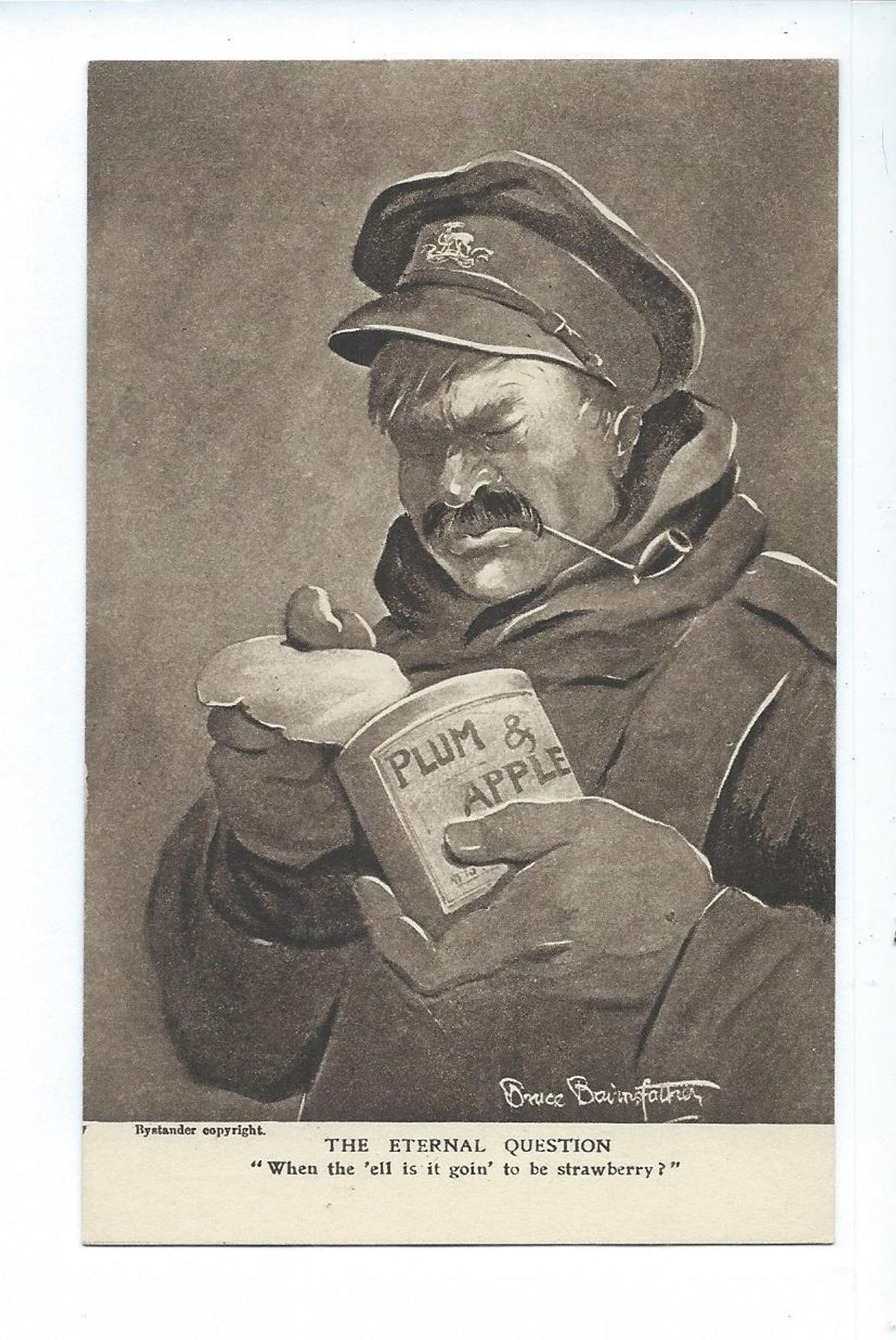
”The Eternal Question”, the cartoon which is the basis for the plate illustration
In 1921, Bairnsfather married Cecilia Agnes Scott (née Bruton). She was the divorced wife of eminent golfer Michael Scott, and the marriage caused a minor scandal in their social circle.
‘Old Bill’ and Bairnsfather himself continued in popularity between the wars. Many police officers of the time had similar facial hair, and that may have led to British police being referred to as The Old Bill.
Bairnsfather was the subject of one of the first British sound films in 1927. He then wrote and directed the 1928 Canadian film Carry On Sergeant, (NOT th later British bawdy comedy of the same name), and took part in the early Alexandra Palace television transmissions in 1936. ‘Old Bill’ appeared in numerous books, plays, musicals and films. Bairnsfather's autobiography, Wide Canvas, appeared in 1939.
When the Second World War broke out, Bairnsfather continued to produce ‘Old Bill’ cartoons, but was not asked to assist with the British war effort, unlike his contemporary, W. Heath-Robinson. Instead, he became official cartoonist to the American forces in Europe, contributing to the U.S. publications, Stars and Stripes and Yank, bringing his work to a brand new audience and generation of servicemen, where he became extremely popular: the generation may have changed, but forces humour stayed the same. He also drew cartoons at American bases and nose art on aircraft. His works are considered to have influenced artists such as Bill Mauldin.
One famous cartoon that Bairnsfather drew shows ‘Old Bill’ sitting in a trench with a big shell hole next to him from a near miss.’ Old Bill’ says to the men around him "Mice!" What the Germans thought of this cartoon was revealed in a British newspaper clipping from World War II. Quoting a Nazi textbook taken from a German prisoner of war that shows the cartoon, the clipping reads: "Obviously, the hole was not made by a mouse. It was made by a shell. There is no humour in this mis-statement of facts. The man, ‘Old Bill’, was clearly mistaken in thinking a mouse had made it. People who can laugh at such mistakes are obviously not normal; therefore we should pay careful attention to their psychology. Their very decadence may prove to be a weapon of self-defence."
During later life, Bairnsfather had found himself typecast as the creator of ‘Old Bill.’ His Times obituary, discussing his career, came to the conclusion that he was "fortunate in possessing a talent … which suited almost to the point of genius one particular moment and one particular set of circumstances; and he was unfortunate in that he was never able to adapt, at all happily, his talent to new times and new circumstances".
He died in Worcester in 1959, aged 72, of complications from bladder cancer.
The brand Royal Winton was a brand name of the ceramics and pottery company, Grimwades Bros. The company was founded by Leonard Lumsden Grimwade, an experienced pottery modeller, in 1885; he was joined by his brother Sidney Richard Grimwade, also a potter; they started a factory originally at the Winton Pottery, just on the Hanley side of the border of the pottery towns of Hanley and Stoke-on-Trent, England. The works were named after Winton Wood. The Winton Pottery Works was their original and largest factory and this name gave rise to their well-known ‘Winton Ware.’
In March 1900 the business of Grimwade Bros was incorporated as Grimwades Ltd, with the partners named as Leonard Lumsden Grimwade,and his brothers Sydney and also now Edward. The business expanded rapidly and they took over a number of potteries: in 1900, the Stoke Pottery of James Plant; (James Plant joined the Grimwades board); circa 1906, the Upper Hanley Pottery at the Brownfield Works. Also in 1906, the Rubian Art Pottery company; in 1907, the Heron Cross Pottery; and finally in 1910, the Atlas China Company.
The enamelling room at the Winton factory circa 1910
From 1906-1912, in addition to the dinner, tea and decorative ware they introduced a range of utility ware. King George V and Queen Mary graced them with a royal visit in 1913, giving them a Royal Appointment and the brand name change prefix Royal Winton. By the time of the outbreak of the Great War, the Grimwade businesses employed 1,000 people.
Before the war, the company had become renowned for ‘chintz’ ware, very colourful and bright; however, war time restrictions in materials purchasing led them to reduce the colours of their pigments and oxides in their pottery, giving it a more utilitarian feel. They were quick to tap in to the new popular culture, so a range of ware featuring the face and phrases of ‘Old Bill’ quickly appeared in 1915.
This plate, has been produced as a display piece, as evidenced by the hanging holes punched into the back prior to firing. It is also unusual in that it has a painted border; including one of the first uses of an image of aeroplanes in a war-time ceramic. The majority of Royal Winton ‘Old Bill’ plates have a plain, cream border.
A serious fire at the Winton factory in 1916 led to Grimwade proposing that Stoke on Trent should have at least three motor fire engines.
A Liberal free-trader, He was elected to Stoke upon Trent council and was also appointed to the local magistrates' bench. He was secretary of the Potteries Association for the Promotion of Federation, founded in 1907, and published 160 favourable replies to a circular letter to leaders of trade and industry in his Book of Opinions. Questioned by counsel for Fenton during the passage of the federation bill through Parliament and asked where he lived Leonard Grimwade replied "I sleep in Wolstanton but I live in the Potteries". He unsuccessfully contested the parliamentary election in Hanley as a Liberal in 1918. He was a member of King Street, Newcastle, Congregational church.
He modified his free-trade views to some extent during the First World War, by which time his five factories employed 1,000 people. In December 1917 he printed a message from the prime minister asking for economy in consumption of food on reduced sized butter dishes, milk jugs and plates, which sold at one shilling each.
He married twice and had two sons and two daughters. His first wife, Marion, was elected to the Stoke Board of Guardians in 1897. He was killed in a road accident on 26nd January 1931 and was buried in Hartshill Cemetery.
The fictional character of ‘Old Bill’ created in 1914–15 by Bairnsfather, illustrated as he was as a belligerent, unflappable, elderly, pipe-smoking British "Tommy" with a walrus moustache; struck a cord with both the British Expeditionary Force (B.E.F.) and the professional soldiers that made up the small British army at the time; and as the war was fought in far away lands, although France was close to home, the civilian population at home. He embodied the personality of the brother, the father, the uncle that was joining up, the bloke down the pub, the fella on the street corner. Due to these reasons, and the fact that the humour was equally visually, but also self-effacing, meant that the character achieved a great deal of popularity during the Great War; indeed, the authorities considered him a major morale booster for the British troops. ‘Old Bill’, and his younger troopmate ‘Little Alphie’, were always depicted as private infantrymen in unnamed regiment in the B.E.F.
Many claims have been put forth as being the model for ‘Old Bill’, but the most likely appears to be Thomas Henry Rafferty, a lance-corporal from Birmingham in Bairnsfather's regiment, the Royal Warwickshires. Rafferty was killed in the same action that invalided Bairnsfather in April 1915. Rafferty was featured in the Weekly Dispatch in 1917, referred to as "Old Bill", along with a photograph taken by Bairnsfather.
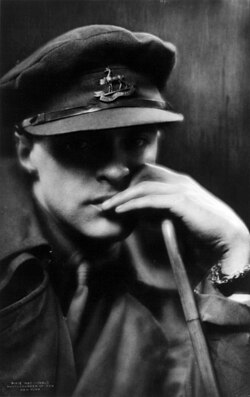
Photo of Captain Bruce Bairnsfather by Pirie MacDonald, 1918
Leave a Reply