Or: ‘the gift that nobody wanted.’
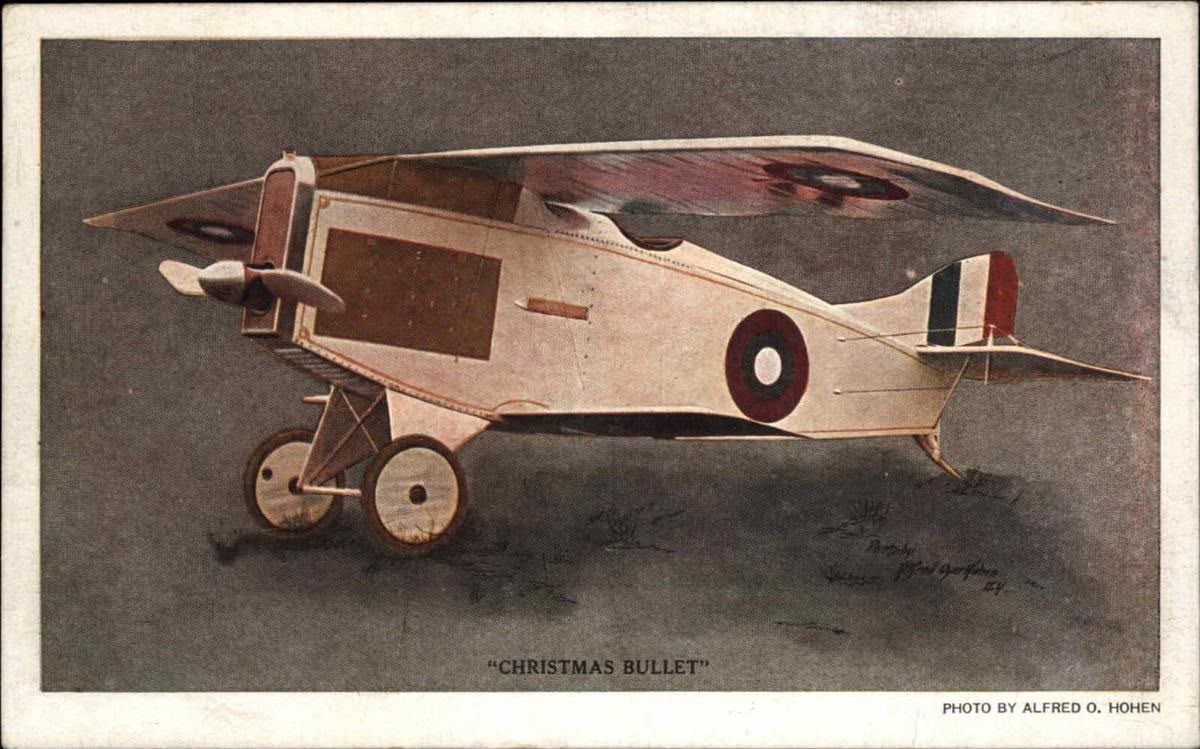
The artifact: a 1918 advertising postcard depicting the Christmas Bullet, from a photograph by Alfred O. Hohen.
The Christmas Bullet — later known as the Cantilever Aero Bullet, or the Christmas Strutless Biplane — was an American single-seat cantilever-wing biplane. It is considered by many to be among the worst aircraft ever constructed. It is as much the story of one man as of the aeroplane itself, and that man was the unfortunately named Dr William Whitney Christmas.
William Whitney Christmas was born on 1 September 1865 in Warrenton, North Carolina. He attended St John’s Military Academy and then the University of Virginia, where he took bachelor’s and master’s degrees, and graduated from George Washington University in 1905 with an M.D. He married May Norris in 1899; they had a son, Whitney Norris Christmas.
Christmas claimed to have designed or developed a string of aircraft — the Red Bird (1909), Red Bird II (1910), a 1912 pusher biplane, a 1913 tractor biplane, a 1915 biplane, the Aerial Express, and finally the Bullet — most of which never left the drawing board. It is unlikely that any of them other than the Bullet ever flew; indeed, despite extensive research, no evidence beyond his own claims has ever been found for the existence of the earlier machines.
Christmas — who at the time had no experience of aircraft design or aeronautical work, and possibly very little practical knowledge of any kind — founded the Christmas Aeroplane Company in Washington, DC, in 1910. By 1912 it had become the Durham Christmas Aeroplane Sales & Exhibition Company, and later, after moving to Copiague, New York, the Cantilever Aero Company.
Christmas, whose powers of persuasion must have been legendary, convinced two brothers, Henry and Alfred McCorry, to back him financially. On visiting the Continental Aircraft Company on Long Island, he somehow convinced both the brothers and the entire company that his planned aircraft would be the key element in an almost unbelievably fanciful plan: to kidnap Kaiser Wilhelm II of Germany and return him in triumph to the United States.
Two designs were proposed — a single-seat ‘scout’ and a three-place ‘fighting machine.’ The single-seat Christmas Bullet featured all-wood construction with a veneer-clad fuselage, and was powered by a prototype Liberty 6 engine. Although the US Army had been persuaded to lend the engine — likely, again, thanks to Christmas’s persuasive nature — the proviso was that the prototype was to be fitted into an airframe for ground testing only.
The design had one fatal flaw: it lacked any struts or braces for the wings, Christmas insisting they should be flexible, with control achieved by warping the flying surfaces. There were precedents — Anthony Fokker had forgone bracing struts and wires on his prototype for the hugely successful Fokker Dr.I triplane — but by 1918 most manufacturers using wing-warping had moved on to ailerons. Although Continental’s chief engineer, Vincent Burnelli, tried to institute changes, the Bullet was completed with its original features intact; the materials were scrounged from available wood and steel stock and were not ‘aircraft grade,’ a further concern to Burnelli.
On its maiden flight in January 1919, the wings of the Bullet peeled away from the fuselage; the aircraft crashed and was totally destroyed, killing the pilot, Cuthbert Mills. The destruction of the prototype Liberty engine was never revealed to the US Army. A second Bullet was built, this one powered by a Hall-Scott L-6 engine.
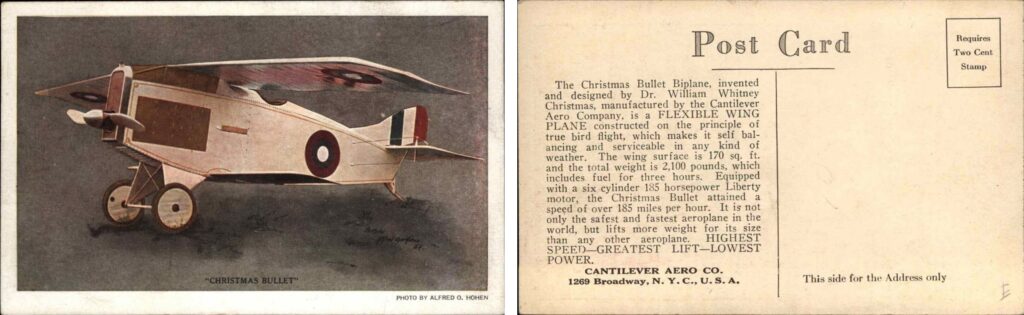
Despite the crash, Christmas placed advertisements claiming the Bullet had reached a top speed of 197 mph before Colonel Harmon at Central Park, Long Island. The second aircraft was displayed in Madison Square Garden on 8 March 1919 as the ‘First Strutless Airplane.’ As part of the campaign, Cantilever had advertising postcards printed — the front bearing a picture of the stubby yet modern-looking machine, taken from the photograph by Alfred O. Hohen. This very card is the artifact.
The reverse carried, in the space nominally reserved for a message: ‘The Christmas Bullet Biplane, invented and designed by Dr. William Whitney Christmas, manufactured by the Cantilever Aero Company, is a FLEXIBLE WING PLANE constructed on the principle of true bird flight, which makes it self-balancing and serviceable in any kind of weather. The Wing surface is 170 sq. ft. and the total weight is 2,100 pounds, which includes fuel for 3 hours. Equipped with a six-cylinder 185-horsepower Liberty motor, the Christmas Bullet attained a speed of over 185 miles per hour. It is not only the safest and fastest aeroplane in the world, but lifts more weight for its size than any other. HIGHEST SPEED — GREATEST LIFT — LOWEST POWER. Cantilever Aero Co., 1269 Broadway, N.Y.C., U.S.A.’
The second aeroplane was, sadly yet somewhat inevitably, also destroyed on its maiden flight, again with the loss of the test pilot, Lieutenant Allington Joyce Jolly. The project was abandoned before its US Army Air Service evaluation. What persuaded Jolly to make that second attempt is beyond comprehension given what we know today — though it is not known how much he was aware of the true state of affairs, or how far he was taken in by Christmas.
Following the crash, Christmas continued to campaign for funding, claiming ‘hundreds’ of patents or patent submissions from his aeronautical research. His far-fetched assertions were proved untrue, though he claimed to have sold his wing design to the US Army. In retirement he was still proposing improbable aeroplanes. He died of pneumonia at Bellevue Hospital, Manhattan, on 14 April 1960.
Leave a Reply