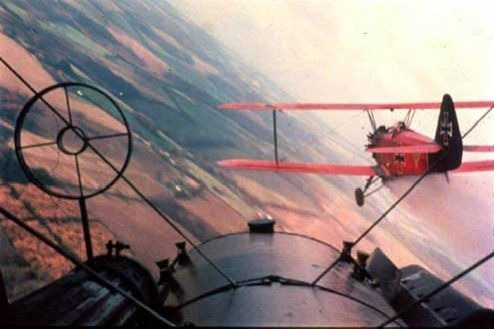
The 1976 film Aces High was directed by Jack Gold, and had a stellar cast of young British actors: Malcolm McDowell, Peter Firth, Christopher Plummer and Simon Ward. An Anglo-French production, the film is based on the 1928 play Journey’s End by R. C. Sherriff, with additional material from fighter ace Cecil Lewis’s memoir, Sagittarius Rising. The screenplay was written by Howard Barker. Aces High is basically the plot of the Great War story Journey’s End, but based on an RFC squadron as opposed to a trench, and the desperate aerial battles fought in 1917 by the Royal Flying Corps. The film covers a week of a squadron where the high death rate puts an enormous strain on the surviving pilots. Many characters and plot lines are taken directly from those of Journey’s End: the idealistic new officer who is killed at the end, and whose sister is the girlfriend of his tough but alcoholic commanding officer, the kindly middle-aged second-in-command (known as “Uncle” by the younger officers) who is killed on a dangerous intelligence-gathering mission ordered by the top brass, and the officer whose claims of neuralgia are taken to be cowardice.
The idea for the film came from producer Benny Fisz, who had served in the RAF in the Second World War and made such movies as The Battle of Britain. He pitched the idea of remaking Journey’s End with an air force background to British director Jack Gold.
Gold said he was attracted to the film because “That was innocence, extreme youth, marred lives of these pilots who knew they are going to die. And we could show not only chivalry and bravery but also the fear. What interests me is human relationships,” said Gold. “Aces High has aerial battle scenes but they’re not just thrown in.”
The movie was co-financed by EMI Films. Production was announced in July 1975 by Nat Cohen of EMI, as part of a slate of films worth £6-7 million. The shooting schedule took seven weeks with one week for rehearsal. Exteriors were shot in Spain and Southern England with principal photography at Booker Airfield, High Wycombe, Buckinghamshire, as well as St Katharine Docks and Eton College. Interiors were completed at Pinewood Studios. Malcolm McDowell recalls a highlight was
when WWII fighter leader Douglas Bader visited the set.
The production paid close attention to authenticity with First World War–era equipment being used throughout the film such as the airfield facilities, barracks and motor transport. The squadron depicted (known as 76 Squadron) is loosely based on Cecil Lewis book Sagittarius Rising, and his time with 56 Squadron, which flew the S.E.5a that regained Allied air superiority in mid-1917, and are depicted in the film. Some scenes are based on real events, such as pilots choosing between jumping to their deaths or burning alive in their aircraft. (as they were not issued parachutes). The mess room songs and young pilots ‘public school’ attitudes capture the fatalistic attitudes of the time, when the life expectancy of a new pilot could be measured in weeks, or even days.
Although the film reused some aerial sequences from The Blue Max (1966) and Von Richthofen and Brown (1971), the producers shot their own flight scenes. All British S.E.5as were heavily modified Stampe SV.4s, a Belgian two-seat trainer that first flew in the 1930s, that had a similar profile to the S.E.5a. Sinclair’s plane was a period Avro 504.
German aircraft were all adapted post-WWI aircraft except for a replica Fokker E-III Eindecker. The reproduction is seen when it is brought down intact and its pilot given a toast by his British counterparts.
Production stills show Malcolm McDowell (Gresham) posing with the Bristol M.1C from the
Shuttleworth Collection, but this particular aeroplane does not appear in the film. Director Jack Gold later recalled: “It was very difficult to obtain those planes. Sometimes we used models or archive footage. Action sequences in the air were very difficult to make and they were also very much tied with story. I had great assistant in Derek Cracknell and great specialist for special effects.” The chief stunt pilot on the film Tony Bianchi, with other pilots including James Gilbert, Iain Weston and Neil Williams.
Neil Williams (1934 – 11th December 1977) was a Welsh aerobatic, stunt and film pilot. Williams was born in 1934 in Canada and educated in Wales, where he first learned to fly in 1951. After completing an engineering apprenticeship, he joined the Royal Air Force), and was trained as a pilot in Canada. He served in Cyprus as a Canberra photo-reconnaissance pilot, and returned to the United Kingdom in 1961, where he joined an experimental squadron. In 1962 he graduated from the Empire Test Pilots’ School and also started competitive aerobatic flying. He won all the U.K. domestic competitions in 1965 and went on to compete in the World Aerobatic Championships (FAI WAC). In 1965 he was the highest placed British pilot in the Lockheed Trophy, and was Europe’s best biplane pilot when he flew a Stampe SV.4B to 4th place in the Top French competition. He gained another ‘first’ for Britain in the following year by reaching the finals of the FAI WAC, and in 1967, flying a standard two-seater Zlin Akrobat, he won the Biancotto Trophy. In 1970 he was awarded the Queen’s Commendation for Valuable Service in the Air, when he successfully crash-landed a Zlin after a wing folded during aerobatic training. Three weeks after receiving the replacement Zlin
from Czechoslovakia, he reached 5th place in the FAI WAC, the highest place achieved by any Zlin pilot.
1974 was marked by the British teams’ outright victory in the FAI European Aerobatic
Championships and Neil’s solo win in the Coupé Champion in France. In 1975 he became British Aerobatic Champion for the eleventh time, and in 1976 reached 4th place in the FAI WAC in Kiev. Captain of the British Aerobatic Team from 1966 until his death in 1977, he regularly flew at airshows and was best known for his displays in the Pitts Special, Rothmans Aerobatic Team, Spitfire, and the famous machines of the Shuttleworth Collection and for his test flying of unusual and tricky aeroplanes.
He was killed, along with three others, on 11 December 1977, when the CASA 2.111, which was a Spanish licence-built Heinkel H.E.III World War Two period bomber, he was flying from Cuatro Vientos Airport to the United Kingdom crashed in poor visibility into the Sierra de
Guadarrama mountains north of Madrid. Also travelling in the aircraft and killed with him were his second wife, Lynn, Blackbushe Airport Chief Engineer Joseph Donaghy, and Blackbushe Ground Controller, Stephen Parnell. The British Aerobatic Association organized the Neil Williams Memorial Trophy in his honour.
Below in his own words, he describes the filming of Aces High.
“One hears so often if a flying film being planned, only to find in the end it fails to materialise, that one learns not to become excited at the prospect of taking part. So when we heard that a flying film, entitled ‘Aces High’ was being planned, we half expected it to go the way of the others. It wasn’t until I walked into the hangar at Brooker one day to find three Stampes being feverishly transformed into S.E.5a replicas, that I really began to believe that this time it was going to come off. We were eventually to increase the film fleet to quite a mixed bag, for apart from the S.E.5as, we were to finish up with a Viima, Tiger Moth, two Jungmeisters, and two replicas, one of a Fokker Eindecker and one a Morane Bullet. With Tony Bianchi wearing the chief pilot’s hat, assisted by James Gilbert, Iain Weston and myself, we prepared to go to war.
We started off on the ‘easy’ shots, but very soon came up against a few basic problems. Working on the film set in the north-west corner of Booker airfield, where a replica of a World War I aerodrome had been built, we were surrounded by club aeroplanes. Not only that, but we were required always to take off towards ‘enemy lines’ and land in the opposite direction, and since the afternoon sun could be made on film to look like dawn, not only were we never sure where ‘east’ or ‘west’ were supposed to be, but we invariably found that we had to take off and land downwind.
Not only did this on occasion cause utter confusion in the Booker circuit, but in the small space available, and with the S.E.5as performing on take-off like the proverbial shot duck, we regularly scraped over the hedge with heart in mouth and nothing to spare. ‘Great stuff’ the Director would say, ‘Do it again!’
Becoming put off by these hedge-trimming operations quite early on, I volunteered to play the part of the wicked Hun, at least I wouldn’t have to do any take off shots! I should have known better, because the first combat shot of the film involved flying the Fokker Eindecker in a dogfight with an S.E.5a.
As in all flying films, the Director was never fully convinced that a victory would be confirmed in the cinemagoer’s eyes unless the victim burst into flames. This, however, not only prolongs the film, butt is expensive in pilot and aircraft replacement, so one has to make do with smoke bombs. These contraptions were attached to the underside of the aeroplane, usually near the carburettors, fuel filters and so on, and were electrically fired from the cockpit. Having insisted that these bombs were placed on the undercarriage struts, we proceeded with the shot. It was not a success. The Fokker suffered from wing flutter when dived at 70 knots, and the wings flexed in the most alarming manner during manoeuvres. To be on the safe side, I reduced speed, whereupon the S.E.5a stalled and fell out of the sky. The fiasco by now well under way, I pressed the button to fire the smoke bombs and was promptly enveloped with thick acrid black smoke which made my eyes stream and almost completely prevented breathing.
We found out that pilots on The Blue Max and other films had used breathing apparatus: I’m not surprised. Finally, and surprisingly quickly, the smoke stopped, to my great relief. I would have been less relieved had I known that the mounting brackets had melted and that the still-smoking bombs had disappeared earthwards!
Perhaps the most spectacular sight in the air was when a forward-facing camera was in use and we closed to almost zero range behind our smoking victim as he twisted and turned low over the trees. Incandescent debris detached and hurled backwards towards the camera: the first time I saw it I really thought he was on fire.
Most of the original dogfights took place at altitude, but every film director insists that one must engage in combat below tree-top height if it is to look realistic! For this exercise we obtained CAA clearance to operate out of a farmer’s field liberally sprinkled with trees and copses. With the advantage of being away from the airfield, we were able for the first time to appreciate the incredible freedom of pure flying, with no restrictions.
We also quickly realised how, without a high degree of self-discipline, this could degenerate into a dangerous situation. Our first attempts to operate here with the Eindecker were so potentially dangerous that we quickly replaced it with the Viima, but even with the extra power, solidity and control, it was still not a pleasant experience to dodge in and out of the trees fighting the slipstream of the S.E.5a ahead. We were appalled when we saw the rushes and realised that though we had only been 15 feet behind, the wide-angle lens made the distance look like 20 yards. We
experimented, and found that we could fly directly into the leader’s slipstream, so close that it actually stabilised the following aircraft. We were almost being towed along by the ‘victim’, except that to stay close the leader had to fly at one-third throttle, while the attacker used full power to overcome the downwash- a most unnatural thing to do with a separation of only four feet! We also found problems in the standard quarter attack. Normally one’s guns are pointed ahead of the target, so that it intercepts the bullets at a predetermined point in space. With a camera one has to hold the target centrally in the frame, and with a fixed camera, one inevitably finishes up flying a curve of pursuit to finish in line astern. To achieve the illusion of the quarter attack, the ‘victim’ has to fly as slowly as possible whilst the attacker keeps his speed up. With a rather tired S.E.5a the speed differential was still only about 50mph, but even this was quite fast enough when one had a 35-mm camera mounted directly in front of the windscreen! We were expected to hold the attack to a very close range, and we frantically peered round or under the camera to keep the rapidly- expanding target in view.
To get the ‘victim’s’ point of view, i.e. that of an S.E.5a approaching to a very close range on a quarter attack, we had to resort to a helicopter. Aces High was unusual in that much of the aerial combat was actually shot from the film aircraft, and as a result, looks even more realistic. But for some shots a helicopter was the only possible camera-ship. To get really accurate and close attacking shots it was necessary for the helicopter to fly as slowly as possible: hovering was out of the question because of the vibration and buffeting around the camera platform. The slow-flying helicopter seemed to have an almost hypnotic quality in that it was difficult to appreciate the true closing speed until the last moment.
As time went on it became obvious that there were several shots that we could just not get with normal camera positions: in particular shooting straight forward or back, and panning 360° in azimuth. The problem was solved when a device named ‘Astrovision’ was tried out in an Aztec. It consisted of a periscope protruding through the belly of the aeroplane, with a camera mounted inside the cabin. This assembly was remotely controlled from the rear seat by means of a pressure- sensitive control stick, with which a monitor screen in the rear of the cabin, showed the field of view of the camera at all times. Now we could really show some dogfight scenes, since we could allow the ‘victim’ to use full power, while the Aztec, using half flap, formatted only a few feet behind. This was fine in level flight, but as soon as the target started to manoeuvre, the Aztec at 80mphor less was in pre-stall buffet, which caused camera vibration. In the end this was accepted, as it gave the shot more realism, but from the long-suffering Aztec pilot’s point of view, as he sat in the right-hand seat (an insurance requirement) while I flew the plane from the left, it must have seemed that the whole sortie was flown with the stall warning horn on. One of the most surprising features of this tail- chasing situation was the incredible power of the biplane’s wingtip vortices. Reversing the turn in the Aztec, trying to stay on the S.E.5a’s tail, I needed full rudder, aileron and a lot of differential throttle, with the horn permanently screeching it’s warning. It needed quite a bit of practice to hold that cavorting S.E.5a squarely in the centre of the windscreen! But the Aztec had its advantages: on a winter’s day at nearly 10,000 feet with the heater on I felt really sorry for the three accompanying S.E. pilots as we cruised for over an hour looking for the right sort of cloud background. One of the other major problems occurred when we were perhaps at 3,000 feet, alone in the sky, in the Fokker Eindecker (maximum speed 60 knots), unable to manoeuvre, and then a modern club aeroplane hove into view over the horizon. At first he was amazed at the sight of such a frail contraption, but as his eyes lit on the black crosses and machine-gun, one could almost see the transformation from Cessna to Sopwith Camel! We had no way of knowing what his skills were; he might have been a 30-hour pilot with no formation experience and no real idea of closing speeds. We could not escape, and could only hope to avoid his clumsy passes. For the first time we could appreciate the vulnerability of the World War I pilot, and our opponent here was not even armed. How must a German balloon observer have felt, high in his basket, when he heard the hum of Hispano engines, and then could pick out against the evening sky, three small specks, gradually taking shape- S.E.5as? Screaming into his telephone he urged the winch crew to wind him down. Beneath him activity was feverish, orders being shouted, men running, and all the while the aircraft drawing closer. In the lead S.E.5a, with the red pennants flying from the struts, I raised my hand, James and Tony nodded and started to drop back into low-level battle formation. I held 600 feet, and waited until I crossed the road which runs from Lane End to Marlow, then I eased down into the dive. I studied the active runway carefully: I had a clear run. A backward glance showed the other two S.E.s in position as I switched on the strobe light attached to the muzzles of my mock-up machine-guns. Now I could see the camera crew, behind the observer’s basket, which was suspended for this shot, from a crane. Still in my headlong dive, I saw the observer bale out- but he only fell five feet onto a pile of mattresses and cardboard boxes. Because of the wide-angle lens, I had to leave the pull-out as late as possible, but I was aware of the jib of the crane reaching out towards me- ‘now’! And I broke hard to the left, wings vertical. When we saw the rushes, it was disappointing: our break was too far away, but we could not get closer,
Sometimes the most horrific shots were the easiest and safest. As the Viima pilot I was shot at the beginning of a take-off run, and the aircraft crashed out of control, into a copse, where it burst into flames. This shot took three days. First the actor pilot was wired up with explosive charges attached to capsules of imitation blood. A ground camera ‘saw’ a diving S.E.5a in the background: there was a rattle of machine-gun fire and the pilot streaming with ‘blood’, collapsed. Now I changed places with the pilot, and climbed, rather squeamishly, into the synthetic blood-spattered cockpit. The cameraman, lashed onto a cradle on the wing, filmed the observer, panic-stricken, as the aircraft taxied across the field. Finally a ground camera filmed the aircraft, tail-up, heading straight for the wood: in plenty of time I cut the power and swung off to one side.
Next day, a camera was set up inside the copse. The aircraft, tail lashed onto a land Rover, was positioned only feet from the edge of the copse, and the engine was started. The camera turned and the Land Rover drove away, towing the aircraft backwards. When the film is run in reverse it really looks like a collision! Finally an explosive charge was planted in the wood where a mock up of the Viima burned steadily. Perfect!
As a result of their continuous use of explosives the special effects team tended to trigger everything by this means. For one shot a metal box was attached to the wing of the Eindecker adjacent to the pilot’s right elbow. This box contained debris which would signify a hit. It was, however, to be activated by an explosive charge. Now we pilots had a very high concern for our skins, so it was decided to stage a ground demonstration, with the engine running. When a volunteer was called for to sit in the cockpit, the four pilots retreated to a safe distance, whereupon Doug Bianchi offered to ignite the device.
The pilots retreated even further and Doug, evidently suspecting that we might know something that he didn’t, handed over control to a special effects man, who quite cheerfully pressed the button and vanished in a blinding flash and a cloud of dust. By this time the pilots were further away from the Fokker than ever, having decided that the machine was bad enough to fly at the best of times, without an explosive box practically in the cockpit.
But perhaps the actors had the worst of it. I have never seen people so nearly blown up or set on fire on so many occasions. On one occasion Christopher Plummer was practically lifted out of his cockpit by one over-enthusiastic explosion!
Then, suddenly, it was all over; no more shivering round the tea urn at first light on a frost-covered airfield; no more cruising at 7,000 feet, using the Viima as a camera ship while our expert cameraman, Peter Allwork, fought against the slipstream to steady the camera in sub-zero temperatures. Though the filming was over, something remained. The pilots who had worked together for nearly four months began to see the value of teamwork, and had come to place implicit trust in the others, something that is not too common these days in civil aviation, but is found more at squadron level in the armed forces. More than anything else, this film had brought home to us a tremendous admiration for those early pilots.’
Neil Williams, 1975/6.
Leave a Reply